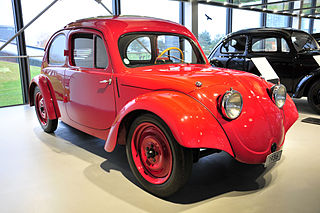
Erwin Komenda was an Austrian automobile designer and Porsche employee, and a lead contributor to the design of the bodies for the VW Beetle and various Porsche sports cars.

The Bugatti Type 51 series succeeded the famous Type 35 as Bugatti's premier racing car for the 1930s. The main distinction is that it uses a twin cam engine. Unlike the dominant Type 35s of the prior decade, the Type 51 were unable to compete with the government-supported German and Italian offerings.
The McLaren M4B was a Formula One racing car constructed by Trojan for Bruce McLaren Motor Racing and raced five times by New Zealander Bruce McLaren at the start of 1967.
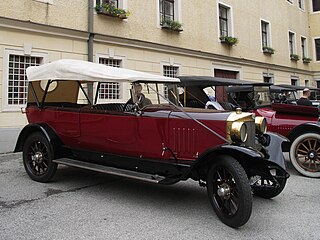
Steyr was an Austrian automotive brand, established in 1915 as a branch of the Österreichische Waffenfabriks-Gesellschaft (ÖWG) weapon manufacturing company. Renamed Steyr-Werke AG in 1926 and merged with Austro-Daimler and Puch into Steyr-Daimler-Puch AG, it continued manufacturing Steyr automobiles until 1959.

The March 83G is a IMSA GTP/Group C sports prototype race car, designed, developed and built by British manufacturer and constructor March Engineering, for sports car racing, in 1983.

The Lola T330 was an open-wheel formula race car, designed, developed and built by Lola Cars, for Formula 5000 racing, in 1973.
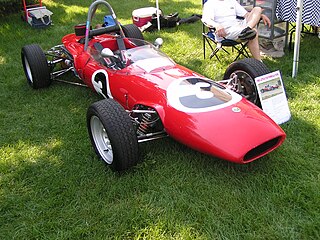
The Lotus 51 was an open-wheel Formula Ford race car built in 1967 by the British motorsport team Lotus. It was powered by a 1.6 L (98 cu in) Ford Crossflow four-cylinder engine, developing a respectable 110 hp (82 kW), which drove the rear wheels through either a Renault R-8 type 330 4-speed, or a Hewland 5-speed manual transmission.

The Lotus 69 was an open-wheel formula racing car developed by Lotus in 1969 for use in Formula 2, Formula 3, and Formula Ford.

The Ralt RT4 is an open-wheel formula racing car, designed, developed, and built by Ralt for Formula Atlantic in 1980. It was later converted into a closed-wheel prototype and used in the revived Can-Am series between 1982 and 1985, where it achieved only modest success. In Can-Am competition, the car achieved 1 podium finish, 1 class victory, and a best result of a 2nd-place finish.
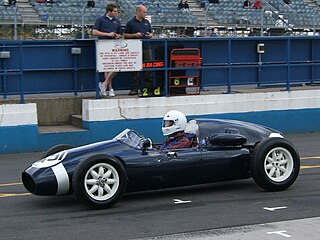
The Cooper T45 was an open-wheel formula racing car, developed and built by the Cooper Car Company in 1958, and designed by Owen Maddock. It competed in Formula 2 racing as well as in Formula One racing, where it won one World Championship Grand Prix, the 1958 Monaco Grand Prix, being driven by Maurice Trintignant.

The Lola T190 was an open-wheel formula race car, designed, developed and built by Lola Cars, for Formula 5000 racing, in 1969. A total of 17 models were produced.

Bugatti made a series of Grand Prix, and later Formula One, straight-8 racing engines; between 1922 and 1939, and once again in 1956.

The BRM P154 is a purpose-built sports prototype race car, designed, developed and built by British Racing Motors to Group 7 racing specifications, specifically to compete in the Can-Am racing series, in 1970. It was BRM's first Can-Am car. It is powered by a naturally aspirated, Chevrolet big-block engine, developing 760 hp (570 kW), and 650 lb⋅ft (880 N⋅m) of torque.

The March 84G was a mid-engined Group C and IMSA racing sports prototype, designed and developed by March Engineering in late 1983 and used in sports car racing until 1989. It was powered by a number of different engines, including a Chevrolet small-block, a Buick V6, a Porsche flat-six, and even a Mazda 13B Wankel rotary engine. Power output was around 620 hp (460 kW). It only managed to score 5 wins, and clinch a total of 10 podium, over the course of 7 years and 119 race entries.

The Cooper T57 , also known as the Cooper T57 Monaco, or the Cooper Monaco T57, is a sports racing car, designed, developed and built by British manufacturer Cooper, in 1960, and was constructed as the successor model to the T49. It competed in motor racing between 1961 and 1965, and won a total of 26 races, scored 43 podium finishes, and clinched 3 pole positions. It was powered by a naturally-aspirated 2.7 L (160 cu in) Coventry Climax FPF four-cylinder engine; producing 220 hp (160 kW), and 200 lb⋅ft (270 N⋅m) of torque.
The BRM 4-cylinder engines are a series of four-stroke, naturally-aspirated, 2.5 L (150 cu in), inline-four Formula One racing engines, designed, developed and built by British Racing Motors, between 1956 and 1960. They were exclusively used by BRM; and powered the BRM team cars. It was constructed to conform the FIA engine requirements; necessitating a 2.5 L naturally-aspirated engine displacement formula. The power output for these motors were between 260–285 hp (194–213 kW), and 205 lb⋅ft (278 N⋅m).
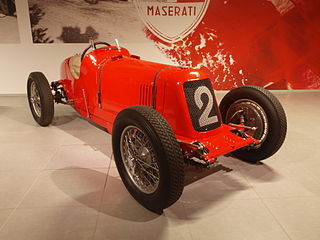
The Maserati 4CM is an open-wheel Grand Prix motor racing car, designed, developed and built by Italian manufacturer Maserati, in 1931.
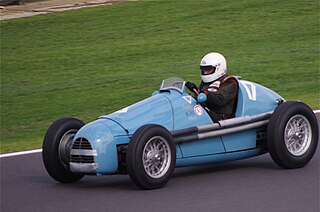
The Gordini T16, also known as Gordini Type 16 is an open-wheel race car, designed, developed and built by French manufacturer Gordini, for Formula One and Formula Two racing categories, between 1952 and 1956.

The Vanwall Grand Prix cars are a series of open-wheel Formula One race cars, designed, developed and built by British manufacturer Vanwall, for Formula One racing, between 1954 and 1960.
The Dallara F3 cars are open-wheel formula racing car, designed, developed and built by Italian manufacturer Dallara, for Formula Three categories.

