Related Research Articles

North Maluku is a province of Indonesia. It covers the northern part of the Maluku Islands, bordering the Pacific Ocean to the north, the Halmahera Sea to the east, the Molucca Sea to the west, and the Seram Sea to the south. The provincial capital is Sofifi on the largest island of Halmahera, while the largest city is the island city of Ternate. The population of North Maluku was 1,038,087 in the 2010 census, making it one of the least-populous provinces in Indonesia, but by the 2020 Census the population had risen to 1,282,937, and the official estimate as at mid 2022 was 1,319,338.
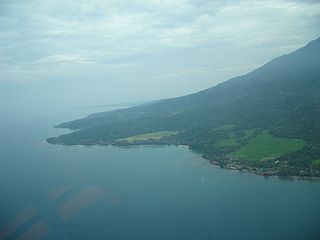
Halmahera, formerly known as Jilolo, Gilolo, or Jailolo, is the largest island in the Maluku Islands. It is part of the North Maluku province of Indonesia, and Sofifi, the capital of the province, is located on the west coast of the island.
In Indonesia, village or subdistrict is the fourth-level subdivision and the smallest administrative division of Indonesia below a district, regency/city, and province. There are a number of names and types for villages in Indonesia, with desa being the most frequently used for regencies and kelurahan for cities. According to the 2019 report by the Ministry of Home Affairs, there are 8,488 urban villages and 74,953 rural villages in Indonesia. North Aceh Regency contained the highest number of rural villages (852) amongst all of the regencies of Indonesia, followed by Pidie Regency with 730 rural villages and Bireuen Regency with 609 rural villages. Prabumulih, with only 12 rural villages, contained the fewest. Counted together, the sixteen regencies of Indonesia containing the most rural villages—namely, North Aceh (852), Pidie (730), Bireuen (609), Aceh Besar (604), Tolikara (541), East Aceh (513), Yahukimo (510), Purworejo (469), Lamongan (462), South Nias (459), Kebumen (449), Garut (421), Bojonegoro (419), Bogor (416), Cirebon (412), and Pati (401)—contain one-third of all the rural villages in Indonesia. Five of these are located in Aceh, two in Highland Papua, three in Central Java, two in East Java, three in West Java, and one in North Sumatra. An average number of rural villages in the regencies of Indonesia is 234 villages.
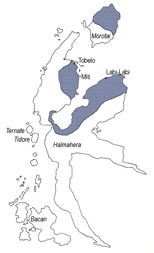
Tobelo is a North Halmahera language spoken on the eastern Indonesian island of Halmahera and on parts of several neighboring islands. The Tobelo-speaking heartland is in the six administrative districts of Tobelo, located on the western shore of Kao Bay and forming the central part of Halmahera Utara Regency. Other Tobelo-speaking areas are the five districts of Wasile on the southern and eastern shores of Kao Bay, and the northern half of Morotai Island. The district capital, also known as Tobelo, serves as a regional commercial and administrative center and is the largest settlement on Halmahera.

Tobelo is a town and a district on the eastern Indonesian island of Halmahera. It is the capital of the regency (kabupaten) of North Halmahera, part of the province of North Maluku. The town was formalised as the capital of North Halmahera in the district elections held in 2004. It had a population of 34,150 at the 2020 Census. A palm tree lined coastal road connects Tobelo to Galela. The town is predominantly Muslim with a large Christian minority and a Protestant Church has existed in Tobelo since at least 1924.

North Halmahera Regency is a regency of North Maluku Province, Indonesia. It was declared a Regency on 31 May 2003, formed from part of the former North Maluku Regency. The capital town of the regency lies at the port of Tobelo. The Regency, which has been considerably reduced by the separation of Tidore and of Morotai Island, now covers an area of 3,891.62 square kilometres (1,502.56 sq mi) and had a population of 161,847 people at the 2010 Census, 179,783 at the 2015 Intermediate Census. and 197,640 at the 2020 Census. The official estimate as at mid 2022 was 202,755. The principal settlements are Tobelo, Kao and Galela. The area is noted for its white beaches and coral reefs.

Seko is a district of North Luwu Regency, South Sulawesi, Indonesia. A mountainous district with a population of 13,000 people, it is a relatively isolated region from the rest of the regency and province.

Ambelau or Ambalau is a volcanic island in the Banda Sea within Maluku Islands of Indonesia. The island forms an administrative district which is part of the South Buru Regency of Maluku province, Indonesia. It has a land area of 201.7 km2, and had a population of 6,846 at the 2010 Census; the official estimate as at mid 2022 was 9,170. The administrative center is Wailua, a settlement located at the south of the island. About half of the island's population is composed of indigenous Ambelau people who speak the Ambelau language; the other half are mostly immigrants from the nearby Maluku Islands and Java.
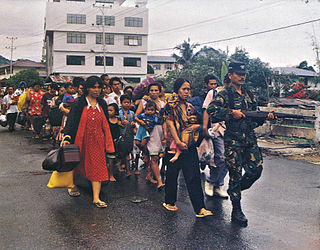
The Maluku Islands sectarian conflict was a period of ethno-political conflict along religious lines, which spanned the Indonesian islands that compose the Maluku archipelago, with particularly serious disturbances in Ambon and Halmahera islands. The duration of the conflict is generally dated from the start of the Reformasi era in early 1999 to the signing of the Malino II Accord on 13 February 2002.

Rao Rao Mosque is one of the oldest mosques in Indonesia located in Nagari Rao Rao, Tarab River, Tanah Datar Regency, West Sumatra. It is located on the road from Batusangkar bound to Bukittinggi, precisely in Rao Rao. This mosque of Minangkabau and Persian architecture was built in 1908 with a roof made from fibers before being changed to zinc.
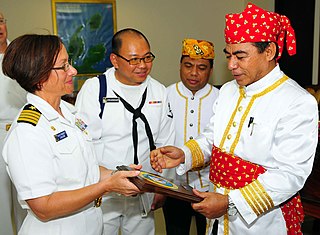
The Tobelo people is one of the northern Halmahera peoples living in eastern Indonesia, in the northern part of the Maluku Islands and in the eastern side of North Halmahera Regency.
This is a list of emblems or coat of arms used in Indonesia. Indonesia is divided into 38 provinces, and each province is divided into regencies (kabupaten) and cities (kota). There are 416 regencies and 98 cities. Each province, regency, and city has its own emblem.

The Patimburak Old Mosque is a mosque located in Kampung Patimburak, Kokas District, Fakfak, West Papua, Indonesia. The oldest mosque in Fakfak Regency, the mosque is one of the historical legacies of Islam in Papua and has become one of the centers of Islam in Fakfak Regency.
2022 Southeast Maluku riot were riots that occurred on 6 October and 12 November 2022 in Southeast Maluku Regency, Maluku. This riot involved three villages in Kei Besar District, namely the villages of Bombai and Ngurdu with the Elat village.

Pasukan Putih, later Pasukan Jihad, were a Muslim militia formed in North Maluku province, Indonesia. It was founded by Abu Bakar Wahid in December 1999, it gained regional prominence in early 2000 due to the Battle of Galela.

The Pasukan Kuning, were the personal traditional army of the Sultan of Ternate, then governor of North Maluku province, Indonesia. It was founded by Mudaffar Syah in Late 1999, it was defeated and dissolved on 28 December 1999 during the Tidore-Putihan invasion of Ternate.
Kao is ethnic group who inhabit North Halmahera Regency, North Maluku. The customary territory they occupy is called Tanah Kao which covers five districts, namely Kao, Kao Barat, Kao Utara, Kao Teluk, and Malifut.
References
- ↑ "Ritual Tagi Jere di Tanah Kao". etnis.id. Retrieved 2023-05-25.
- ↑ "SITUS KAMPUNG TUA KAO: Identitas Asal Usul dan Jejak Peradaban Islam di Wilayah Pedalaman Halmahera Utara". Kementerian Pendidikan dan Kebudayaan Republik Indonesia . Retrieved 2023-05-25.
{{cite journal}}: Cite journal requires|journal=(help) - 1 2 3 "23 Tahun NHM Mengeruk Emas di Tanah Kao". www.qureta.com. Retrieved 2023-05-25.
- ↑ "Pemekaran 4 Lembaga Adat di Halmahera Utara Dorong Pemekaran Kao Raya". halmaherapost.com. Retrieved 2023-05-25.
- ↑ "Bakal Bentuk 4 Kabupaten Daerah Otonomi Baru Pemekaran Wilayah di Provinsi Maluku Utara, Ini Penjelasannya..." palpos.disway.id. Retrieved 2023-05-25.