Most languages of Europe belong to the Indo-European language family. Out of a total European population of 744 million as of 2018, some 94% are native speakers of an Indo-European language. Within Indo-European, the three largest phyla in Europe are Romance, Germanic, and Slavic; they have more than 200 million speakers each and together account for close to 90% of Europeans. Smaller phyla of Indo-European found in Europe include Hellenic, Baltic, Albanian, Celtic, and Armenian ; Indo-Aryan, though a large subfamily of Indo-European, has a relatively small number of speakers in Europe.
Hutterite German is an Upper German dialect of the Bavarian variety of the German language, which is spoken by Hutterite communities in Canada and the United States. Hutterite is also called Tirolean, but this is an anachronism.

Pakistan is a multilingual country with dozens of languages spoken as first languages. The majority of Pakistan's languages belong to the Indo-Iranian group of the Indo-European language family.

Minangkabau is an Austronesian language spoken by the Minangkabau of West Sumatra, the western part of Riau, South Aceh Regency, the northern part of Bengkulu and Jambi, also in several cities throughout Indonesia by migrated Minangkabau. The language is also a lingua franca along the western coastal region of the province of North Sumatra, and is even used in parts of Aceh, where the language is called Aneuk Jamee.
Masaba (Lumasaaba), sometimes known as Gisu (Lugisu) after one of its dialects, is a Bantu language spoken by more than two million people in East Africa. The Gisu dialect in eastern Uganda is mutually intelligible with Bukusu, spoken by ethnic Luhya in western Kenya. Masaba is the local name of Mount Elgon and the name of the son of the ancestor of the Gisu tribe. Like other Bantu languages, Lumasaba nouns are divided into several sets of noun classes. These are similar to the genders in Germanic and Romance languages, except that instead of the usual two or three, there are around eighteen different noun classes. The language has a quite complex verb morphology.
In addition to its classical and literary form, Malay had various regional dialects established after the rise of the Srivijaya empire in Sumatra, Indonesia. Also, Malay spread through interethnic contact and trade across the south East Asia Archipelago as far as the Philippines. That contact resulted in a lingua franca that was called Bazaar Malay or low Malay and in Malay Melayu Pasar. It is generally believed that Bazaar Malay was a pidgin, influenced by contact among Malay, Hokkien, Portuguese, and Dutch traders.

Surigaonon is an Austronesian language spoken by Surigaonon people. As a regional Philippine language, it is spoken in the province of Surigao del Norte, Dinagat Islands, Surigao del Sur, and some portions of Agusan del Norte, especially the towns near the Mainit Lake, Agusan del Sur and Davao Oriental.
The Tigre people are an ethnic group indigenous to Eritrea. They mainly inhabit the lowlands and northern highlands of Eritrea.
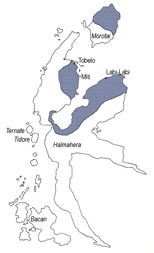
Tobelo is a North Halmahera language spoken on the eastern Indonesian island of Halmahera and on parts of several neighboring islands. The Tobelo-speaking heartland is in the six administrative districts of Tobelo, located on the western shore of Kao Bay and forming the central part of Halmahera Utara Regency. Other Tobelo-speaking areas are the five districts of Wasile on the southern and eastern shores of Kao Bay, and the northern half of Morotai Island. The district capital, also known as Tobelo, serves as a regional commercial and administrative center and is the largest settlement on Halmahera.

Spanish is the language that is predominantly understood and spoken as a first, or second language by nearly all of the population of Argentina. According to the latest estimations, the population is currently greater than 45 million.
Baka is a dialect cluster of Ubangian languages spoken by the Baka Pygmies of Cameroon and Gabon. The people are ethnically close to the Aka, the two together called the Mbenga (Bambenga), but the languages are not related, apart from some vocabulary dealing with the forest economy, which suggests the Aka may have shifted to Bantu, probably 15000 people have shifted.

Twi is a dialect of the Akan language spoken in southern and central Ghana by several million people, mainly of the Akan people, the largest of the seventeen major ethnic groups in Ghana. Twi has about 17–18 million speakers in total, including second-language speakers; about 80% of the Ghanaian population speaks Twi as a first or second language. Twi has a simple tonal language system which is reflected in its phonology.
Zaramo is a Niger-Congo language, formerly primary language of the Zaramo people of eastern Tanzania. Zaramo is also known as Zalamo, Kizaramo, Dzalamo, Zaramu, Saramo and, Myagatwa. The language is critically endangered. The ethnic population of the Zaramo people reaches about 200,000, yet there are only a few elderly speakers remaining.
Munya or Muya is one of the Qiangic languages spoken in China. There are two dialects, Northern and Southern, which are not mutually intelligible. Most research on Munya has been conducted by Ikeda Takumi. There are about 2,000 monolinguals.
Pagu, named after one of its dialects, is a North Halmahera language of Indonesia. The Kao language is highly identified with this language.

Itneg is a South-Central Cordilleran dialect continuum found in the island of Luzon, Philippines. This language and Ilocano are spoken by the Itneg people in Abra.

Inpui or Puiron is a Naga language spoken in different villages of Senapati district, Tamenglong district, Noney District, and Imphal district in Manipur, and in some areas in Nagaland, India. Speakers of Inpui and Rongmei are subsumed under single ethnic group Kabui. But the two major ethnic groups have different languages and identity. Even though they are considered to be cognate ethnic group. The speakers of this language use Meitei language as their second language (L2) according to the Ethnologue.
The Tobelo people is one of the northern Halmahera peoples living in eastern Indonesia, in the northern part of the Maluku Islands and in the eastern side of North Halmahera Regency.
Tanah Kao or Kao Raya is a designation for the area inhabited by Kao people in North Halmahera Regency, North Maluku. Administratively, its territory includes the districts of Kao, Kao Teluk, Kao Barat, Kao Utara, and Malifut.

