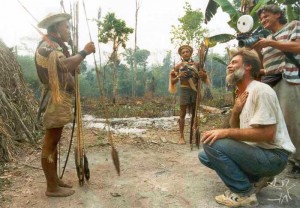
The Trobriand Islands are a 450-square-kilometre (174-square-mile) archipelago of coral atolls off the east coast of New Guinea. They are part of the nation of Papua New Guinea and are in Milne Bay Province. Most of the population of 12,000 indigenous inhabitants live on the main island of Kiriwina, which is also the location of the government station, Losuia.
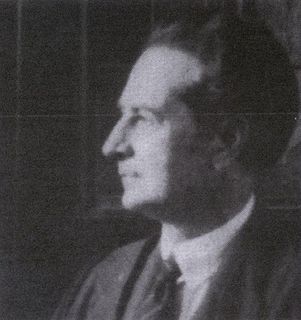
Alfred Reginald Radcliffe-Brown, FBA was an English social anthropologist who developed the theory of structural functionalism and coadaptation.
In cultural anthropology, reciprocity refers to the non-market exchange of goods or labour ranging from direct barter to forms of gift exchange where a return is eventually expected as in the exchange of birthday gifts. It is thus distinct from the true gift, where no return is expected.
Kula, also known as the Kula exchange or Kularing, is a ceremonial exchange system conducted in the Milne Bay Province of Papua New Guinea. The Kula ring was made famous by the father of modern anthropology, Bronisław Malinowski, who used this test case to argue for the universality of rational decision making, and for the cultural nature of the object of their effort. Malinowski's path-breaking work, Argonauts of the Western Pacific (1922), directly confronted the question, "why would men risk life and limb to travel across huge expanses of dangerous ocean to give away what appear to be worthless trinkets?" Malinowski carefully traced the network of exchanges of bracelets and necklaces across the Trobriand Islands, and established that they were part of a system of exchange, and that this exchange system was clearly linked to political authority. Malinowski's study became the subject of debate with the French anthropologist, Marcel Mauss, author of The Gift. Since then, the Kula ring has been central to the continuing anthropological debate on the nature of gift giving, and the existence of gift economies.

David Rolfe Graeber is an American anthropologist, anarchist activist and author known for his 2011 Debt: The First 5000 Years and 2018 Bullshit Jobs: A Theory. He is a professor of anthropology at the London School of Economics.
Facing Mount Kenya, first published in 1938, is an anthropological study of the people of the Kikuyu ethnicity of central Kenya. It was written by native Kikuyu and future Kenyan president Jomo Kenyatta.

Sir Raymond William Firth was an ethnologist from New Zealand. As a result of Firth's ethnographic work, actual behaviour of societies is separated from the idealized rules of behaviour within the particular society. He was a long serving Professor of Anthropology at London School of Economics, and is considered to have singlehandedly created a form of British economic anthropology.
Meyer Fortes was a South African-born anthropologist, best known for his work among the Tallensi and Ashanti in Ghana.
Siegfried Frederick Nadel, known as Fred Nadel, was an Austrian-born British anthropologist, specialising in African ethnology.
Timeline of anthropology, 1920–1929
Audrey Isabel Richards, CBE, FBA, was a pioneering British social anthropologist who worked mainly in sub-Saharan Africa.

Isaac Schapera, was a social anthropologist at the London School of Economics specialising in South Africa. He was notable for his contributions of ethnographic and typological studies of the indigenous peoples of Botswana and South Africa. Additionally, he was one of the founders of the group that would develop British social anthropology.
Phyllis Mary Kaberry was a social anthropologist who dedicated her work to the study of women in various societies. Particularly with her work in both Australia and Africa, she paved the way for a feminist approach in anthropological studies. Her research on the sacred life and significant role of the Aboriginal women of Australia proved to be a controversial topic, as anthropology during her years of early fieldwork was male-dominated, filled with the misconceptions that men were the superior in any aspect of life. Contributing proof of women's significance to societal development and organisation, Kaberry can be defined as an influential and significant anthropologist.
Ralph O’Reilly Piddington was a New Zealand psychologist, anthropologist and university professor.

J. P. S. Uberoi is an Indian sociologist and philosophical anthropologist. He retired as a Professor of Sociology at the Delhi School of Economics, New Delhi, India. He is best known for establishing an alternative paradigm in the Indian social sciences, which inaugurates the space for a non-western reading of the West and paves the way for a history and anthropology of science and European modernity. In 2011, the Indian Sociological Society honored him with the Lifetime Achievement Award.