The Cabiri, a Seattle-based non-profit physical theater troupe, was founded in 1999 by Artistic Director John S. Murphy. In 2001, the troupe became legally incorporated (under the organization The Anunnaki Project) and obtained 501(c)(3) status from the IRS. The mission of The Cabiri and The Anunnaki Project is to preserve the mythologies of cultures that have passed into antiquity, utilizing theatrical, storytelling dance performances, educational presentations, and a free online encyclopedia of terms from folklore and mythology.
In 2006, the organization expanded its activities to include aerial dance instruction for adults.
The troupe draws from accredited academic resources that have undergone peer review when creating new work, and strives to educate the public about folklore and mythology via its theatrical productions. The organization's work has been presented to thousands of audience members throughout North America in the last decade and has been featured in a variety of media and arts-related publications.
Performance history
The Genesis of Ereshkigal (July 2000): utilizing puppetry, physical theatre, and fire performance, this early production depicted Ereshkigal's abduction by Kur and Enki's rescue attempt.
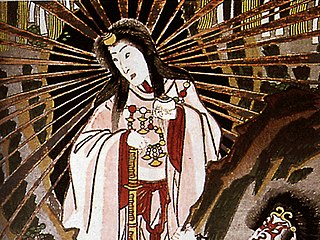
The Kojiki of Amaterasu (September 2001): one of the final performances on the stage at the old Seattle Opera House, the story of Japanese solar goddess Amaterasu.
Vasalisa the Beautiful (March 2002): a tale from Russian folklore, in which Baba Yaga, the forest witch encounters the lovely Vasalisa and sets before her three impossible tasks.
Dance of the Calusari (May 2003): in collaboration with Radost Folk Ensemble, explored Romanian folklore and the Calusari folk dancers.
The Ghost Game (October 2006): survey of folklore and mythology regarding ghosts; premise inspired by Hyaku Monogatari, a Japanese ghost story game.
Garden of Dreams (June 2007): nine tales depicting folklore and mythology of plants from a variety of cultures.
Gods of the Night (July 2008): seven Mesopotamian planetary gods and Inanna's epic descent to the Underworld and encounter with Ereshkigal, Queen of the Sumerian Underworld.
The Ghost Game: Tales of 13 Witches (October 2008): nine performances exploring the witch archetype in folklore and mythology.
The Ghost Game: Dead Gods (October 2009): six vignettes depicting deaths of deities from folklore and mythology.
The Ghost Game: Devil In the Deep Blue Sea (October 2010): seven vignettes exploring tales from bodies of water, including the Slavic Rusalka, the Scottish Each uisge, Japanese Kappa, Ondine, and Egyptian Apep.
The Ghost Game: Winternacht (October 2011): vignettes exploring tales of winter, including the Slavic Marzanna, the Himalayan Yeti, Algonquian Wendigo, and Russian Father Frost, and Hittite Telepinu.
Tarhun: Legend of the Lightning God (April 2012): a full-length production depicting the storm god Tarhun and his battles against various foes including the great serpent Illuyanka, frost god Hahhimas and rock golem Ullikummi.
Publishing
In April 2012, the organization published its first book "Tarhun: Legend of the Lightning God." Co-authored by Mark Teppo and John Murphy, the text explores Hittite mythology, focusing upon storm god mythos and includes a novelization of the script for the theatrical production by the same name. ISBN978-0-9853031-4-3.
Photos
Members of The Cabiri performance troupe as "Ishtar", June 2009
The Cabiri performance troupe in "Nergal", July 2008
A goddess is a female deity. In many known cultures, goddesses are often linked with literal or metaphorical pregnancy or imagined feminine roles associated with how women and girls are perceived or expected to behave. This includes themes of spinning, weaving, beauty, love, sexuality, motherhood, domesticity, creativity, and fertility. Many major goddesses are also associated with magic, war, strategy, hunting, farming, wisdom, fate, earth, sky, power, laws, justice, and more. Some themes, such as discord or disease, which are considered negative within their cultural contexts also are found associated with some goddesses. There are as many differently described and understood goddesses as there are male, shapeshifting, or neuter gods.
Inanna is the ancient Mesopotamian goddess of love, war, and fertility. She is also associated with beauty, sex, divine law, and political power. Originally worshiped in Sumer, she was known by the Akkadian Empire, Babylonians, and Assyrians as Ishtar. Her primary title was "the Queen of Heaven".
Zecharia Sitchin was an author of a number of books proposing an explanation for human origins involving ancient astronauts. Sitchin attributed the creation of the ancient Sumerian culture to the Anunnaki, which he stated was a race of extraterrestrials from a planet beyond Neptune called Nibiru. He asserted that Sumerian mythology suggests that this hypothetical planet of Nibiru is in an elongated, 3,600-year-long elliptical orbit around the Sun. Sitchin's books have sold millions of copies worldwide and have been translated into more than 25 languages.
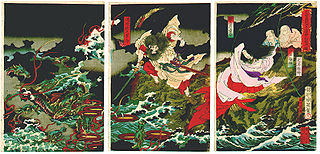
Yamata no Orochi, or simply Orochi (大蛇), is a legendary eight-headed and eight-tailed Japanese dragon/serpent.
Baba Yaga is an enigmatic or ambiguous character from Slavic folklore who has two opposite roles. In some motifs she is described as a repulsive or ferocious-looking old woman who fries and eats children, while in others she is a nice old woman, who helps out the hero. She is often associated with forest wildlife. Her distinctive traits are flying around in a mortar, wielding a pestle, and dwelling deep in the forest in a hut standing on chicken legs.
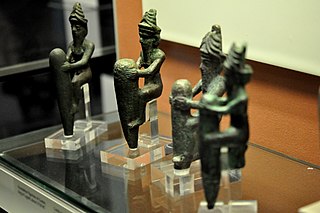
The Anunnaki are a group of deities of the ancient Sumerians, Akkadians, Assyrians and Babylonians. In the earliest Sumerian writings about them, which come from the Post-Akkadian period, the Anunnaki are deities in the pantheon, descendants of An and Ki, the god of the heavens and the goddess of earth, and their primary function was to decree the fates of humanity. They should not be confused with the Apkallu.
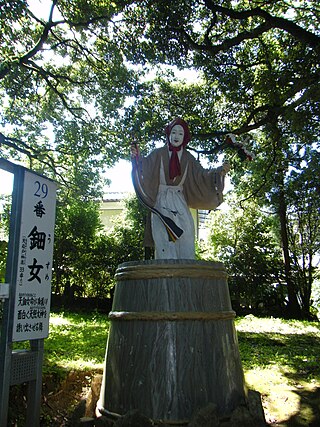
Ame-no-Uzume-no-Mikoto is the goddess of dawn, mirth, meditation, revelry and the arts in the Shinto religion of Japan, and the wife of fellow-god Sarutahiko Ōkami. She famously helped draw out the missing sun deity, Amaterasu Omikami, when she had hidden herself in a cave. Her name can also be pronounced as Ama-no-Uzume-no-Mikoto. She is also known as Ōmiyanome-no-Ōkami, an inari kami possibly due to her relationship with her husband. She is also known as Ame-no-Uzume-no-Mikoto, The Great Persuader, and The Heavenly Alarming Female. She is depicted in kyōgen farce as Okame, a woman who revels in her sensuality.
Japanese mythology is a collection of traditional stories, folktales, and beliefs that emerged in the islands of the Japanese archipelago. Shinto traditions are the cornerstones of Japanese mythology. The history of thousands of years of contact with Chinese and Indian myths are also key influences in Japanese religious belief.
Georgian mythology refers to the mythology of pre-Christian Georgians, an indigenous Caucasian ethnic group native to Georgia and the South Caucasus. The mythology of the Kartvelian peoples is believed by many scholars to have formed part of the religions of the kingdoms of Diauehi, Colchis and Iberia.
Stories and practices that are considered part of Korean folklore go back several thousand years. These tales derive from a variety of origins, including Shamanism, Confucianism, Buddhism, and more recently Christianity.
Hittite mythology and Hittite religion were the religious beliefs and practices of the Hittites, who created an empire centered in what is now Turkey from c. 1600–1180 BC.
The folklore of Romania is the collection of traditions of the Romanians. A feature of Romanian culture is the special relationship between folklore and the learned culture, determined by two factors. First, the rural character of the Romanian communities resulted in an exceptionally vital and creative traditional culture. Folk creations were the main literary genre until the 18th century. They were both a source of inspiration for cultivated creators and a structural model. Second, for a long time learned culture was governed by official and social commands and developed around courts of princes and boyars, as well as in monasteries.
A weather god or goddess, also frequently known as a storm god or goddess, is a deity in mythology associated with weather phenomena such as thunder, snow, lightning, rain, wind, storms, tornadoes, and hurricanes. Should they only be in charge of one feature of a storm, they will be called after that attribute, such as a rain god or a lightning/thunder god. This singular attribute might then be emphasized more than the generic, all-encompassing term "storm god", though with thunder/lightning gods, the two terms seem interchangeable. They feature commonly in polytheistic religions, especially in Proto-Indo-European ones.
Shinto is frequently a theme in Japanese popular culture, including film, manga, anime, and video games. Shinto religion is at the core of Japanese culture and history and as such greatly affects the outcome of pop culture in modern Japan.
There are many references to ghosts in ancient Mesopotamian religion – the religions of Sumer, Babylon, Assyria and other early states in Mesopotamia. Traces of these beliefs survive in the later Abrahamic religions that came to dominate the region.
The ancient Mesopotamian underworld, most often known in Sumerian as Kur, Irkalla, Kukku, Arali, or Kigal and in Akkadian as Erṣetu, although it had many names in both languages, was a dark, dreary cavern located deep below the ground, where inhabitants were believed to continue "a transpositional version of life on earth". The only food or drink was dry dust, but family members of the deceased would pour sacred mineral libations from the earth for them to drink. In the Sumerian underworld, it was initially believed that there was no final judgement of the deceased and the dead were neither punished nor rewarded for their deeds in life.
Lower mythology is a sphere of mythological representations relating to characters who have no divine status, demons and spirits, as opposed to higher gods and the official cult. This opposition is particularly pronounced in world religions.
This page is based on this Wikipedia article Text is available under the CC BY-SA 4.0 license; additional terms may apply. Images, videos and audio are available under their respective licenses.