Related Research Articles
George Peele was an English translator, poet, and dramatist, who is most noted for his supposed, but not universally accepted, collaboration with William Shakespeare on the play Titus Andronicus. Many anonymous Elizabethan plays have been attributed to him, but his reputation rests mainly on Edward I, The Old Wives' Tale, The Battle of Alcazar, The Arraignment of Paris, and David and Bethsabe. The Troublesome Reign of John, King of England, the immediate source for Shakespeare's King John, has been published under his name.

Edith Wilson was the first lady of the United States from 1915 to 1921 and the second wife of President Woodrow Wilson. She married the widower Wilson in December 1915, during his first term as president. Edith Wilson played an influential role in President Wilson's administration following the severe stroke he suffered in October 1919. For the remainder of her husband's presidency, she managed the office of the president, a role she later described as a "stewardship", and determined which communications and matters of state were important enough to bring to the attention of the bedridden president.
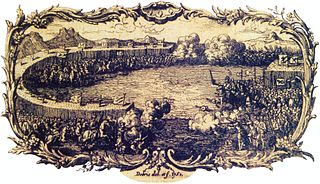
The Battle of Alcácer Quibir was fought in northern Morocco, near the town of Ksar-el-Kebir and Larache, on 4 August 1578.
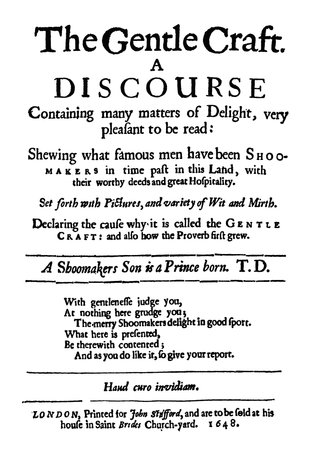
Thomas Deloney was an English silk-weaver, novelist, and ballad writer.

Thomas Stucley was an English mercenary who fought in France, Ireland and at the Battle of Lepanto before being killed at the Battle of Alcácer Quibir in 1578. He was a Catholic recusant and a rebel against the Protestant Elizabeth I.
"Geordie" is an English language folk song concerning the trial of the eponymous hero whose lover pleads for his life. It is listed as Child ballad 209 and Number 90 in the Roud Folk Song Index. The ballad was traditionally sung across the English speaking world, particularly in England, Scotland and North America, and was performed with many different melodies and lyrics. In recent times, popular versions have been performed and recorded by numerous artists and groups in different languages, mostly inspired by Joan Baez's 1962 recording based on a traditional version from Somerset, England.
The Battle of Alcazar is a play attributed to George Peele, perhaps written no later than late 1591 if the play "Muly Molucco" mentioned in Henslowe's diary is this play, and published anonymously in 1594, that tells the story of the battle of Alcácer Quibir in 1578.
The Famous Chronicle of King Edward the First, sirnamed Edward Longshankes, with his returne from the holy land. ALSO THE LIFE OF LLEVELLEN rebell In Wales. Lastly, the sinking of Queen Elinor, who sunck at Charingcrosse, and rose againe at Pottershith, now named Queenehith. is a play by George Peele, published 1593, chronicling the career of Edward I of England.
Believe as You List is a Caroline era tragedy by Philip Massinger, famous as a case of theatrical censorship.
"The Ballad of Ira Hayes" is a song written by folk singer Peter La Farge. Its words tell the story of Ira Hayes, one of the six marines who became famous for having raised the U.S. flag on Mount Suribachi during the Battle of Iwo Jima in World War II. Members of the Western Writers of America chose it as one of the Top 100 Western songs of all time.

The Generall Historie of Virginia, New-England, and the Summer Isles is a book written by Captain John Smith, first published in 1624. The book is one of the earliest, if not the earliest, histories of the territory administered by the London Company.

The Anglo-Moroccan alliance was established at the end of the 16th century and the early 17th century between the kingdoms of England and Morocco. Commercial agreements had been reached by Queen Elizabeth I of England and the Moroccan Sultan Ahmad al-Mansur on the basis of a common enmity to Philip II of Spain. The arms trade dominated the exchange, and numerous attempts at direct military collaboration were also made.

The Capture of Fez occurred in 1576 at the Moroccan city of Fez, when an Ottoman force from Algiers supported the prince Abd al-Malik in gaining the throne of the Saadi Sultanate against his nephew and rival claimant Mulay Muhammed al-Mutawakkil in exchange for making the Sultanate an Ottoman vassal.
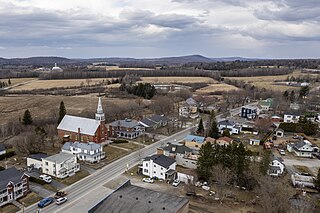
Lawrenceville is a village municipality in the Le Val-Saint-François Regional County Municipality in the Estrie region of Quebec, Canada.
Stukely Stafford Ellsworth, Sr., was an American politician from New York state. He served two terms in the New York State Assembly, representing Otsego County, and later served in the New York State Senate.
Henry Squire was an English poet and clergyman, and Archdeacon of Barnstaple from 1554 to 1582.
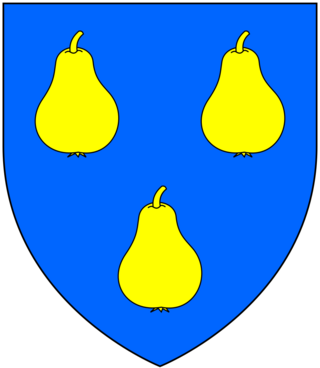
Sir Lewis Stukley lord of the manor of Affeton in Devon, was Vice-Admiral of Devonshire. He was guardian of Thomas Rolfe, and a main opponent of Walter Raleigh in his last days. Stucley's reputation is equivocal; popular opinion at the time idealised Raleigh, and to the public he was Sir "Judas" Stucley.
Philip Bell was Governor of Bermuda from 1626 to 1629, of the Providence Island colony from 1629 to 1636, and of Barbados from 1640 to 1650 during the English Civil War. During his terms of office in Providence and Barbados, the colonies moved from using indentured English workers to slaves imported from West Africa. The Providence Island colony, despite its puritan ideals, became a haven for privateers attacking ships in the Spanish Main.
Girolamo Franchi di Conestaggio was a Genoese merchant and scholar.

The action off Bermuda, also known as Grenville's action off the Bermuda's, was a minor naval engagement that took place off the island of Bermuda over three days in late August 1585 during the Anglo–Spanish War between an English galleass, Tiger, and a larger Spanish galleon, Santa Maria de San Vicente. Tiger was victorious when the Spanish ship surrendered after a severe bombardment.
References
- ↑ J.W.M. Gibbs, Biography of Sir Thomas Stucley. The Famous History of the Life and Death... London: Chatto and Windus, 1878 (pg. 25)
- ↑ Ambrose Philips, A Collection of Old Ballads: Corrected From the Best and Most Ancient Copies Extant. London: J. Roberts, 1723 (pgs. 189-190)
- ↑ Karen Ordahl Kupperman, The Jamestown Project. Cambridge, MA: Harvard University Press, 2007 (pg. 122-123)
- ↑ Gibbs, 144
- ↑ Leonard R.N. Ashley, George Peele. Woodbridge, CT: Twayne Publishers, 1970 (pgs. 84-85)