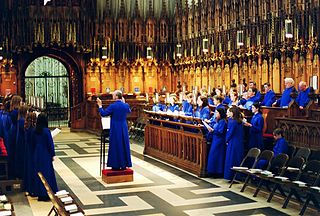
A choir ( KWIRE; also known as a chorale or chorus is a musical ensemble of singers. Choral music, in turn, is the music written specifically for such an ensemble to perform or in other words is the music performed by the ensemble. Choirs may perform music from the classical music repertoire, which spans from the medieval era to the present, or popular music repertoire. Most choirs are led by a conductor, who leads the performances with arm, hand, and facial gestures.

Jean Sibelius was a Finnish composer of the late Romantic and early modern periods. He is widely regarded as his country's greatest composer, and his music is often credited with having helped Finland develop a stronger national identity when the country was struggling from several attempts at Russification in the late 19th century.

The Bournemouth Symphony Orchestra (BSO) is an English orchestra, founded in 1893 and originally based in Bournemouth. With a remit to serve the South and South West of England, the BSO is administratively based in the adjacent town of Poole, since 1979. The orchestra is resident at Lighthouse in Poole, with other major concert series given at Portsmouth Guildhall, the Great Hall of Exeter University and Bristol Beacon. Shorter series are also given in Bournemouth and Basingstoke.

Paavo Allan Engelbert Berglund was a Finnish conductor and violinist.
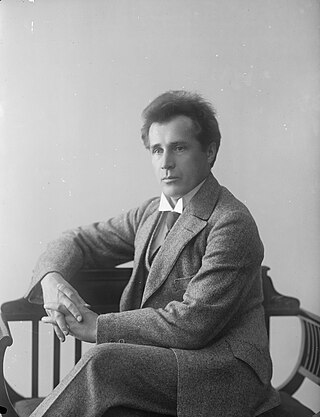
Leevi Antti Madetoja was a Finnish composer, music critic, conductor, and teacher of the late-Romantic and early-modern periods. He is widely recognized as one of the most significant Finnish contemporaries of Jean Sibelius, under whom he studied privately from 1908 to 1910.

Aulis Heikki Sallinen is a Finnish contemporary classical music composer. His music has been variously described as "remorselessly harsh", a "beautifully crafted amalgam of several 20th-century styles", and "neo-romantic". Sallinen studied at the Sibelius Academy, where his teachers included Joonas Kokkonen. He has had works commissioned by the Kronos Quartet, and has also written seven operas, eight symphonies, concertos for violin, cello, flute, horn, and English horn, as well as several chamber works. He won the Nordic Council Music Prize in 1978 for his opera Ratsumies.
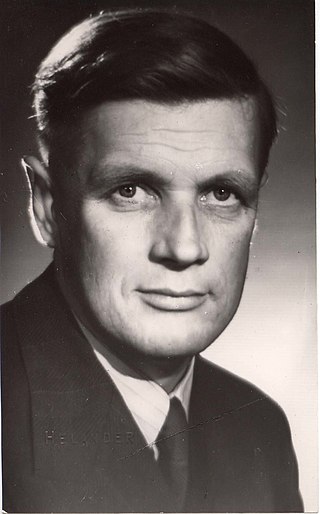
Uuno (Kalervo) Klami was a Finnish composer of the modern period. He is widely recognized as one of the most significant Finnish composers to emerge from the generation that followed Jean Sibelius.

Kullervo, Op. 7, is a five-movement symphonic work for soprano, baritone, male choir, and orchestra written from 1891–1892 by the Finnish composer Jean Sibelius. Movements I, II, and IV are instrumental, whereas III and V feature sung text from Runos XXXV–VI of the Kalevala, Finland's national epic. The piece tells the story of the tragic hero Kullervo, with each movement depicting an episode from his ill-fated life: first, an introduction that establishes the psychology of the titular character; second, a haunting "lullaby with variations" that portrays his unhappy childhood; third, a dramatic dialogue between soloists and chorus in which the hero unknowingly seduces his long-lost sister; fourth, a lively scherzo in which Kullervo seeks redemption on the battlefield; and fifth, a funereal choral finale in which he returns to the spot of his incestuous crime and, guilt-ridden, takes his life by falling on his sword.

Toivo Timoteus Kuula was a Finnish composer and conductor of the late-Romantic and early-modern periods, who emerged in the wake of Jean Sibelius, under whom he studied privately from 1906 to 1908. The core of Kuula's oeuvre are his many works for voice and orchestra, in particular the Stabat mater, The Sea-Bathing Maidens (1910), Son of a Slave (1910), and The Maiden and the Boyar's Son (1912). In addition he also composed two Ostrobothnian Suites for orchestra and left an unfinished symphony at the time of his murder in 1918 in a drunken quarrel.

Robert Kajanus was a Finnish conductor, composer, and teacher. In 1882, he founded the Helsinki Orchestral Society, Finland's first professional orchestra. As a conductor, he was also a notable champion and interpreter of the music of Jean Sibelius.

The Philharmonic Orchestra (TPO) is an amateur orchestra in Singapore, initiated as a project by Maestro Lim Yau in 1998. The orchestra consists of adults who have a keen and serious interest to perform music. Formerly known as the Philharmonic Chamber Orchestra Society (PCOS), the group became The Philharmonic Orchestra (TPO) to better reflect its intention to perform both symphonic and chamber works.

Cantores Minores is a choir of the Helsinki Cathedral, and Finland's oldest and most successful boys' choir. The patron of the choir is the President of Finland. The choir consists of around three hundred 4- to 25-year-old boys and young men.

My Own Land, Op. 92, is a single-movement, patriotic cantata for mixed choir and orchestra written in 1918 by the Finnish composer Jean Sibelius. The piece, which is a setting of Kallio's Finnish-language poem of the same name, is chronologically the sixth of Sibelius's nine orchestral cantatas; in particular, it belongs to the series of four "little known, but beautiful" cantatas from the composer's mature period that also includes Song of the Earth, Hymn of the Earth, and Väinämöinen's Song. My Own Land premiered on 25 October 1918 in Helsinki with Armas Maasalo conducting the Helsinki Youth League —the commissioning ensemble and dedicatee—and the Helsinki Philharmonic Orchestra.

The Captive Queen, Op. 48, is a single-movement, patriotic cantata for mixed choir and orchestra written in 1906 by the Finnish composer Jean Sibelius. The piece, which is a setting of the Finnish author Paavo Cajander's Finnish-language poem of the same name, is chronologically the fifth of Sibelius's nine orchestral cantatas.
The Breaking of the Ice on the Oulu River, Op. 30, is a composition by Jean Sibelius, an "improvisation for narrator, men's chorus and orchestra". Sibelius composed it in 1899 on a poem by Zachris Topelius, a Swedish-language Finnish poet, who had dedicated it to Tsar Alexander II of Russia, thus escaping censorship. The piece was an "explicit protest composition" against a Russia restricting the autonomy of the Grand Duchy of Finland. Sibelius wrote it for a lottery of the Savonian-Karelian Students' Association, where he conducted the first performance on 21 October 1899.
Jutta Seppinen is a Finnish conductor and mezzo-soprano.

The Polytech Orchestra is a symphony orchestra based in Otaniemi, Espoo.

Aino is a single-movement symphonic poem for male choir and orchestra written in 1885 by the Finnish conductor and composer Robert Kajanus. The piece tells the tragic story of the eponymous heroine from the Kalevala, although the Finnish-language text—Ring, Kantele, Ring! —sung by the male choir at the end of the symphonic poem is not from the literary epic but rather is by an anonymous author. Aino premiered on 28 February 1885 at a concert celebrating the fiftieth anniversary of the Kalevala.

Kullervo, Op. 15, is a symphonic poem for orchestra written in 1913 by Finnish composer Leevi Madetoja. The piece premiered on 14 October 1913 with Madetoja conducting the Helsinki Philharmonic Society.

The Bells of Kallio Church, JS 102 is a brief chorale for mechanized carillon written in 1912 by the Finnish composer Jean Sibelius. The piece, which the titular institution commissioned, sounds twice daily—at noon and 18 o'clock—in Helsinki on four of the seven German-made, bronze church bells in the brick-and-granite steeple. As such, it is the most frequently performed composition in Sibelius's oeuvre, as well as a notable part of the capital's soundscape.


