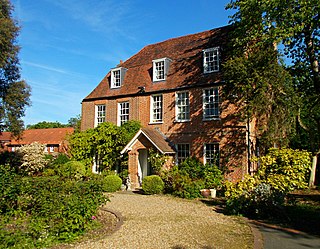
Cheam is a suburb of London, England, 10.9 miles (17.5 km) southwest of Charing Cross. It is divided into North Cheam, Cheam Village and South Cheam. Cheam Village contains the listed buildings Lumley Chapel and the 16th-century Whitehall. It is adjacent to two large parks, Nonsuch Park and Cheam Park. Nonsuch Park contains the listed Nonsuch Mansion. Parts of Cheam Park and Cheam Village are in a conservation area. Cheam is bordered by Worcester Park to the northwest, Morden to the northeast, Sutton to the east, Epsom, Ewell and Stoneleigh to the west and Banstead and Belmont to the south.

Belmont is a village in the London Borough of Sutton, in South London, England. It is located off the A217 road and near to Banstead Downs in Surrey. It is a suburban development situated 10.8 miles (17.4 km) south-southwest of Charing Cross.

The London Borough of Sutton is an Outer London borough in London, England. It covers an area of 43 km2 (17 sq mi) and is the 80th largest local authority in England by population. It borders the London Borough of Croydon to the east, the London Borough of Merton to the north and the Royal Borough of Kingston upon Thames to the north-west; it also borders the Surrey boroughs of Epsom and Ewell to the west and Reigate and Banstead to the south. The local authority is Sutton London Borough Council. Its principal town is Sutton.

Epsom and Ewell is a local government district with borough status in Surrey, England, covering the towns of Epsom and Ewell. The borough lies just outside the administrative boundary of Greater London, but it is entirely within the M25 motorway which encircles London. Many of the borough's urban areas form part of the wider Greater London Built-up Area.
The A24 is a major road in England that runs for 53.2 miles (85.6 km) from Clapham in south-west London to Worthing on the English Channel in West Sussex via the suburbs of south-west London, as well as through the counties of Surrey and West Sussex.

The King's Head is one of the oldest public houses with a coaching yard in the south of England. It is located in the Market Square, Aylesbury, Buckinghamshire, and is a Grade II* Listed Building.

Sutton is a town in the London Borough of Sutton in South London, England. It is the administrative headquarters of the Outer London borough, on the lower slopes of the North Downs. It is 10 miles (16 km) south-southwest of Charing Cross, one of the fourteen metropolitan centres in the London Plan.

Ewell is a town in the borough of Epsom and Ewell in Surrey, England. It is approximately 12 miles (19 km) south of central London and 2 miles (3.2 km) northeast of Epsom. In the 2011 Census, the town had a population of 34,872. The majority of which (73%) is in the ABC1 social class, except the Ruxley Ward that is C2DE.

Worcester Park is a suburban town in South London, England. It lies in the London boroughs of Sutton and Kingston, and partly in the Surrey borough of Epsom and Ewell. The area is 10 miles (16 km) southwest of Charing Cross. The suburb's population was 16,031 at the time of the 2001 census. The suburb comprises the Worcester Park ward, an electoral area of the London Borough of Sutton with a population in 2011 of 11,655, as well as the Cuddington ward, an electoral area of Epsom and Ewell, which had a population of 5,791 at the time of the 2001 census.

Carshalton was a local government district in north east Surrey from 1883 to 1965 around the town of Carshalton.
Stoneleigh is a suburban area southwest of London, situated in the north of the Epsom and Ewell borough in the county of Surrey, England. It is situated approximately 11 miles (18 km) from central London. In the 2011 Census, the population was 8,741.

The A240 is a partially primary status A road in Surrey and Greater London that connects the A217 with the A3 and continues beyond through Surbiton to Kingston upon Thames. The road is 8.5 miles (13.7 km) long and is dualled as the Ewell bypass and thereafter to Tolworth Broadway. In conjunction with the A3 it provides an alternative to the congested A24 corridor through Morden and Merton.
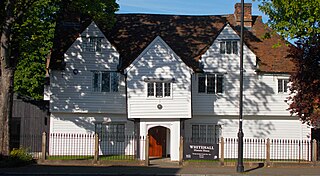
Whitehall is a timber-framed historic house museum in the centre of Cheam Village, Sutton, Greater London. It is thought to have been a wattle and daub yeoman farmer's house originally, built around 1500. It is Grade II* listed on Historic England's National Heritage List.
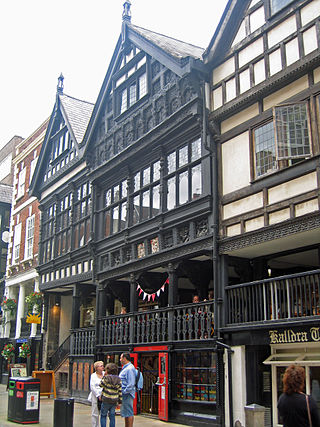
Bishop Lloyd's House is at 41 Watergate Street, and 51/53 Watergate Row, Chester, Cheshire, England. It is recorded in the National Heritage List for England as a designated Grade I listed building. The architectural historian Nikolaus Pevsner considered it to be "perhaps the best" house in Chester.

The New Inn, 16 Northgate Street, Gloucester, England, is a timber framed building used as a public house, hotel and restaurant. It is the most complete surviving example of a medieval courtyard inn with galleries in Britain, and is a Grade I listed building. The announcement of Lady Jane Grey's succession to the English throne was made from the Inn gallery in 1553.

The Feathers Hotel is a historic inn in Ludlow, Shropshire. Its imposing half-timbered frontage was constructed in 1619, over an earlier core, for a local lawyer, Rees Jones. John Newman describes the hotel as a "prodigy" of Tudor architecture and it is noted for its Jacobean furnishings. It is a Grade I listed building, listed on 15 April 1954, and is one of approximately 500 listed buildings in Ludlow, but one of its best known.

The Falcon is a Grade II listed public house at 2 St John's Hill, Battersea, London.
Arthur Edward Sewell (1872–1946) was an English architect, particularly known for the public houses he designed whilst working as the in-house architect for Truman's Brewery. His career peaked in the 1920s and 1930s, and at least five pubs that he designed in that period are now listed buildings with Historic England. In all, he designed around 50 pubs.

Priest Hill is a 35-hectare (86-acre) nature reserve on the eastern outskirts of Ewell, near Epsom in north Surrey. It is managed by the Surrey Wildlife Trust. It is a Site of Nature Conservation Importance.
