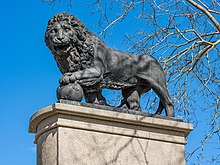
The Battle of Narva on 30 November [O.S. 19 November] 1700 was an early battle in the Great Northern War. A Swedish relief army under Charles XII of Sweden defeated a Russian siege force three to four times its size. Previously, Charles XII had forced Denmark–Norway to sign the Treaty of Travendal. Narva was not followed by further advances of the Swedish army into Russia; instead, Charles XII turned southward to expel August the Strong from Livonia and Poland–Lithuania. Tsar Peter the Great of Russia took Narva in a second battle in 1704.

Djursholm is one of four suburban districts in, and the seat of Danderyd Municipality, Stockholm County, Sweden. Djursholm is included in the multi-municipal Stockholm urban area. Djursholm is divided into a number of different areas: Djursholms Ekeby (northwest), Svalnäs (northeast), Ösby (central), Berga (southwest) and Gamla Djursholm. It is also partly located in Täby Municipality.

The Branting Monument is a monument in Stockholm, Sweden, with a statue of the Swedish Social Democratic leader Hjalmar Branting. The monument is 5 meters tall and 6 meters wide.

Liljevalchs konsthall is a kunsthalle art venue located on Djurgården island in Stockholm, Sweden. Designed by architect Carl Bergsten (1879–1935) and inaugurated in March 1916, it is today owned by the City of Stockholm.

Peter Jakob Freiherr Clodt von Jürgensburg, known in Russian as Pyotr Karlovich Klodt, was a favourite sculptor of Nicholas I of Russia.

The Crossing of the Düna took place during the Great Northern War on July 19, 1701 near the city of Riga, present-day Latvia. The Swedish king Charles XII was in hot pursuit of king Augustus II the Strong of the Polish–Lithuanian Commonwealth and Saxony. The crossing was easily made, and the coalition troops were quickly broken and retreated.

Riksbron is an arch bridge in central Stockholm, Sweden, leading from Drottninggatan on Norrmalm 44 metres (144 ft) over to Riksgatan on Helgeandsholmen.

Eric Grate was a Swedish sculptor, painter and graphics artist.
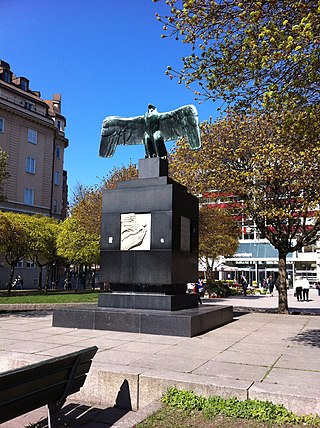
The Aviator Monument is a statue that stands at Karlaplan in central Stockholm, Sweden. The statue was a gift from the Swedish Aeronautical Society in memory of different Swedish aviation pioneers who fell in both the North Pole expedition of 1898 and in the Swedish aviator era in 1917. The task to build the monument was given to the famous sculptor Carl Milles. The Aviator Monument was finished in 1931.

This is a sub-article to Battle of Narva (1944).
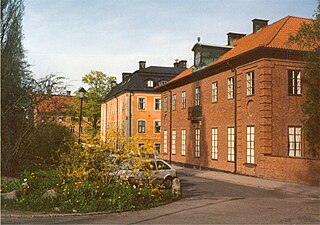
Värmlands nation is one of the 13 student nations at Uppsala University. Värmlands nation catchment corresponds to Karlstad diocese, that is, the regions Värmland and Dalsland. No formal requirement related to any of these landscapes are nowadays a must. The nation has a wide range of activities, in addition to the nation's restaurant, café, pub and party activities the nation also has a library to borrow literature from. In addition, students also have the opportunities to apply for scholarships, and obtaining temporary loans from the nation. Other activities are: photography, sports, choir and theater. The nation building in red brick is designed by the architect Ragnar Östberg and was completed in the year 1930.

Bellevue (Bellevueparken) is a park in central Stockholm, Sweden. Bellevue borders to Vasastan and is part of the Royal National City Park.
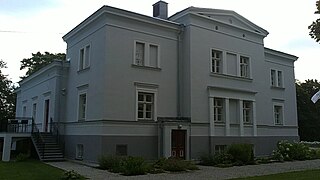
Saka is a village in Toila Parish, Ida-Viru County in northeastern Estonia. Before the 2017 Administrative Reform, the village belonged to Kohtla Parish. Karjaoru Falls is located in Saka.
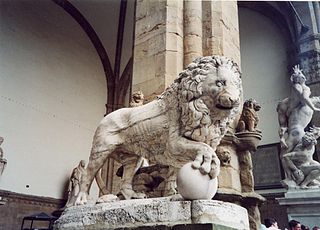
The Medici lions are a pair of marble sculptures of lions: one of which is Roman, dating to the 2nd century AD, and the other a 16th-century pendant. By 1598 both were placed at the Villa Medici, Rome. Since 1789 they have been displayed at the Loggia dei Lanzi in Florence. The sculptures depict standing male lions with a sphere or ball under one paw, looking to the side.

Johan(n) Gustav Stockenberg was a Swedish sculptor, wood carver and stonemason who worked in Sweden, Russia and mainly in Reval.

The Jewish Museum in Stockholm, Sweden, is devoted to objects and environments related to Jewish religion, tradition, and history, particularly in connection to Judaism in Sweden.

Galärvarvskyrkogården is a cemetery on the island of Djurgården in Stockholm, Sweden. It has about 1,300 burial sites and an area of approximately 0.9 hectares.
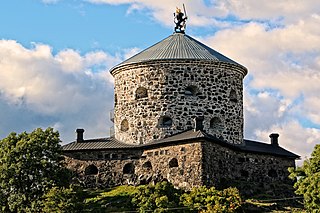
Skansen Lejonet, formally Westgötha Leijon, is a redoubt on the hill Gullberg in Gothenburg, Sweden, built in 1687–92 on the site of an earlier medieval castle. It was decommissioned in 1822 and has since served a range of other purposes.

Slottslejonen are two bronze sculptures of lions that stand on Lejonbacken below the northern facade of Stockholm Palace in Stockholm, Sweden.