Related Research Articles

Sherborne Abbey, otherwise the Abbey Church of St. Mary the Virgin, is a Church of England church in Sherborne in the English county of Dorset. It has been a Saxon cathedral (705–1075), a Benedictine abbey church (998–1539), and since 1539, a parish church.
Sherborne is a market town and civil parish in north west Dorset, in South West England. It is sited on the River Yeo, on the edge of the Blackmore Vale, 6 miles east of Yeovil. The parish includes the hamlets of Nether Coombe and Lower Clatcombe. The A30 road, which connects London to Penzance, runs through the town. In the 2011 census the population of Sherborne parish and the two electoral wards was 9,523. 28.7% of the population is aged 65 or older.

Henry Chichele was Archbishop of Canterbury (1414–1443) and founded All Souls College, Oxford.

The Worshipful Company of Drapers is one of the 111 livery companies of the City of London. It has the formal name The Master and Wardens and Brethren and Sisters of the Guild or Fraternity of the Blessed Mary the Virgin of the Mystery of Drapers of the City of London. More usually known simply as the Drapers' Company, it is one of the historic Great Twelve Livery Companies and was founded during the Middle Ages.

Thomas Seckford or Thomas Sakford Esquire was a senior lawyer, a "man of business" at the court of Queen Elizabeth I, a landowner of the armigerous Suffolk gentry, Member of Parliament, and public benefactor of the town of Woodbridge. He was one of the Masters in Ordinary of the Court of Requests to Queen Elizabeth, 1569-1587, and was Surveyor of the Court of Wards and Liveries 1581-1587. He built mansions in Woodbridge, Ipswich and Clerkenwell, and was at different times Steward of the Liberty of Ely in Suffolk, Bailiff for the Crown of the former possessions of Clerkenwell Priory in the City of London and County of Middlesex, and deputy Steward for the northern parts of the Duchy of Lancaster. He was the patron of Christopher Saxton in the making of the first surveyed County Atlas of England and Wales.
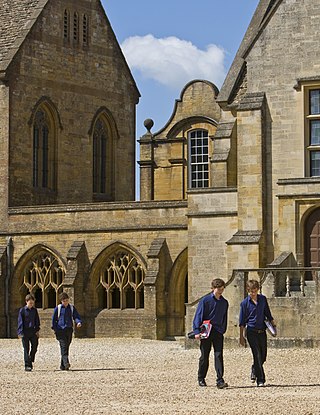
Sherborne School is a 11–18 boys public school and boarding school located beside Sherborne Abbey, in the parish of Sherborne, Dorset. The school has been in continuous operation on the same site for over 1,300 years. It was founded in 705 AD by St Aldhelm and, following the dissolution of the monasteries, re-founded in 1550 by King Edward VI, making it one of the oldest schools in the United Kingdom. Sherborne is one of the twelve founding member public schools of the Headmasters' and Headmistresses' Conference in 1869 and is a member of the Eton Group and Boarding Schools Association.
Sevenoaks School is a highly selective coeducational private school in Sevenoaks, Kent, England. It is the second oldest non-denominational school in the United Kingdom, dating back to 1432, only behind Oswestry (1407). Over 1,000 day pupils and boarders attend, ranging in age from 11 to 18 years. There are approximately equal numbers of boys and girls. In 2006 it became the first major UK school to switch entirely from A level exams to the International Baccalaureate. The school is a former member of the G20 Schools group.

Merton Priory was an English Augustinian priory founded in 1114 by Gilbert Norman, Sheriff of Surrey under King Henry I (1100–1135). It was situated within the manor of Merton in the county of Surrey, in what is today the Colliers Wood area in the London Borough of Merton.

Heytesbury is a village and a civil parish in Wiltshire, England. The village lies on the north bank of the Wylye, about 3+1⁄2 miles (5.6 km) southeast of the town of Warminster.
St Saviour's Grammar School was a free grammar school for boys located in the borough of Southwark, south of the River Thames in London, England. It existed as a separate entity from 1559 until 1896, when it was amalgamated with St Olave's Grammar School, which was renamed St Olave's and St Saviour's Grammar School For Boys.

The College of God's Gift, often referred to as the Old (Dulwich) College, was a historic charity founded in 1619 by the Elizabethan actor and businessman Edward Alleyn who endowed it with the ancient Manor of Dulwich in south London. In 1857 it was renamed as Alleyn's College of God's Gift. The charity was reorganised in 1882 and again in 1995, when its varied component activities were split up into separate registered charities. The former constituent elements of College of God's Gift, which have been independent charities since 1995, are:
Events from the 1430s in England.

Gray's Almshouses is a terrace of almshouses in Taunton, Somerset, England, founded in 1635 by the wealthy cloth-merchant Robert Gray, whose monument survives in the Church of St Mary Magdalene. The building is one of the oldest surviving in Taunton and is one of the earliest brick buildings in the county. The Almshouses were designed to provide accommodation for six men and ten women and for a reader who was to act as chaplain and schoolmaster. It is a Grade I listed building as designated by English Heritage. Following renovation in the late twentieth century it now comprises sheltered accommodation of nine flats for the elderly.
Foster's Grammar School for Boys, Sherborne, Dorset, was founded by Richard Foster in 1640. It closed in 1992.

The Tollemache Almshouses, also known as the Wilbraham Almshouses or Wilbraham's Almshouses, are six former almshouses in Nantwich, Cheshire, England. They are in two blocks of three cottages each, located on the north side of Welsh Row at numbers 118–128. The present buildings, which are listed at grade II, were erected in 1870 by John Tollemache to replace adjacent almshouses founded by Sir Roger Wilbraham in 1613. The almshouses were modernised in 1980 and remain in residential use. The Hospital of St Lawrence, a medieval house for lepers, was possibly on or near the site of the present almshouses.

Dean Incent's House is a 15th-century timber-framed house in Berkhamsted, Hertfordshire, England. It is reputed to be the birthplace of John Incent, a dean in the Church of England who held office at St Paul's Cathedral from 1540 to 1545.
Uckfield School, founded in 1718, later called Uckfield Grammar School, grew from a small local charity school at Uckfield into a grammar school with about 160 boys, including boarders. It closed in 1930.

Richard Platt was an English brewer of the City of London, who served as Sheriff of London and founded Aldenham School and almshouses in his home village in Hertfordshire.
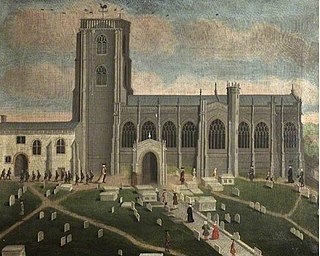
Yeovil Grammar School was a grammar school in Yeovil, Somerset, which was founded or refounded about 1860 and closed in 1906 when its only headmaster, Henry Monk, retired.