
Lorenzo di Piero de' Medici, known as Lorenzo the Magnificent, was an Italian statesman, the de facto ruler of the Florentine Republic, and the most powerful patron of Renaissance culture in Italy. Lorenzo held the balance of power within the Italic League, an alliance of states that stabilized political conditions on the Italian Peninsula for decades, and his life coincided with the mature phase of the Italian Renaissance and the golden age of Florence. As a patron, he is best known for his sponsorship of artists such as Botticelli and Michelangelo. On the foreign policy front, Lorenzo manifested a clear plan to stem the territorial ambitions of Pope Sixtus IV, in the name of the balance of the Italic League of 1454. For these reasons, Lorenzo was the subject of the Pazzi conspiracy (1478), in which his brother Giuliano was assassinated. The Peace of Lodi of 1454 that he supported among the various Italian states collapsed with his death. He is buried in the Medici Chapel in Florence.

Giorgio Vasari was an Italian Renaissance painter, architect, art historian and biographer, who is best known for his work Lives of the Most Excellent Painters, Sculptors, and Architects, considered the ideological foundation of all art-historical writing, and still much cited in modern biographies of the many Italian Renaissance artists he covers, including Leonardo da Vinci and Michelangelo, although he is now regarded as including many factual errors, especially when covering artists from before he was born.

The Pazzi were a powerful family in the Republic of Florence. Their main trade during the fifteenth century was banking. In the aftermath of the Pazzi conspiracy in 1478, members of the family were banished from Florence and their property was confiscated; the family name and coat-of-arms were permanently suppressed by order of the Signoria.
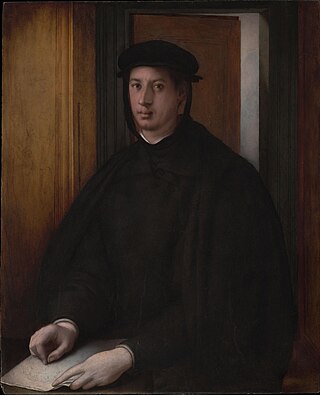
Alessandro de' Medici, nicknamed "il Moro" due to his dark complexion, Duke of Penne and the first Duke of the Florentine Republic, was ruler of Florence from 1530 to his death in 1537. The first Medici to rule Florence as a hereditary monarch, Alessandro was also the last Medici from the senior line of the family to lead the city. His assassination at the hands of distant cousin Lorenzaccio caused the title of Duke to pass to Cosimo I de Medici, from the family's junior branch.

Silvio Passerini was an Italian cardinal.

Francesco Salviati or Francesco de' Rossi was an Italian Mannerist painter who lived and worked in Florence, with periods in Bologna and Venice, ending with a long period in Rome, where he died. He is known by various names, usually the adopted one of Francesco Salviati or Il Salviati, after an early patron, but also Francesco Rossi and Cecchino del Salviati.

Giovanni Salviati was a Florentine diplomat and cardinal. He was papal legate in France, and conducted negotiations with the Emperor Charles V.
Francesco Salviati was the archbishop of Pisa from 1474 to 1478. He was one of the organisers of the Pazzi conspiracy, a plot to displace the Medici family as rulers of the Florentine Republic; he was executed after the failure of the plot.

Antonio Maria Salviati was a Florentine Roman Catholic cardinal.
The Florentine banking family of the Gondi were prominent financial partners of the Medici. Unlike the Medici, they were of the old Florentine nobility, tracing their line traditionally from the legendary Philippi, said to have been ennobled by Charlemagne himself, in 805; from him the Strozzi and the Gualfreducci also claimed their descent. With Orlando Bellicozzo, a member of the Great Council of Florence in 1197, the Gondi emerge into history, receiving their patronymic from Gondo Gondi, sitting on the Great Council in 1251, signatory to a treaty between Florence and Genoa in that year. In the fourteenth century several members of the family sat on the Great Council. Simon de Gondi renounced the Ghibelline party for himself and his house, in 1351; he loaned the Republic 8000 golden florins in a time of extremity. He held extensive lands round Valcava, in the Mugello, where the church bore the Gondi arms inside and out. Of Simon's seven children, his grandson another Simon was the first of the Gondi to hold the position of Grand Prior of the Republic, on three occasions. His daughter Maddalena, who married Giovanni Salviati, by the marriage of her daughter Maria with Giovanni dalle Bande Nere, became the grandmother of Cosimo I de' Medici; thence were descended all the Catholic crowned heads of pre-Napoleonic Europe. Carlo de Gondi was a staunch backer of Piero de' Medici, and when the Medici came to be Grand Dukes, the Gondi received empty but honorary titles of Senators.

Filippo Vincenzo Romolo Salviati was an Italian nobleman, scientist and friend of Galileo. He is remembered today mainly because he appears as one of the figures in Galileo's controversial work the Dialogue Concerning the Two Chief World Systems (1632).

Lucrezia Maria Romola de' Medici was an Italian noblewoman, the eldest daughter of Lorenzo de' Medici and Clarice Orsini and mother of Maria Salviati and Giovanni Salviati. Her portrait was considered as the baby Jesus in Our Lady of the Magnificat of Sandro Botticelli.
This is a bibliography of the history of Lyon. The history of Lyon has been deeply studied by many historians who published hundreds of books on architecture, arts, religion, etc., in Lyon throughout centuries.
Charles-Félix de Galéan (1620-1700) was a French aristocrat and Lieutenant-General. He was the first Duke of Châteauneuf-de-Gadagne.
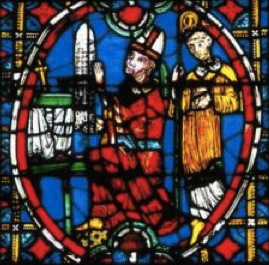
Renaud de Forez was a French churchman who was Archbishop of Lyon as Renaud II (1193–1226). A son of Count Guigues II of Forez, Renaud acted as regent of the county of Forez for his nephew, Guigues IV, between 1203 and 1218. He joined the Lyon chapter during the episcopate of Guichard of Pontigny. He became abbot of Saint-Just in 1182.

Guillaume de Gadagne was a French soldier and nobleman. He came from the Guadagni family, a rich family of bankers and businessmen from Pontassieve near Florence which had been forced out of Italy by the Medici.

Thomas II de Gadagne, known as Thomas the Magnificent was an Italian banker active in France.

The Église Notre-Dame-de-Confort was a church in the French city of Lyon, near Place des Jacobins, where a plaque marks its site.

The Incredulity of Saint Thomas is a 1543–1547 painting by Francesco Salviati. It was commissioned for the église Notre-Dame-de-Confort in Lyon by Thomas II de Gadagne, a Florentine counselor to Francis I of France. It is now held in the Louvre Museum and measures 275 cm by 234 cm. It is signed FRANCESCO SALVIATO FLO. OPUS (S.B.D.) and the apostle shown in three-quarter-profile is a self-portrait of Salviati.

The Altoviti are a prominent noble family of Florence, Italy. Since the medieval period they were one of the most distinguished banking and political families appointed to the highest offices of the Republic of Florence, friends and patrons of Galileo Galilei, Vasari, Raphael, and Michelangelo. They had a close personal relationship with the papacy. Through a predominant endogamous marriage policy they established alliances with dynasties of principal and papal nobility as the Medici, Cybo, Rospigliosi, Sacchetti, Corsini, and Aldobrandini.


