Derbyshire Wildlife Trust is one of 46 local Wildlife Trusts around the UK working to promote and protect local wildlife. It covers the whole of Derbyshire and was founded in 1962 in response to environmental threats to the local countryside, since when it has continued to grow. The trust is now based at East Mill on the River Derwent in the town of Belper, Derbyshire. It is a registered charity, supported by more than 14,000 members and over 500 volunteers.

Bishop Middleham Quarry is a disused quarry, about 4 kilometres (2.5 mi) north-west of Sedgefield, County Durham, England. Quarry-working here ceased in 1934, and the site has since been colonised by vegetation. The underlying rock is Magnesian Limestone and this has had a strong influence in determining the range of plant and animal communities now found there.
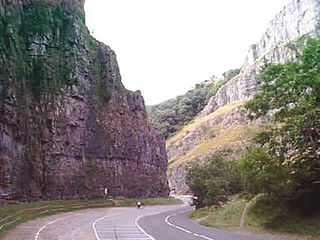
The Cheddar Complex is a 441.3-hectare (1,090-acre) biological Site of Special Scientific Interest near Cheddar around the Cheddar Gorge and north east to Charterhouse in the Mendip Hills, Somerset, England, notified in 1952.

Levitt Hagg is an abandoned hamlet in South Yorkshire, located approximately two miles southwest of Doncaster and near Conisbrough Castle. Limestone began to be quarried at the site in ancient times. Levitt Hagg was also the site, along with nearby environs in the Don Gorge, of ancient woodlands rich in yew trees. The old settlement of Levitt Hagg was removed in the 1950s.

Wotton Hill is a hill on the edge of the Cotswold Hills in Gloucestershire, England, 0.5 miles (0.80 km) north of Wotton-under-Edge. The Cotswold Way passes over the hill.
Lower Wye Gorge is a 65-hectare (160-acre) biological and geological Site of Special Scientific Interest in Gloucestershire, notified in 1954 and renotified 1987. The site includes two Gloucestershire Wildlife Trust nature reserves being Ban-y-gor Wood and Lancaut. The Natural England citation states a revision for Lancaut inclusion.

Hobbs Quarry, Longhope is a 1-hectare (2.5-acre) geological and biological Site of Special Scientific Interest in Gloucestershire, England, notified in 1966. It is situated midway between Longhope and Dursley Cross in the Forest of Dean. Adjacent woods are Kiln Wood and Coleman's Wood. The site was managed by the Gloucestershire Wildlife Trust. Ownership changed to an independent Charitable Trust - Hobbs Nature Reserve Trust - on 1 August 2023. The Management Plan is similar to the one GWT had agreed with Natural England, combining conservation and research work on the geological exposures and preservation of the valuable natural environment. An explanatory website is under development to aid any groups planning educational visits. Local specialists are available to assist with these if required.
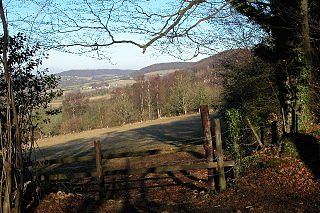
Bull Cross, The Frith and Juniper Hill is a 42.33-hectare (104.6-acre) biological and geological Site of Special Scientific Interest in Gloucestershire, notified in 1954. The site is listed in the ‘Stroud District’ Local Plan, adopted November 2005, Appendix 6 as an SSSI and Regionally Important Geological Site (RIGS).

Crickley Hill and Barrow Wake is a 56.8-hectare (140-acre) biological and geological Site of Special Scientific Interest in Gloucestershire, notified in 1974.
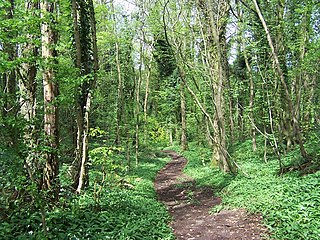
Shorn Cliff And Caswell Woods is a 69.2-hectare (171-acre) biological Site of Special Scientific Interest in Gloucestershire, notified in 1986. The site is listed in the 'Forest of Dean Local Plan Review' as a Key Wildlife Site (KWS).

Quarry Moor is a Site of Special Scientific Interest, or SSSI, at the south edge of Ripon, North Yorkshire, England, and adjacent to the A61 road. It contains an outcrop of Magnesian Limestone, exposed by former quarrying. 255 million years ago this limestone was the peripheral sediment of a tropical sea. The land was donated in 1945 to the people of Ripon by the town's mayor, Alderman Thomas Fowler Spence, a varnish manufacturer. The land was notified as an SSSI in 1986 because its calcareous grassland supported a large diversity of plant species. The site features a Schedule 8 protected plant, thistle broomrape. The land is protected as a nature reserve, and it is also managed as a recreational area. Therefore, its calcareous grass area is fenced off for protection and study, but it also contains a car park, information signs, a children's play area, accessible paths, benches, and dog waste bins.

Mar Field Fen is a Site of Special Scientific Interest, or SSSI, north of Masham, North Yorkshire, England, in a rural area known as Marfield. It is situated on land containing woodland carr, fen, spring-fed marshy grassland and drier calcareous grassland, between the River Ure to the east and Marfield Wetland nature reserve to the west. As "one of the best examples of fen habitat in the Vale of York," it is a protected habitat for a variety of plants, including the common butterwort, a carnivorous plant. There is no public access to this site.

Ripon Parks is a Site of Special Scientific Interest, or SSSI, situated north of Ripon, to the west of the River Ure and to the east of the village of North Stainley, in North Yorkshire, England. It was once part of the land held since the Middle Ages as a deer park by the archbishops of York and the canons of Ripon. The site was designated as an SSSI in 1983, because its varied habitats are valued for their breeding birds, amphibians and varied flora. The woods here are "of note" for the parasitic flowers of common toothwort and yellow star-of-Bethlehem. A small part of the site is accessible via public footpaths; there are no public facilities or dedicated car parks. The site incorporates the High Batts Nature Reserve, which is privately run for training, recording and educational purposes, and accessible to members only, except for its annual open day. Ripon Parks is now owned by the Ministry of Defence, and parts of the site are used as military training areas.

The Wye Valley is the limestone valley of the River Wye in the White Peak of Derbyshire, England. The source of the River Wye is west of Buxton on Axe Edge Moor. One main channel runs underground through Poole's Cavern. The river flows though Buxton Pavilion Gardens and then along a culvert under the town centre. After leaving the flat area of central Buxton, the Wye Valley becomes distinct as a gorge running east for 10 miles (16 km) before the valley broadens at Ashford-in-the Water.
Farleton Knott is a Site of Special Scientific Interest (SSSI) in Cumbria, England. It is located 6km west of Kirkby Lonsdale, near Farleton. This protected area includes an exceptional limestone pavement on the top of a hill called Farleton Fell. Farleton Knott SSSI includes within its boundary Newbiggin Crags, Holme Park Fell and a National Nature Reserve called Clawthorpe Fell.

Eaves Wood is a Site of Special Scientific Interest (SSSI) within the Arnside and Silverdale National Landscape in Lancashire, England. It is located 1 km north of Silverdale. This protected area includes King Williams Hill where there is a monument marking the Golden Jubilee of Queen Victoria's accession to the throne, known as the 'Pepperpot'. This woodland is protected because of the plant species found there and because the red squirrel is found in this woodland.

Tick Wood and Benthall Edge is a Site of Special Scientific Interest (SSSI) in Shropshire, England. This protected area is located on the opposite side of the River Severn from Ironbridge and extends west towards the village of Wyke. This extent of woodland is protected because of the diversity of plant species that reflects some of the variation in underlying geology.
Jack Scout is a Site of Special Scientific Interest (SSSI) within Arnside and Silverdale National Landscape in Lancashire, England. This protected area is located 2km southwest of Silverdale and it borders the much larger protected area called Morecombe Bay SSSI. This protected area has exceptional calcareous grassland important for its plant diversity. This protected area has a small area of limestone pavement.
Yarncliff Wood, Padley is a Site of Special Scientific Interest (SSSI) within Peak District National Park in Derbyshire, England. It is located 200m from Nether Padley or 200m from Grindleford Railway Station. This protected area contains a woodland community that once covered much of the edges of upland areas of the Peak District, but is now largely restricted to steep sided valleys. This protected area includes a section of the valley of a stream called Burbage Brook encompassing Padley Gorge.
Dove Valley and Biggin Dale is a Site of Special Scientific Interest (SSSI) within Peak District National Park, and contains land in both Derbyshire and Staffordshire, England. It is located 4km north of the town of Ashbourne and encompasses the valley of the River Dove, where it flows through the parish of Eaton and Alsop, past Milldale, towards the village of Thorpe. This valley has exceptional plant and insect diversity including species that live on limestone outcrops or on scree landforms.
