Related Research Articles

Mulk Raj Anand was an Indian writer in English, recognised for his depiction of the lives of the poorer class in the traditional Indian society. One of the pioneers of Indo-Anglian fiction, he, together with R. K. Narayan, Ahmad Ali and Raja Rao, was one of the first India-based writers in English to gain an International readership. Anand is admired for his novels and short stories, which have acquired the status of classics of modern Indian English literature; they are noted for their perceptive insight into the lives of the oppressed and for their analysis of impoverishment, exploitation and misfortune. He became known for his protest novel Untouchable (1935), which was followed by other works on the Indian poor such as Coolie (1936) and Two Leaves and a Bud (1937). He is also noted for being among the first writers to incorporate Punjabi and Hindustani idioms into English, and was a recipient of the civilian honour of the Padma Bhushan, the third-highest civilian award in the Republic of India.

Sunil Gangopadhyay or Sunil Ganguly was an Indian poet, novelist, short story writer, and critic in the Bengali language. He was one of the foremost poets experimenting with new forms, themes, rhythms, and words in Bengali poetry in the 1950s and 1960s. In 1953, along with Deepak Majumder and Ananda Bagchi, he founded the Bengali poetry magazine, Krittibas. He is regarded as one of the most prolific and popular writers in Bengali since Rabindranath Tagore.
Indian poetry and Indian literature in general, has a long history dating back to Vedic times. They were written in various Indian languages such as Vedic Sanskrit, Classical Sanskrit, Ancient Meitei, Modern Meitei, Telugu, Tamil, Odia, Maithili, Kannada, Bengali, Assamese, Hindi, Marathi and Urdu among other prominent languages. Poetry in foreign languages such as English also has a strong influence on Indian poetry. The poetry reflects diverse spiritual traditions within India. In particular, many Indian poets have been inspired by mystical experiences. Poetry is the oldest form of literature and has a rich written and oral tradition.

Amitav Ghosh is an Indian writer. He won the 54th Jnanpith award in 2018, India's highest literary honour. Ghosh's ambitious novels use complex narrative strategies to probe the nature of national and personal identity, particularly of the people of India and South Asia. He has written historical fiction and non-fiction works discussing topics such as colonialism and climate change.
Anita Desai is an Indian novelist and Emerita John E. Burchard Professor of Humanities at the Massachusetts Institute of Technology. She has been shortlisted for the Booker Prize three times. She received the Sahitya Akademi Award in 1978 for her novel Fire on the Mountain, from the Sahitya Akademi, India's National Academy of Literature. She won the Guardian Prize for The Village by the Sea (1983). Her other works include The Peacock, Voices in the City, Fire on the Mountain and an anthology of short stories, Games at Twilight. She is on the advisory board of the Lalit Kala Akademi and a Fellow of the Royal Society of Literature, London. Since 2020 she has been a Companion of Literature.

Rabindra Sangeet, also known as Tagore Songs, are songs from the Indian subcontinent written and composed by the Bengali polymath Rabindranath Tagore, winner of the 1913 Nobel Prize in Literature, the first Indian and also the first non-European to receive such recognition. Tagore was a prolific composer with approximately 2,232 songs to his credit. The songs have distinctive characteristics in the music of Bengal, popular in India and Bangladesh.

Manik Bandyopadhyay [alias Banerjee] is an Indian author regarded as one of the major figures of 20th century Bengali literature. During a lifespan of 48 years and 28 years of literary career, battling with epilepsy from the age of around 28 and financial strains all along, he produced some masterpieces of novels and short stories, besides some poems, essays etc. One of the early neo-realist film shot in Pakistan, The Day Shall Dawn is based on his story.

Sarat Chandra Chattopadhyay, was a Bengali novelist and short story writer of the early 20th century. He generally wrote about the lives of Bengali family and society in cities and villages. However, his keen powers of observation, great sympathy for fellow human beings, a deep understanding of human psychology, an easy and natural writing style, and freedom from political biases and social prejudices enable his writing to transcend barriers and appeal to all Indians. He remains the most popular, translated, and adapted Indian author of all time.

Bibhutibhushan Bandyopadhyay was an Indian writer in the Bengali language. His best known works are the autobiographical novel Pather Panchali, Aparajito (Undefeated), Chander Pahar and Aranyak.

The Bengal Renaissance, also known as the Bengali Renaissance, was a cultural, social, intellectual, and artistic movement that took place in the Bengal region of the British Raj, from the late 18th century to the early 20th century. Historians have traced the beginnings of the movement to the victory of the British East India Company at the 1757 Battle of Plassey, as well as the works of reformer Raja Rammohan Roy, considered the "Father of the Indian Renaissance," born in 1772. Nitish Sengupta stated that the movement "can be said to have … ended with Rabindranath Tagore," Asia's first Nobel laureate.
Indian English literature (IEL), also referred to as Indian Writing in English (IWE), is the body of work by writers in India who write in the English language but whose native or co-native language could be one of the numerous languages of India. Its early history began with the works of Henry Louis Vivian Derozio and Michael Madhusudan Dutt followed by Rabindranath Tagore and Sri Aurobindo. R. K. Narayan, Mulk Raj Anand and Raja Rao contributed to the growth and popularity of Indian English fiction in the 1930s. It is also associated, in some cases, with the works of members of the Indian diaspora who subsequently compose works in English.
Bengali literature denotes the body of writings in the Bengali language and which covers Old Bengali, Middle Bengali and Modern Bengali with the changes through the passage of time and dynastic patronization or non-patronization. Bengali has developed over the course of roughly 1,400 years. If the emergence of the Bengali literature supposes to date back to roughly 650 AD, the development of Bengali literature claims to be 1600 years old. The earliest extant work in Bengali literature is the Charyapada, a collection of Buddhist mystic songs in Old Bengali dating back to the 10th and 11th centuries. The timeline of Bengali literature is divided into three periods: ancient (650–1200), medieval (1200–1800) and modern. Medieval Bengali literature consists of various poetic genres, including Hindu religious scriptures, Islamic epics, Vaishnava texts, translations of Arabic, Persian and Sanskrit texts, and secular texts by Muslim poets. Novels were introduced in the mid-19th century. Nobel laureate Rabindranath Tagore is the best known figure of Bengali literature to the world. Kazi Nazrul Islam, notable for his activism and anti-British literature, was described as the Rebel Poet and is now recognised as the National poet of Bangladesh.

Mannu Bhandari was an Indian author, screenplay writer, teacher, and playwright. Primarily known for her two Hindi novels, Aap Ka Bunty and Mahabhoj (Feast), Bhandari also wrote over 150 short stories, several other novels, screenplays for television and film, and adaptations for theater. She was a pioneer of the Nayi Kahani movement in Hindi literature, which focused on the aspirations of the emerging Indian middle class, and her own work is notable for its depiction of the inner lives of middle class working and educated women. Her work tackles themes of family, relationships, gender equality, and caste discrimination in India.

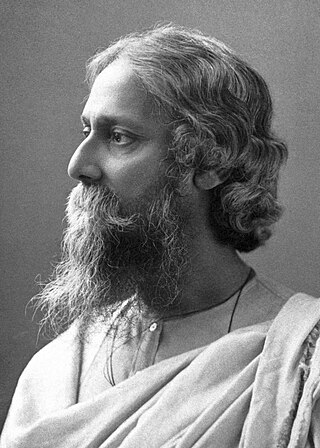
Rabindranath Thakur was an Indian polymath who worked as a poet, writer, playwright, composer, philosopher, social reformer, and painter of the Bengal Renaissance. He reshaped Bengali literature and music as well as Indian art with Contextual Modernism in the late 19th and early 20th centuries. Author of the "profoundly sensitive, fresh and beautiful" poetry of Gitanjali. In 1913, Tagore became the first non-European (non-White) and the first Asian to win a Nobel Prize in any category, and also the first lyricist to win the Nobel Prize in Literature. Tagore's poetic songs were viewed as spiritual and mercurial; where his elegant prose and magical poetry were widely popular in the Indian subcontinent. He was a fellow of the Royal Asiatic Society. Referred to as "the Bard of Bengal", Tagore was known by the sobriquets Gurudeb, Kobiguru, and Biswokobi.
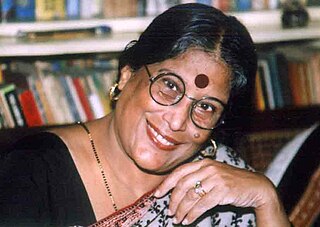
Nabaneeta Dev Sen was an Indian writer and academic. After studying arts and comparative literature, she moved to the US where she studied further. She returned to India and taught at several universities and institutes as well as serving in various positions in literary institutes. She published more than 80 books in Bengali: poetry, novels, short stories, plays, literary criticism, personal essays, travelogues, humour writing, translations and children's literature. She was awarded the Padma Shri in 2000 and the Sahitya Akademi Award in 1999.
Nabendu Ghosh was an Indian author in Bengali literature, and screenwriter. He has written screenplays of classic Bollywood movies like, Sujata, Bandini, Devdas, Majhli Didi, Abhimaan and Teesri Kasam. He has written stories for movies like Baap Beti, Shatranj, Raja Jani. He has also acted briefly in Do Bigha Zameen, Teesri Kasam and Lukochuri. Later in his career, he directed four movies as well.
Shiv K. Kumar was an Indian English-language poet, playwright, novelist, and short story writer. His grandfather late Tulsi Das Kumar was a school teacher and his father Bishan Das Kumar, was a retired headmaster. The letter 'K' stands for Krishna, i.e. Shiv Krishna Kumar.

Santosh Kumar Ghosh was an Indian Bengali litterateur and a journalist of repute.

Ramapada Chowdhury was a Bengali-language novelist and short story writer in India. For his novel Bari Badle Jay, he received the Sahitya Akademi Award in 1988. He was also a recipient of the Rabindra Puraskar and several other awards. He won the Rabindranath Tagore Memorial International Prize in its inaugural year. Many of his works have been adapted into films, including the multiple-award-winning Kharij, directed by Mrinal Sen, and Ek Doctor Ki Maut, directed by Tapan Sinha. Chowdhury started writing during the Second World War. He was associated with Anandabazar Patrika for many years, and edited its Sunday supplement. His novels are marked by an economy of expression. He is one of the most well known short story writers in contemporary Bengali literature.

Shesh Namaskar is a 1971, Indian, Bengali-language novel that was written by Santosh Kumar Ghosh. The novel, which is considered to be its author's magnum opus, is written in the form of a series of letters from a son to his deceased mother. It won the Sahitya Akademi Award in 1972.
References

- 1 2 Das, Sisir Kumar. A History of Indian Literature. 2. . New Delhi: Sahitya Akademi, 1995. p. 757
- ↑ Sanyal, Ashis. Contribution of Bengali Writers to National Freedom Movement . Calcutta: Model Publ. House, 1989. p. 161
- ↑ Chattopadhyay, Suchorita, and Debalina Sen. Tapestry: An Anthology of 20th Century Indian Short Stories . Kolkata: DSA Publication, Dept. of Comparative Literature, Jadavpur University, 2004. p. 145
- ↑ Ghosh, G. K. Language, Literature and National Integration . New Delhi: Ashish Pub. House, 1995. p. 108