
Look up toroidal in Wiktionary, the free dictionary.
Toroidal describes something which resembles or relates to a torus or toroid:
Toroidal describes something which resembles or relates to a torus or toroid:

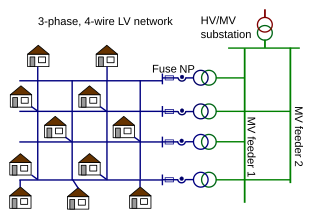
A grid network is a computer network consisting of a number of computer systems connected in a grid topology.
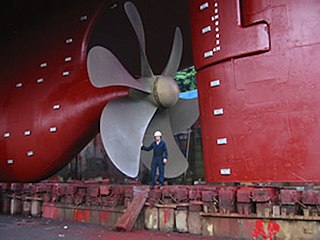
A propeller is a device with a rotating hub and radiating blades that are set at a pitch to form a helical spiral which, when rotated, exerts linear thrust upon a working fluid such as water or air. Propellers are used to pump fluid through a pipe or duct, or to create thrust to propel a boat through water or an aircraft through air. The blades are shaped so that their rotational motion through the fluid causes a pressure difference between the two surfaces of the blade by Bernoulli's principle which exerts force on the fluid. Most marine propellers are screw propellers with helical blades rotating on a propeller shaft with an approximately horizontal axis.
Ring may refer to:

In mathematics, genus has a few different, but closely related, meanings. Intuitively, the genus is the number of "holes" of a surface. A sphere has genus 0, while a torus has genus 1.
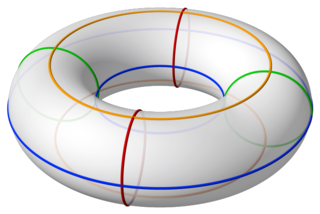
In geometry, a torus is a surface of revolution generated by revolving a circle in three-dimensional space one full revolution about an axis that is coplanar with the circle. The main types of toruses include ring toruses, horn toruses, and spindle toruses. A ring torus is sometimes colloquially referred to as a donut or doughnut.

In fluid dynamics, a vortex is a region in a fluid in which the flow revolves around an axis line, which may be straight or curved. Vortices form in stirred fluids, and may be observed in smoke rings, whirlpools in the wake of a boat, and the winds surrounding a tropical cyclone, tornado or dust devil.

A vortex ring, also called a toroidal vortex, is a torus-shaped vortex in a fluid; that is, a region where the fluid mostly spins around an imaginary axis line that forms a closed loop. The dominant flow in a vortex ring is said to be toroidal, more precisely poloidal.
A toroidal mirror is a reflector whose surface is a section of a torus, defined by two radii of curvature. Such reflectors are easier to manufacture than mirrors with a surface described by a paraboloid or ellipsoid. They suffer from spherical aberration and coma, but do not suffer from astigmatism like a spherical mirror when used in an off-axis geometry, provided the angle of incidence is matched to the design angle. Because they are easier to manufacture, they are much cheaper than ellipsoidal or paraboloidal mirrors for the same surface quality.
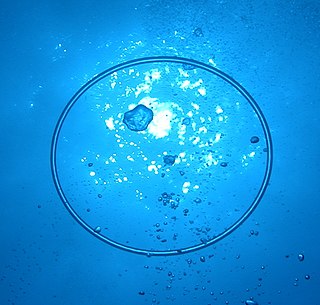
A bubble ring, or toroidal bubble, is an underwater vortex ring where an air bubble occupies the core of the vortex, forming a ring shape. The ring of air as well as the nearby water spins poloidally as it travels through the water, much like a flexible bracelet might spin when it is rolled on to a person's arm. The faster the bubble ring spins, the more stable it becomes. The physics of vortex rings are still under active study in fluid dynamics. Devices have been invented which generate bubble vortex rings.

The duocylinder, also called the double cylinder or the bidisc, is a geometric object embedded in 4-dimensional Euclidean space, defined as the Cartesian product of two disks of respective radii r1 and r2:
A vortex is a dynamic phenomenon of fluids.
A swing-piston engine is a type of internal combustion engine in which the pistons move in a circular motion inside a ring-shaped "cylinder", moving closer and further from each other to provide compression and expansion. Generally two sets of pistons are used, geared to move in a fixed relationship as they rotate around the cylinder. In some versions the pistons oscillate around a fixed center, as opposed to rotating around the entire engine. The design has also been referred to as a oscillating piston engine, vibratory engine when the pistons oscillate instead of rotate, or toroidal engine based on the shape of the "cylinder".
Trisops was an experimental machine for the study of magnetic confinement of plasmas with the ultimate goal of producing fusion power. The configuration was a variation of a compact toroid, a toroidal (doughnut-shaped) structure of plasma and magnetic fields with no electromagnetic coils or electrodes penetrating the center. It lost funding in its original form in 1978.

The terms toroidal and poloidal refer to directions relative to a torus of reference. They describe a three-dimensional coordinate system in which the poloidal direction follows a small circular ring around the surface, while the toroidal direction follows a large circular ring around the torus, encircling the central void.
A torus, pl. tori, is a type of surface.

In mathematics, a toroid is a surface of revolution with a hole in the middle. The axis of revolution passes through the hole and so does not intersect the surface. For example, when a rectangle is rotated around an axis parallel to one of its edges, then a hollow rectangle-section ring is produced. If the revolved figure is a circle, then the object is called a torus.

Toroidal inductors and transformers are inductors and transformers which use magnetic cores with a toroidal shape. They are passive electronic components, consisting of a circular ring or donut shaped magnetic core of ferromagnetic material such as laminated iron, iron powder, or ferrite, around which wire is wound.

The Compact Toroidal Hybrid (CTH) is an experimental device at Auburn University that uses magnetic fields to confine high-temperature plasmas. CTH is a torsatron type of stellarator with an external, continuously wound helical coil that generates the bulk of the magnetic field for containing a plasma.

A toroidal planet is a hypothetical type of telluric exoplanet with a toroidal or doughnut shape. While no firm theoretical understanding as to how toroidal planets could form naturally is necessarily known, the shape itself is potentially quasistable, and is analogous to the physical parameters of a speculatively constructible megastructure in self-suspension, such as a Dyson Ring, ringworld, Stanford torus or Bishop Ring.
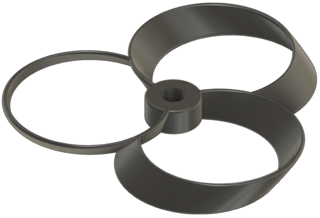
A toroidal propeller is a type of propeller that is ring-shaped with each blade forming a closed loop. The propellers are significantly quieter at audible frequency ranges where humans are not susceptible to sensitivity, between 20 Hz and 20 kHz, while generating comparable thrust to traditional propellers. In practice, toroidal propellers reduce noise pollution in both aviation and maritime transport.