Torre di Roncisvalle

Last updated
Torre di Roncisvalle
Torre di Roncisvalle.jpg
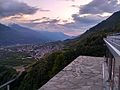
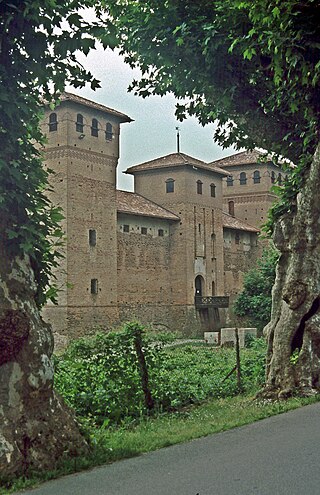
View from the entrance to the tower of Roncisvalle of Castionetto di Chiuro
Location Chiuro
Lombardy
Northern Italy
Coordinates 46°10′53.56″N10°0′0.17″E / 46.1815444°N 10.0000472°E / 46.1815444; 10.0000472 Coordinates: 46°10′53.56″N10°0′0.17″E / 46.1815444°N 10.0000472°E / 46.1815444; 10.0000472
Height15 metres (49 ft)
OwnerMunicipal ownership
Italy provincial location map 2016.svg
Red pog.svg
Location of the Torre di Roncisvalle

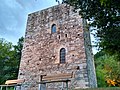
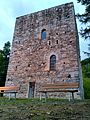
Torre di Roncisvalle is a tower overlooking Valtellina at an altitude of 689 metres, located in the Castionetto district of Chiuro, in the province of Sondrio, northern Italy. The massive tower offers an effective lookout point even today.

Contents

Early history

The building is said to have belonged to Stefano Quadrio and is known as the Castionetto or Roncisvalle tower, the latter evoking the legendary route of Roncesvalles in Navarre, Spain.

The tower is mentioned in notarial deeds in the Middle Ages, one such document, drawn up in 1460, states a sale by Maria Maffina to Andrea Maffina, and the property comprised: a vineyard, fields, woodlands, shed, threshing barn, stable with hayloft, indoor kitchen with hearth, two courtyards, and right of way, located in the Castionetto district "ubi dictor ad dossum majorem seu ad Ronzivallem". [1] ["known as Dosso Maggiore, and near to Roncisvalle"].

The Italian philologist, semiotician and literary critic Cesare Segre attributes the name Roncisvalle to "roscida valle", meaning a damp valley, and to "roscidare", meaning to irrigate, but also to "ronco", "runchet" from "runcare", to till a ground for planting new vines.

The stylized map shows the historical names of the paths that departed from the tower Torre di Roncisvalle cartina sentieri storici.png
The stylized map shows the historical names of the paths that departed from the tower

The square-plan tower is eleven metres in length and width, and fifteen metres high, and far more imposing than those surviving at Teglio, Castello dell'Acqua, the two towers that are part of the respective Grumello castles, the Mancapane tower above Montagna, the two Castel Masegra towers, the Santa Maria di Tirano castle tower, and the Bellaguarda castle tower at Tovo di Sant'Agata. Given the sturdiness of the structure, with walls as thick as two and a half metres at the base, the tower must certainly have played a defensive as well as an observation role. Indeed, in 1487, defended by Zenone Groppello, the tower served as a precious bulwark against the invasion attempted by Grisons. The tower was restored in more recent times, after centuries of neglect, and reopened to the public in May 2003.

Tower Design

The design aspects of the tower are significant, imitating forms of construction inspired by Lombard architectural traditions, highlighted by the materials used and by the quality of the details, like the ogival windows outlined with close-set ashlars. The façades have a uniform appearance thanks to the building method of standardized measures and materials, clearly seen in the stone courses and the cornerstones with characteristic bosses. The opening on the first floor was originally the entrance, accessed by a drawbridge operated from a niche above it. Today's entrance corresponds to an earlier opening. The ground floor and the first floor are barrel vaulted and a stone staircase leads up to the second floor.

No known documents establish the tower's construction period, although scholars agree that it can be dated thirteenth–fifteenth century, the period of greatest prosperity for the Quadrio family, settled down at Chiuro at the time.

The Quadrios were originally from Como, and left the city in the twelfth century, because of the Guelph–Ghibelline feuds. From the end of the 1300s to the first half of the 1400s, the military captain Stefano Quadrio led the village of Chiuro into a thriving economic and political period. Stefano owned a castle in Sazzo, a district of Ponte in Valtellina, but in what is now Via Torre there are the remains of his fortified mansion, built "ad Visnatem" [the Vicinate quarter, later Canterana or Cantarana – a compound of "cantare" and "rana" referring to the frogs that chirped in the canals whose water supplied blacksmiths]. Chiuro was dotted with towers whose lower sections are visible in later buildings erected on them.

In his Castelli e Torri Valtellinesi [Castles and Towers of Valtellina], Egidio Pedrotti writes that Zenone Gropello – a Sforza family military commander – used the tower and the Chiuro fortifications as a base, following the first Grisons attack of Valtellina, in 1486–7. [2]

It is likely that during Grisons rule, the Castionetto tower suffered the same fate as the fortifications in the province of Sondrio since the invaders reinforced their control by neutralizing the military features of occupied territories.

n a document dated 1622, kept in the Chiuro archives, the tower is listed as the property of the religious order "Scuola del Rosario", which owned the building and surrounding land until the early 1800s, when it became the property of the "Scuola del SS. Sacramento". [3]

By the first half of the nineteenth century, the Lombardy–Veneto land registers listed the lands as the property of the municipality of Chiuro. [4] In 1885, the Lavizzari title deed states that the land and the tower had been expropriated and had become municipal property [5]

Modern Period

Subsequently the tower fell into neglect although it lost none of its monumental character. [6] Restoration work carried out in the early 2000s, funded under Law No 102/90 (better known as the Valtellina Act), restored the tower to public use and ensured its preservation as a monument. [7] [8] [9]

Tower of roncesvalles in Castionetto di Chiuro Sondrio Italy Torre di Roncisvalle Castionetto di Chiuro.jpg
Tower of roncesvalles in Castionetto di Chiuro Sondrio Italy

Related Research Articles

<span class="mw-page-title-main">Grisons</span> Largest and easternmost canton of Switzerland

The Grisons or Graubünden, more formally the Canton of the Grisons or the Canton of Graubünden, is one of the twenty-six cantons of Switzerland. It has eleven regions, and its capital is Chur. The German name of the canton, Graubünden, translates as the "Grey Leagues", referring to the canton's origin in three local alliances, the Three Leagues. The other native names also refer to the Grey League: Grischùn in Sutsilvan, Grischun in the other forms of Romansh, and Grigioni in Italian. Rhaetia is the Latin name for the area. The Alpine ibex is the canton's heraldic symbol.

<span class="mw-page-title-main">Sondrio</span> City in Lombardy, Italy

Sondrio is an Italian city and comune and Provincial Capital located in the heart of the Valtellina. As of 2012, Sondrio counts approximately 21,876 inhabitants (2015) and it is the administrative centre for the province of Sondrio. In 2007, Sondrio was given the Alpine Town of the Year award.

<span class="mw-page-title-main">San Gimignano</span> Comune in Tuscany, Italy

San Gimignano is a small walled medieval hill town in the province of Siena, Tuscany, north-central Italy. Known as the Town of Fine Towers, San Gimignano is famous for its medieval architecture, unique in the preservation of about a dozen of its tower houses, which, with its hilltop setting and encircling walls, form "an unforgettable skyline". Within the walls, the well-preserved buildings include notable examples of both Romanesque and Gothic architecture, with outstanding examples of secular buildings as well as churches. The Palazzo Comunale, the Collegiate Church and Church of Sant' Agostino contain frescos, including cycles dating from the 14th and 15th centuries. The "Historic Centre of San Gimignano" is a UNESCO World Heritage Site. The town also is known for saffron, the Golden Ham, pecorino cheese and its white wine, Vernaccia di San Gimignano, produced from the ancient variety of Vernaccia grape which is grown on the sandstone hillsides of the area.
<span class="mw-page-title-main">Salò</span> Comune in Lombardy, Italy

Salò is a town and comune in the Province of Brescia in the region of Lombardy on the banks of Lake Garda, on which it has the longest promenade. The city was the seat of government of the Italian Social Republic from 1943 to 1945, with the ISR often being referred to as the "Salò Republic".

<span class="mw-page-title-main">Colico</span> Comune in Lombardy, Italy

Colico is a city in the province of Lecco, Lombardy, Italy. It is situated on the northern arm of Lake Como, where the river Adda enters the lake. Colico is the most important city in the northern part of Lake Como, which is often identified as its Colico branch.

Mazzo di Valtellina is a comune (municipality) in the Province of Sondrio in Lombardy, about 120 kilometres (75 mi) northeast of Milan.

<span class="mw-page-title-main">Verrès Castle</span> 14th-century castle in Verrès, Aosta Valley, Italy

Verrès Castle is a fortified 14th-century castle in Verrès, in the lower Aosta Valley, in north-western Italy. It has been called one of the most impressive buildings from the Middle Ages in the area. Built as a military fortress by Yblet de Challant in the fourteenth century, it was one of the first examples of a castle constructed as a single structure rather than as a series of buildings enclosed in a circuit wall.
The castle stands on a rocky promontory on the opposite side of the Dora Baltea from Issogne Castle. The castle dominates the town of Verrès and the access to the Val d'Ayas. From the outside it looks like an austere cube, thirty metres long on each side and practically free of decorative elements.

<span class="mw-page-title-main">Montepescali</span> Frazione in Tuscany, Italy

Montepescali is a small town in southern Tuscany, Italy, a frazione of the comune of Grosseto. The site, from which the scenic panorama of the coastal strip and the Tuscan Archipelago up to Corsica can be seen, is also known as "Terrace or balcony of the Maremma".

<span class="mw-page-title-main">Batignano</span> Frazione in Tuscany, Italy

Batignano is a small town in southern Tuscany, a frazione of the comune of Grosseto, positioned at about 10 km north-east of the capital on one of the last foot-hills of the valley of Ombrone which dominated the ancient city of Roselle.

<span class="mw-page-title-main">Rocca Borromeo di Angera</span> Building in Angera, Italy

The Rocca Borromeo di Angera, or Rocca d'Angera, also called Borromeo Castle, is a rocca on a hilltop above the town of Angera in the Province of Varese on the southern shores of Lago Maggiore. It has medieval origins and initially belonged to the Milanese archbishop. It passed then to the Visconti of Milan and later to the Borromeos, who are still the owners.

<span class="mw-page-title-main">Ravi, Gavorrano</span> Frazione in Tuscany, Italy

Ravi is a village in Tuscany, central Italy, administratively a frazione of the comune of Gavorrano, province of Grosseto. At the time of the 2001 census its population amounted to 263.

<span class="mw-page-title-main">Visconti Castle (Pandino)</span>

The Visconti Castle in Pandino is a 14th-century castle located in the center of the town of Pandino, province of Cremona, region of Lombardy, Italy. It was built by Bernabò Visconti and his wife, Beatrice Regina della Scala, between 1355 and 1361. Today it essentially retains its original forms.

<span class="mw-page-title-main">Palazzo Salis</span>

The Palazzo Salis is situated in the heart of the historic centre of Tirano, a small town in the valley Valtellina in the north of Italy. The building got constructed during the second half of the 17th century by the noble family von Salis-Zizers, a branch of the important and well known grison family von Salis.

<span class="mw-page-title-main">Rock Engraving Park of Grosio</span>

The Rock Engraving Park is an Archaeological Park situated in Grosio and Grosotto, two villages in the valley Valtellina in Lombardy, northern Italy. The park was founded in 1978 to conserve, study and develop the Cultural Heritage on the Dosso dei Castelli.

<span class="mw-page-title-main">Museo Etnografico Tiranese</span>

The Museo Etnografico Tiranese (MET) is an ethnographic museum in Tirano, a town in the valley of Valtellina in the Lombardy region. It was founded in 1973 thanks to the "Centro Iniziativa Giovanile (C.I.G.)" with the aim to document peasant life and culture of the mountain region of the Valtellina. The "Centro Iniziativa Giovanile" run the museum until the end of the year 2017, since then the municipality of Tirano took responsibility for the continuation and development of the museum.

<span class="mw-page-title-main">Castelvecchio (Castel Goffredo)</span>

Castelvecchio is the ancient fortified village of Castel Goffredo, in the province of Mantua Lombardy region in Italy, surrounded by walls and a moat. The boundaries currently correspond to the garden of the Palazzo Gonzaga-Acerbi to the north, to vicolo Remoto and vicolo Cannone to the east, to Piazza Mazzini to the south and to piazzetta Castelvecchio and vicolo Castelvecchio to the west.

<span class="mw-page-title-main">Visconti Castle (Fagnano Olona)</span>

The Visconti Castle of Fagnano is a castle located in Fagnano Olona, Lombardy, northern Italy. It lies at the border between the town of Fagnano and the Olona valley.
<span class="mw-page-title-main">Visconti Castle (Cherasco)</span> Castle in northern Italy

The Visconti Castle of Cherasco is a medieval castle in Cherasco, Piedmont, Northern Italy. It was built in the 14th century by Luchino Visconti, Lord of Milan, and partly reconstructed at the beginning of the 20th century.

<span class="mw-page-title-main">Visconti Castle (Vogogna)</span> Castle in northern Italy

The Visconti Castle of Vogogna is a medieval stone-made castle in Vogogna, Piedmont, Northern Italy. It was built in the 14th century by the Visconti, lords and dukes of Milan.

References

  1. Medievale deed 1460
  2. Pedrotti, Egidio (1957). Castelli E Torri Valtellinesi. Milano: A. Giuffrè.
  3. Document dated 1622 from Castionetto di Chiuro's parish archive
  4. Lombard's cadastre
  5. Lavizzari's deed. 1885.
  6. Bombardieri, Armida; Della Ferrera, Tarcisio (1990). Censimento dei beni culturali, Quaderni della Provincia n.9. Sondrio: Amministrazione Provinciale di Sondrio.
  7. Porta, Laura (1982). Tesi di laurea: Aspetti dell'economia fra Trecento e Quattrocento: Gaudenzio e Stefano Quadrio. Milan: Università degli studi di Milano.
  8. Monforte, Franco; Schiappadini, Ellida (1989). Chiuro. Chiuro: Amministrazione Comunale di Chiuro.
  9. Corbellini, Augusta (2011). Una carta imperfetta: conferme e precisazioni su Stefano Quadrio e i suoi discendenti. Chiuro: Amministrazione Comunale di Chiuro.