

Totnes Signal Box is a Grade II listed former Great Western Railway signal box, located on Totnes railway station. It presently functions as a cafe.
Totnes Signal Box is a Grade II listed former Great Western Railway signal box, located on Totnes railway station. It presently functions as a cafe.
The signals at Totnes railway station were initially controlled by "policemen" who walked to each signal to change it. In 1894 they were controlled from a wooden signal box at the west end of the westbound platform.
In 1923 the current structure was built to the standard blue brick-built GWR design, located towards the opposite end of the eastbound platform. From 17 December 1973 under British Railways it was downgraded to a "fringe box" to the Panel Signal Box at Plymouth railway station, when the signal boxes at Brent and other intermediate locations were closed. The signal box was closed on 9 November 1987, when new multiple-aspect signals were brought into use, controlled from the new signalling centre at Exeter. [1]
Now used as a café, it was one of 26 "highly distinctive" signal boxes listed by Ed Davey, minister for the Department for Culture, Media and Sport in July 2013, in a joint initiative by English Heritage and Network Rail to preserve and provide a window into how railways were operated in the past. [2] [3]

Canterbury East railway station is on the Dover branch of the Chatham Main Line in England, and is one of two stations serving the city of Canterbury, Kent.
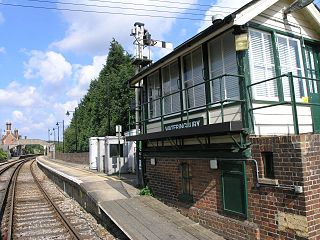
Wateringbury railway station is on the Medway Valley Line in Kent, England, serving the villages of Wateringbury and Nettlestead. It is 39 miles 77 chains (64.3 km) down the line from London Charing Cross via Paddock Wood and is situated between Yalding and East Farleigh. The station and all trains that call are operated by Southeastern.

Trimley railway station is on the Felixstowe Branch Line in the east of England, serving the village of Trimley St. Mary, Suffolk. It is 14 miles 5 chains (22.6 km) down the line from Ipswich and 82 miles 64 chains (133.3 km) measured from London Liverpool Street; it is situated between Derby Road and Felixstowe. Its three-letter station code is TRM.

Newton Abbot railway station serves the market town of Newton Abbot in Devon, England. It is 214 miles 5 chains (345 km) from London Paddington. The station today is managed by Great Western Railway, who provide train services along with CrossCountry.

Totnes railway station serves the town of Totnes in Devon, England. It was opened by the South Devon Railway Company in 1847. Situated on the Exeter to Plymouth Line, it is 222 miles 66 chains measured from the zero point at London Paddington via Box.
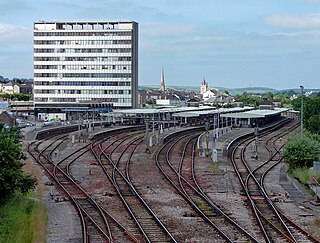
Plymouth railway station serves the city of Plymouth, Devon, England. It is on the northern edge of the city centre, close to the North Cross roundabout. It is the second busiest station in the county of Devon and the largest of the six surviving stations in Plymouth.

Shrewsbury railway station serves the town of Shrewsbury, in Shropshire, England. Built in 1848, it was designated a grade II listed building in 1969.

Crediton railway station is a railway station serving the town of Crediton in Devon, England. It is 7 miles 76 chains (12.8 km) from Exeter Central at milepost 179.25 from London Waterloo.

Pickering railway station is the southern terminus of the North Yorkshire Moors Railway and serves the town of Pickering in North Yorkshire, England. The first railway arrived in Pickering from the north in 1836, however, it wasn't until the railway was connected from the south in 1845, that the current station was built. The station was closed by British Railways in March 1965, but since 1975, the station has served as the southern terminus of the North York Moors Railway.

Princes Risborough station is a railway station on the Chiltern Main Line that serves the town of Princes Risborough in Buckinghamshire, England. It is operated by Chiltern Railways.

Hadlow Road railway station is a Grade II listed heritage railway station and museum in Willaston, on the Wirral Way footpath. It has been restored to have the look and feel of the day the station was permanently closed to passengers in 1956. It has an authentic ticket office, waiting room and telephone box. Formerly the museum was a working railway station on the single track Hooton to West Kirby branch of the Birkenhead Railway, on the Wirral Peninsula, Cheshire. The station is owned by Cheshire West and Chester Council, and Friends of Hadlow Road Station (FHRS) help to maintain and develop the station as a community resource.

Ashwellthorpe was a railway station that existed in the village of Ashwellthorpe, Norfolk, on a cutoff line between Forncett and Wymondham. This entry covers the history of the line and the station.

Southampton Terminus railway station served the Port of Southampton and Southampton City Centre, England from 1840 until 1966. The station was authorised on 25 July 1834 and built as the terminus of the London and Southampton Railway, which later changed its name to the London and South Western Railway (LSWR). The station opened as "Southampton" on 11 May 1840 due to the track not being fully linked between Winchester and Basingstoke.
There are 22 disused railway stations on the Bristol to Exeter line between Bristol Temple Meads and Exeter St Davids. The line was completed in 1844 at which time the temporary terminus at Beambridge was closed. The most recent closure was Tiverton Junction which was replaced by a new station} on a different site in 1986. 12 of the disused stations have structures that can still be seen from passing trains.

There are eleven disused railway stations on the Exeter to Plymouth line between Exeter St Davids and Plymouth Millbay in Devon, England. At eight of these there are visible remains.
There are seventeen disused railway stations on the Cornish Main Line between Plymouth in Devon and Penzance in Cornwall, England. The remains of nine of these can be seen from passing trains. While a number of these were closed following the so-called "Beeching Axe" in the 1960s, many of them had been closed much earlier, the traffic for which they had been built failing to materialise.

The Chard branch lines were two lines serving the town of Chard in Somerset, England. One was a northward branch, opened in 1863, from the Salisbury to Exeter main line, and the other, opened in 1866, ran south-eastwards from the Bristol – Taunton main line. Each branch had its own Chard passenger station at first, although the two lines connected in Chard.

Par signal box is a Grade II listed former Great Western Railway signal box, located on Par railway station in Cornwall, England.

Lostwithiel signal box is a Grade II listed former Great Western Railway signal box, located on Lostwithiel railway station in Cornwall, England. The signal box is situated at the northern end of Platform 1, adjacent to the level crossing.

The Liverpool Street signal box is a Grade II listed disused signal box at Liverpool Street tube station in London.