Related Research Articles
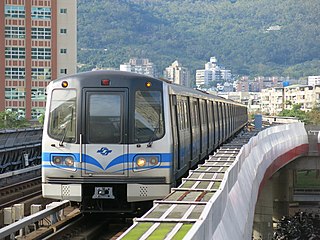
Rail transport is a means of transport that transfers passengers and goods on wheeled vehicles running on rails, which are incorporated in tracks. In contrast to road transport, where the vehicles run on a prepared flat surface, rail vehicles are directionally guided by the tracks on which they run. Tracks usually consist of steel rails.
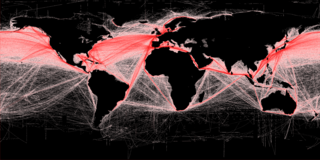
Freight transport, also referred as freight forwarding, is the physical process of transporting commodities and merchandise goods and cargo. The term shipping originally referred to transport by sea but in American English, it has been extended to refer to transport by land or air as well. "Logistics", a term borrowed from the military environment, is also used in the same sense.
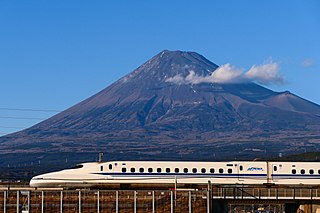
High-speed rail (HSR) is a type of rail transport network utilizing trains that run significantly faster than those of traditional rail, using an integrated system of specialized rolling stock and dedicated tracks. While there is no single standard that applies worldwide, lines built to handle speeds above 250 km/h (155 mph) or upgraded lines in excess of 200 km/h (124 mph) are widely considered to be high-speed.

Personal Rapid Transit (PRT), also referred to as podcars or guided/railed taxis, is a public transport mode featuring small low-capacity automated vehicles operating on a network of specially built guideways. PRT is a type of automated guideway transit (AGT), a class of system which also includes larger vehicles all the way to small subway systems. In terms of routing, it tends towards personal public transport systems.

Transport in Europe provides for the movement needs of over 700 million people and associated freight.
The privatisation of British Rail was the process by which ownership and operation of the railways of Great Britain passed from government control into private hands. Begun in 1994, it had been completed by 1997. The deregulation of the industry was initiated by EU Directive 91/440 in 1991, which aimed to create a more efficient rail network by creating greater competition.

The Eurasian Land Bridge, sometimes called the New Silk Road, is the rail transport route for moving freight and passengers overland between Pacific seaports in the Russian Far East and China and seaports in Europe. The route, a transcontinental railroad and rail land bridge, currently comprises the Trans-Siberian Railway, which runs through Russia and is sometimes called the Northern East-West Corridor, and the New Eurasian Land Bridge or Second Eurasian Continental Bridge, running through China and Kazakhstan. As of November 2007, about one percent of the $600 billion in goods shipped from Asia to Europe each year were delivered by inland transport routes.

Rail transportation in the United States consists primarily of freight shipments along a well integrated network of standard gauge private freight railroads that also extend into Canada and Mexico. The United States has the largest rail transport network size of any country in the world, at a total of approximately 160,000 miles (260,000 km).
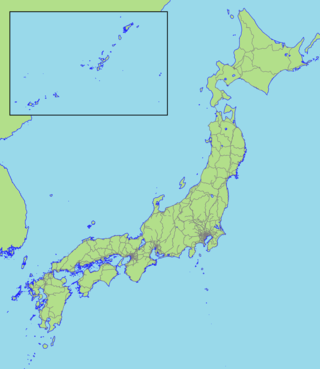
Rail transport in Japan is a major means of passenger transport, especially for mass and high-speed travel between major cities and for commuter transport in urban areas. It is used relatively little for freight transport, accounting for just 0.84% of goods movement. The privatised network is highly efficient, requiring few subsidies and running with extreme punctuality, though since privatisation several unprofitable but socially valuable lines have been closed by private operators.

Rail freight transport is the use of railroads and trains to transport cargo as opposed to human passengers.
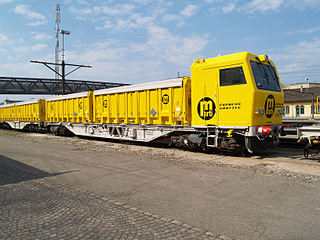
The CargoSprinter is a freight multiple unit designed to transport freight or equipment. The CargoSprinter was designed by Windhoff GmbH (Germany) in the mid-1990s.
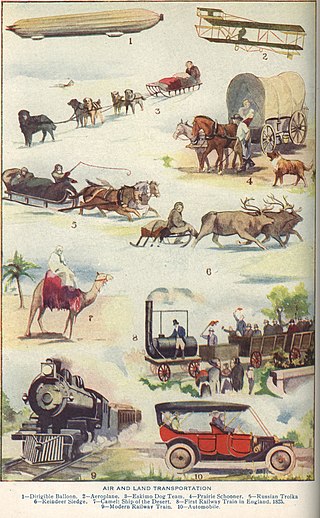
Mode of transport is a term used to distinguish between different ways of transportation or transporting people or goods. The different modes of transport are air, water, and land transport, which includes rails or railways, road and off-road transport. Other modes of transport also exist, including pipelines, cable transport, and space transport. Human-powered transport and animal-powered transport are sometimes regarded as their own mode, but never fall into the other categories. In general, transportation is used for moving of people, animals, and other goods from one place to another. Means of transport, on the other hand, refers to the transport facilities used to carry people or cargo according to the chosen mode. Each mode of transport has a fundamentally different technological solution, and some require a separate environment. Each mode has its own infrastructure, vehicles, transport operators and operations.Transportations helps in the better utilisation of the resources of the backyard areas by linking them with the more advanced areas. It aids in the process of industrialisation and urbanization.

A dual-mode vehicle (DMV) is a vehicle that can operate on conventional road surfaces as well as a railway track or a dedicated track known as a guideway. The development of these vehicles started together with personal rapid transport systems in the 1950s or even earlier.

The Connecticut Southern Railroad is a 90-mile (140 km) long short-line railroad operating in Connecticut and Massachusetts. The company was formed in 1996 as a spinoff of Conrail by shortline holding company RailTex and subsequently acquired in 2000 by RailAmerica. Since 2012, it has been a subsidiary of Genesee & Wyoming. CSO is headquartered in Hartford, Connecticut, site of its Hartford Yard. The company also operates East Hartford Yard.

The main line, or mainline in American English, of a railway is a track that is used for through trains or is the principal artery of the system from which branch lines, yards, sidings, and spurs are connected. It generally refers to a route between towns, as opposed to a route providing suburban or metro services. It may also be called a trunk line, for example the Grand Trunk Railway in Canada, the Trunk Line in Norway, and the Trunk Line Bridge No. 237 in the United States.
Veolia Cargo was a European rail freight transportation company that operated mainly in France and Germany. On 2 September 2009, the company was acquired by Eurotunnel and SNCF, the deal being finalised on 1 December 2009.

The State Railways of the Republic of Turkey, abbreviated as TCDD, is a government-owned national railway company responsible with the ownership and maintenance of railway infrastructure in Turkey, as well as the planning and construction of new lines. TCDD was formed on 4 June 1929 as part of the nationalisation of railways in Turkey.
Public transport is a system of transport for passengers by group travel systems available for use by the general public unlike private transport, typically managed on a schedule, operated on established routes, and that charge a posted fee for each trip. There is no rigid definition of which kinds of transport are included, and air travel is often not thought of when discussing public transport—dictionaries use wording like "buses, trains, etc." Examples of public transport include city buses, trolleybuses, trams and passenger trains, rapid transit and ferries. Public transport between cities is dominated by airlines, coaches, and intercity rail. High-speed rail networks are being developed in many parts of the world.
The Quebec North Shore and Labrador Railway is a private Canadian regional railway that stretches 414 kilometres (257 mi) through the wilderness of northeastern Quebec and western Labrador. It connects Labrador City, Labrador, with the port of Sept-Îles, Quebec, on the north shore of the St. Lawrence River. QNS&L is owned by Iron Ore Company of Canada (IOC), and is a common carrier.

TCDD Taşımacılık A.Ş. is a government-owned railway company responsible for the operations of most passenger and freight rail in Turkey. The company was formed on 14 June 2016, splitting off from the Turkish State Railways (TCDD) to take over railway operations, while TCDD would continue to administer railway infrastructure. TCDD Taşımacılık officially began operations on 1 January 2017.
References
- ↑ April Kuo; Elise Miller-Hooks; Kuilin Zhang & Hani Mahmassani (2008). "Train Slot Cooperation in Multicarrier, International Rail-Based Intermodal Freight Transport" (PDF). Transportation Research Record: Journal of the Transportation Research Board. 2043 (2043): 31–40. doi:10.3141/2043-04 . Retrieved 4 May 2014.
- ↑ Paolo Beria; Emile Quinet; Gines de Rus & Carola Schulze (September 2012). "A comparison of rail liberalisation levels across four European countries" (PDF). Research in Transportation Economics. 36 (1): 110–120. doi:10.1016/j.retrec.2012.03.014.
 | This rail-transport related article is a stub. You can help Wikipedia by expanding it. |