
Transience or transient may refer to:
Transience or transient may refer to:

AM or Am may refer to:
Control theory is a field of control engineering and applied mathematics that deals with the control of dynamical systems in engineered processes and machines. The objective is to develop a model or algorithm governing the application of system inputs to drive the system to a desired state, while minimizing any delay, overshoot, or steady-state error and ensuring a level of control stability; often with the aim to achieve a degree of optimality.
Response may refer to:

COMMAND.COM is the default command-line interpreter for MS-DOS, Windows 95, Windows 98 and Windows Me. In the case of DOS, it is the default user interface as well. It has an additional role as the usual first program run after boot, hence being responsible for setting up the system by running the AUTOEXEC.BAT configuration file, and being the ancestor of all processes.
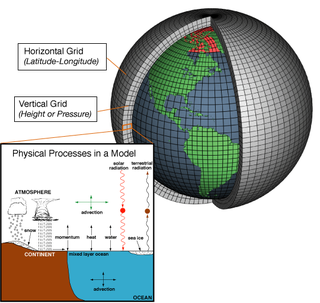
A general circulation model (GCM) is a type of climate model. It employs a mathematical model of the general circulation of a planetary atmosphere or ocean. It uses the Navier–Stokes equations on a rotating sphere with thermodynamic terms for various energy sources. These equations are the basis for computer programs used to simulate the Earth's atmosphere or oceans. Atmospheric and oceanic GCMs are key components along with sea ice and land-surface components.
State most commonly refers to:
In computer science, distributed shared memory (DSM) is a form of memory architecture where physically separated memories can be addressed as a single shared address space. The term "shared" does not mean that there is a single centralized memory, but that the address space is shared—i.e., the same physical address on two processors refers to the same location in memory. Distributed global address space (DGAS), is a similar term for a wide class of software and hardware implementations, in which each node of a cluster has access to shared memory in addition to each node's private memory.
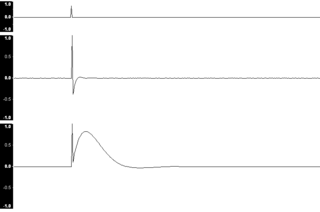
In signal processing and control theory, the impulse response, or impulse response function (IRF), of a dynamic system is its output when presented with a brief input signal, called an impulse (δ(t)). More generally, an impulse response is the reaction of any dynamic system in response to some external change. In both cases, the impulse response describes the reaction of the system as a function of time (or possibly as a function of some other independent variable that parameterizes the dynamic behavior of the system).
Steady state may refer to:
In systems theory, a system or a process is in a steady state if the variables which define the behavior of the system or the process are unchanging in time. In continuous time, this means that for those properties p of the system, the partial derivative with respect to time is zero and remains so:
History is the study of the past.
A transient climate simulation is a mode of running a global climate model (GCM) in which a period of time is simulated with continuously-varying concentrations of greenhouse gases so that the climate of the model represents a realistic mode of possible change in the real world.

In electrical engineering and mechanical engineering, a transient response is the response of a system to a change from an equilibrium or a steady state. The transient response is not necessarily tied to abrupt events but to any event that affects the equilibrium of the system. The impulse response and step response are transient responses to a specific input.
Kinetic Rule Language (KRL) is a rule-based programming language for creating applications on the Live Web. KRL programs, or rulesets, comprise a number of rules that respond to particular events. KRL has been promoted as language for building personal clouds.
In systems theory, a system is said to be transient or in a transient state when a process variable or variables have been changed and the system has not yet reached a steady state. In electrical engineering, the time taken for an electronic circuit to change from one steady state to another steady state is called the transient time.
Real-time simulation refers to a computer model of a physical system that can execute at the same rate as actual "wall clock" time. In other words, the computer model runs at the same rate as the actual physical system. For example, if a tank takes 10 minutes to fill in the real world, it would take 10 minutes to fill in the simulation as well.
Transient modelling is a way of looking at a process with the primary criterion of time, observing the pattern of changes in the subject being studied over time. Its obverse is Steady state, where you might know only the starting and ending figures but do not understand the process by which they were derived.
In mathematical dynamics, discrete time and continuous time are two alternative frameworks within which variables that evolve over time are modeled.
A geomorphological system said to be in dynamic steady state has values that oscillate between maxima and minima around a central mean value.
ASP.NET Web Forms is a web application framework and one of several programming models supported by the Microsoft ASP.NET technology. Web Forms applications can be written in any programming language which supports the Common Language Runtime, such as C# or Visual Basic. The main building blocks of Web Forms pages are server controls, which are reusable components responsible for rendering HTML markup and responding to events. A technique called view state is used to persist the state of server controls between normally stateless HTTP requests.