Related Research Articles
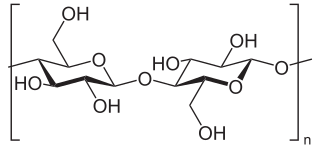
Cellulose is an organic compound with the formula (C
6H
10O
5)
n, a polysaccharide consisting of a linear chain of several hundred to many thousands of β(1→4) linked D-glucose units. Cellulose is an important structural component of the primary cell wall of green plants, many forms of algae and the oomycetes. Some species of bacteria secrete it to form biofilms. Cellulose is the most abundant organic polymer on Earth. The cellulose content of cotton fiber is 90%, that of wood is 40–50%, and that of dried hemp is approximately 57%.

Fiber or fibre is a natural or man-made substance that is significantly longer than it is wide. Fibers are often used in the manufacture of other materials. The strongest engineering materials often incorporate fibers, for example carbon fiber and ultra-high-molecular-weight polyethylene.

Poly (PMMA), also known as acrylic, acrylic glass, or plexiglass, as well as by the trade names Crylux, Plexiglas, Acrylite, Astariglas, Lucite, Perclax, and Perspex, among several others, is a transparent thermoplastic often used in sheet form as a lightweight or shatter-resistant alternative to glass. The same material can be used as a casting resin or in inks and coatings, among many other uses.

Lignin is a class of complex organic polymers that form key structural materials in the support tissues of most plants. Lignins are particularly important in the formation of cell walls, especially in wood and bark, because they lend rigidity and do not rot easily. Chemically, lignins are polymers made by cross-linking phenolic precursors.
Indium tin oxide (ITO) is a ternary composition of indium, tin and oxygen in varying proportions. Depending on the oxygen content, it can either be described as a ceramic or alloy. Indium tin oxide is typically encountered as an oxygen-saturated composition with a formulation of 74% In, 18% O2, and 8% Sn by weight. Oxygen-saturated compositions are so typical, that unsaturated compositions are termed oxygen-deficient ITO. It is transparent and colorless in thin layers, while in bulk form it is yellowish to grey. In the infrared region of the spectrum it acts as a metal-like mirror.

A nanoparticle or ultrafine particle is usually defined as a particle of matter that is between 1 and 100 nanometres (nm) in diameter. The term is sometimes used for larger particles, up to 500 nm, or fibers and tubes that are less than 100 nm in only two directions. At the lowest range, metal particles smaller than 1 nm are usually called atom clusters instead.

Electrochromism is the phenomenon where the color or opacity of a material changes when a voltage is applied. By doing so, an electrochromic smart window can block ultraviolet, visible or (near) infrared light instantaneously and on demand. The ability to control transmittance of near infrared light can increase the energy efficiency of a building, reducing the amount of energy needed to cool during summer and heat during winter.
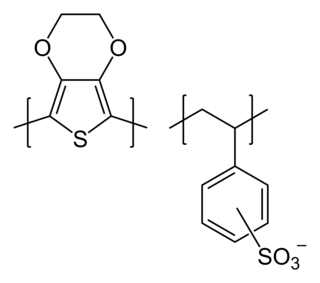
poly(3,4-ethylenedioxythiophene) polystyrene sulfonate (PEDOT:PSS) is a polymer mixture of two ionomers. One component in this mixture is made up of sodium polystyrene sulfonate which is a sulfonated polystyrene. Part of the sulfonyl groups are deprotonated and carry a negative charge. The other component poly(3,4-ethylenedioxythiophene) (PEDOT) is a conjugated polymer and carries positive charges and is based on polythiophene. Together the charged macromolecules form a macromolecular salt.

A biocomposite is a composite material formed by a matrix (resin) and a reinforcement of natural fibers. Environmental concern and cost of synthetic fibres have led the foundation of using natural fibre as reinforcement in polymeric composites. The matrix phase is formed by polymers derived from renewable and nonrenewable resources. The matrix is important to protect the fibers from environmental degradation and mechanical damage, to hold the fibers together and to transfer the loads on it. In addition, biofibers are the principal components of biocomposites, which are derived from biological origins, for example fibers from crops, recycled wood, waste paper, crop processing byproducts or regenerated cellulose fiber (viscose/rayon). The interest in biocomposites is rapidly growing in terms of industrial applications and fundamental research, due to its great benefits. Biocomposites can be used alone, or as a complement to standard materials, such as carbon fiber. Advocates of biocomposites state that use of these materials improve health and safety in their production, are lighter in weight, have a visual appeal similar to that of wood, and are environmentally superior.
An electrochromic device (ECD) controls optical properties such as optical transmission, absorption, reflectance and/or emittance in a continual but reversible manner on application of voltage (electrochromism). This property enables an ECD to be used for applications like smart glass, electrochromic mirrors, and electrochromic display devices.
As the world's energy demand continues to grow, the development of more efficient and sustainable technologies for generating and storing energy is becoming increasingly important. According to Dr. Wade Adams from Rice University, energy will be the most pressing problem facing humanity in the next 50 years and nanotechnology has potential to solve this issue. Nanotechnology, a relatively new field of science and engineering, has shown promise to have a significant impact on the energy industry. Nanotechnology is defined as any technology that contains particles with one dimension under 100 nanometers in length. For scale, a single virus particle is about 100 nanometers wide.
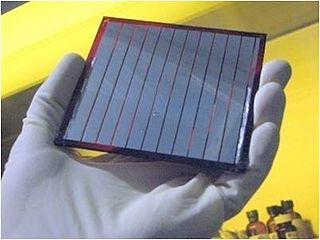
An organic solar cell (OSC) or plastic solar cell is a type of photovoltaic that uses organic electronics, a branch of electronics that deals with conductive organic polymers or small organic molecules, for light absorption and charge transport to produce electricity from sunlight by the photovoltaic effect. Most organic photovoltaic cells are polymer solar cells.

Solid is one of the four fundamental states of matter. The molecules in a solid are closely packed together and contain the least amount of kinetic energy. A solid is characterized by structural rigidity and resistance to a force applied to the surface. Unlike a liquid, a solid object does not flow to take on the shape of its container, nor does it expand to fill the entire available volume like a gas. The atoms in a solid are bound to each other, either in a regular geometric lattice, or irregularly. Solids cannot be compressed with little pressure whereas gases can be compressed with little pressure because the molecules in a gas are loosely packed.

Transparent conducting films (TCFs) are thin films of optically transparent and electrically conductive material. They are an important component in a number of electronic devices including liquid-crystal displays, OLEDs, touchscreens and photovoltaics. While indium tin oxide (ITO) is the most widely used, alternatives include wider-spectrum transparent conductive oxides (TCOs), conductive polymers, metal grids and random metallic networks, carbon nanotubes (CNT), graphene, nanowire meshes and ultra thin metal films.
Cellulose fibers are fibers made with ethers or esters of cellulose, which can be obtained from the bark, wood or leaves of plants, or from other plant-based material. In addition to cellulose, the fibers may also contain hemicellulose and lignin, with different percentages of these components altering the mechanical properties of the fibers.
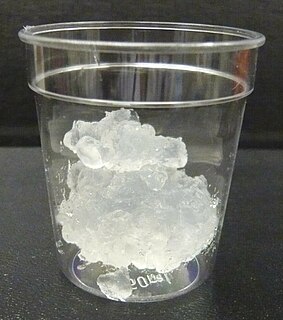
Nanocellulose is a term referring to nano-structured cellulose. This may be either cellulose nanocrystal, cellulose nanofibers (CNF) also called nanofibrillated cellulose (NFC), or bacterial nanocellulose, which refers to nano-structured cellulose produced by bacteria.
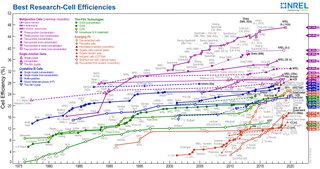
There are currently many research groups active in the field of photovoltaics in universities and research institutions around the world. This research can be categorized into three areas: making current technology solar cells cheaper and/or more efficient to effectively compete with other energy sources; developing new technologies based on new solar cell architectural designs; and developing new materials to serve as more efficient energy converters from light energy into electric current or light absorbers and charge carriers.

A luminescent solar concentrator (LSC) is a device for concentrating radiation, solar radiation in particular, to produce electricity. Luminescent solar concentrators operate on the principle of collecting radiation over a large area, converting it by luminescence and directing the generated radiation into a relatively small output target.
A. R. Forouhi and I. Bloomer deduced dispersion equations for the refractive index, n, and extinction coefficient, k, which were published in 1986 and 1988. The 1986 publication relates to amorphous materials, while the 1988 publication relates to crystalline. Subsequently, in 1991, their work was included as a chapter in “The Handbook of Optical Constants”. The Forouhi–Bloomer dispersion equations describe how photons of varying energies interact with thin films. When used with a spectroscopic reflectometry tool, the Forouhi–Bloomer dispersion equations specify n and k for amorphous and crystalline materials as a function of photon energy E. Values of n and k as a function of photon energy, E, are referred to as the spectra of n and k, which can also be expressed as functions of wavelength of light, λ, since E = hc/λ. The symbol h represents Planck’s constant and c, the speed of light in vacuum. Together, n and k are often referred to as the “optical constants” of a material.
Bio-inspired photonics or bio-inspired optical materials is a subcategory of bioinspiration. It includes artificial materials with optical properties springing inspiration from living organisms. This differs from biophotonics which is the field of study on the development and application of optical techniques to observe biological systems. In living organisms, colours can originate from pigments and/or unique structural characteristics.
References
- 1 2 St. Fluer, Nicholas (13 May 2016). "Wood That Could be Mistaken for Glass". The New York Times . New York City. Retrieved 16 May 2016.
- ↑ Scharping, Nathaniel (16 May 2015). "Transparent Wood Is a Surprisingly Versatile Material". Discover . Online. Retrieved 16 May 2015.
- 1 2 3 4 Zhu, Mingwei; Song, Jianwei; Li, Tian; Gong, Amy; Wang, Yanbin; Dai, Jiaqi; Yao, Yonggang; Luo, Wei; Henderson, Doug; Hu, Liangbing (2016-05-04). "Highly Anisotropic, Highly Transparent Wood Composites". Advanced Materials. Wiley. 28 (26): 5181–5187. doi:10.1002/adma.201600427. ISSN 0935-9648. PMID 27147136.
- ↑ www.instructables.com https://www.instructables.com/Transparent-Wood/ . Retrieved 28 February 2021.Missing or empty
|title=(help) - ↑ Li, Yuanyuan; Fu, Qiliang; Yu, Shun; Yan, Min; Berglund, Lars (2016). "Optically Transparent Wood from a Nanoporous Cellulosic Template: Combining Functional and Structural Performance". Biomacromolecules. 17 (4): 1358–1364. doi: 10.1021/acs.biomac.6b00145 . PMID 26942562.
- ↑ KTH The Royal Institute of Technology (30 Mar 2016). "Wood windows? Transparent wood material used for buildings, solar cells". Science Daily. Retrieved 27 May 2019.
- ↑ Emily Reynolds (31 Mar 2016). "This transparent wood could be used to build windows". Wired UK. Retrieved 27 May 2017.
- ↑ Daniel Akst (21 Apr 2016). "What Could We Build With Extra-Strong, See-Through Wood?". The Wall Street Journal. Retrieved 27 Mar 2019.
- ↑ Fink, Siegfried (1992-01-01). "Transparent Wood – A New Approach in the Functional Study of Wood Structure". Holzforschung. 46 (5): 403–408. doi:10.1515/hfsg.1992.46.5.403. ISSN 1437-434X. S2CID 94219723.
- ↑ Crane, Leah. "Wood can easily be turned transparent to make energy-saving windows". New Scientist. Retrieved 12 February 2021.
- ↑ "A new way to make wood transparent, stronger and lighter than glass". phys.org. Retrieved 12 February 2021.
- 1 2 Xia, Qinqin; Chen, Chaoji; Li, Tian; He, Shuaiming; Gao, Jinlong; Wang, Xizheng; Hu, Liangbing (1 January 2021). "Solar-assisted fabrication of large-scale, patternable transparent wood". Science Advances. 7 (5): eabd7342. doi: 10.1126/sciadv.abd7342 . ISSN 2375-2548. PMC 7840122 . PMID 33571122.
- 1 2 Li, Yuanyuan; Vasileva, Elena; Sychugov, Ilya; Popov, Sergei; Berglund, Lars (2018). "Optically Transparent Wood: Recent Progress, Opportunities, and Challenges". Advanced Optical Materials. 6 (14): 1800059. doi: 10.1002/adom.201800059 . ISSN 2195-1071.
- 1 2 3 4 5 6 Yaddanapudi, Haritha Sree; Hickerson, Nathan; Saini, Shrikant; Tiwari, Ashutosh (2017-12-01). "Fabrication and characterization of transparent wood for next generation smart building applications". Vacuum. 146: 649–654. Bibcode:2017Vacuu.146..649Y. doi:10.1016/j.vacuum.2017.01.016. ISSN 0042-207X.
- 1 2 Wang, Xuan; Zhan, Tianyi; Liu, Yan; Shi, Jiangtao; Pan, Biao; Zhang, Yaoli; Cai, Liping; Shi, Sheldon Q. (2018). "Large-Size Transparent Wood for Energy-Saving Building Applications". ChemSusChem. 11 (23): 4086–4093. doi:10.1002/cssc.201801826. ISSN 1864-564X. PMID 30296365.
- 1 2 Mosher, Dave. "Scientists made see-through wood that is cooler than glass". Business Insider. Retrieved 2019-12-10.
- ↑ https://designerdata.nl/materials/plastics/thermo-plastics/poly(methyl-methacrylate)
- 1 2 3 4 Li, Tian; Zhu, Mingwei; Yang, Zhi; Song, Jianwei; Dai, Jiaqi; Yao, Yonggang; Luo, Wei; Pastel, Glenn; Yang, Bao; Hu, Liangbing (2016-08-11). "Wood Composite as an Energy Efficient Building Material: Guided Sunlight Transmittance and Effective Thermal Insulation". Advanced Energy Materials. 6 (22): 1601122. doi:10.1002/aenm.201601122. ISSN 1614-6832.
- ↑ Davis, Nicola (2019-04-03). "Scientists invent 'transparent wood' in search for eco-friendly building material". The Guardian. ISSN 0261-3077 . Retrieved 2019-12-10.
- ↑ Li, Yuanyuan; Fu, Qiliang; Yang, Xuan; Berglund, Lars (2018-02-13). "Transparent wood for functional and structural applications". Philosophical Transactions. Series A, Mathematical, Physical, and Engineering Sciences. 376 (2112): 20170182. doi:10.1098/rsta.2017.0182. ISSN 1471-2962. PMC 5746562 . PMID 29277747.
- ↑ "Transparent wood: the building material of the future?". phys.org. Retrieved 27 February 2021.
- ↑ Arehart, Joseph (2017-01-01). "Energy Performance Analysis of Transparent Wood Composite-Based Glazing Systems in Commercial Buildings". Civil Engineering Graduate Theses & Dissertations.
- 1 2 Li, Yuanyuan; Cheng, Ming; Jungstedt, Erik; Xu, Bo; Sun, Licheng; Berglund, Lars (2019-03-18). "Optically Transparent Wood Substrate for Perovskite Solar Cells". ACS Sustainable Chemistry & Engineering. 7 (6): 6061–6067. doi:10.1021/acssuschemeng.8b06248. ISSN 2168-0485. PMC 6430497 . PMID 30918764.