Related Research Articles

Renfe-Operadora is the state-owned company which operates freight and passenger trains on the 1,668 mmIberian gauge, the 1,435 mmstandard gauge and the 1,000 mmmetre gauge Spanish railway networks.

Rail transport in Spain operates on four rail gauges and services are operated by a variety of private and public operators. The total route length in 2012 was 16,026 km.

Ferrocarrils de la Generalitat Valenciana or FGV is a Valencian public railway company which operates several 1,000 mmmetre gauge lines, in the autonomous community of Valencia, Spain.

Gandia is a city and municipality in the Valencian Community, eastern Spain on the Mediterranean. Gandia is located on the Costa del Azahar, 65 kilometres (40 mi) south of Valencia and 110 km (68 mi) north of Alicante. Vehicles can access the city through road N-332.

Alta Velocidad Española (AVE) is a service of high-speed rail in Spain operated by Renfe, the Spanish national railway company, at speeds of up to 310 km/h (193 mph). As of December 2021, the Spanish AVE system is the longest HSR network in Europe with 3,622 km (2,251 mi) and the second longest in the world, after China's.

The Costa Blanca is over 200 kilometres (120 mi) of Mediterranean coastline in the Alicante province, on the southeastern coast of Spain. It extends from the town of Dénia in the north, beyond which lies the Costa del Azahar, to Pilar de la Horadada in the south, beyond which lies the Costa Cálida.

The Alicante Tram, trademarked as Alicante Metropolitan TRAM, operates in the Spanish city of Alicante (Valencia) and its surrounding area. Like other narrow gauge railways in the Valencian Community, it is run by Ferrocarrils de la Generalitat Valenciana (FGV). It was inaugurated on 15 August 2003 replacing narrow-gauge diesel trains between Alicante and El Campello.
Euromed is a high-speed rail service operated by Renfe along the Spanish Mediterranean coast.

The Valencian Community, or simply Valencia, is an autonomous community of Spain. It is the fourth most populous Spanish autonomous community after Andalusia, Catalonia and Madrid with more than five million inhabitants. Its homonymous capital Valencia is the third largest city and metropolitan area in Spain. It is located along the Mediterranean coast on the east side of the Iberian Peninsula. It borders with Catalonia to the north, Aragon and Castilla–La Mancha to the west, and Murcia to the south. The Valencian Community consists of three provinces which are Castellón, Valencia and Alicante.

Cercanías Murcia/Alicante is a commuter rail service (cercanías) in the provinces of Alicante and Murcia. The line connects Alicante and Murcia with San Vicente del Raspeig, Elche, Orihuela, Totana, Lorca, and Águilas. It runs through 200 km of railways with a total of 26 stations.
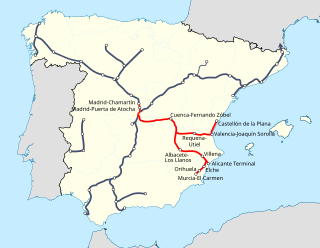
The Madrid–Levante high-speed network is a network of high-speed rail lines that connects Madrid with the Mediterranean coast of the Levante Region, specifically with Castilla-La Mancha, the Valencian Community and the Murcia Region autonomous communities.

Cercanías Valencia is the commuter rail service that serves Valencia, Spain, and its metropolitan area. It is operated by Cercanías Renfe, the commuter rail division of RENFE, the former monopoly of rail services in Spain. The network is owned by Adif, the national railway infrastructure company.

In Spain there is an extensive 1,250 km (780 mi) system of 1,000 mmmetre gauge railways. The majority of these railways was historically operated by FEVE,. Created in 1965 FEVE started absorbing numerous private-owned narrow-gauge railways. From 1978 onwards, with the introduction of regionalisation devolution under the new Spanish constitution, FEVE began transferring responsibility for a number of its operations to the new regional governments. On 31 December 2012 the company disappeared due to the merger of the narrow-gauge network FEVE and the broad-gauge network RENFE.
Traditionally, the gauge of the national railway in Spain, now managed by Adif, is 1,668 mm, known as Iberian gauge. This gauge was decided upon by a Parliamentary committee, after a report known as the Informe Subercase in 1844. Spain has 11,791 km of track with this gauge.
Tren de la Costa is a planned regional rail line in Peru, paralleling the Pan American Highway between the cities of Sullana and Ica, via Lima. The line is estimated to cost $10 billion, and is expected to carry 57 million passengers per year.
In the run up to the 2019 Spanish local elections, various organisations carried out opinion polling to gauge voting intention in local entities in Spain. Results of such polls for municipalities in the Valencian Community are displayed in this article. The date range for these opinion polls is from the previous local elections, held on 24 May 2015, to the day the next elections were held, on 26 May 2019.

The Valencia–Sant Vicenç de Calders railway, also known as the Valencia–Tarragona railway is a railway line in Spain, beginning at Valencia Nord and ending at Sant Vicenç de Calders.
In the run up to the 2015 Spanish local elections, various organisations carried out opinion polling to gauge voting intention in local entities in Spain. Results of such polls for municipalities in the Valencian Community are displayed in this article. The date range for these opinion polls is from the previous local elections, held on 22 May 2011, to the day the next elections were held, on 24 May 2015.
References
- 1 2 "El trazado, nuevo escollo para desbloquear el tren de la costa de la Comunitat Valenciana". Las Provincias . 30 July 2017. Retrieved 8 January 2021.
- ↑ "El Tren de la Costa, un muro entre Valencia y Alicante". La Vanguardia (in Spanish). 12 February 2019. Retrieved 18 March 2019.
- 1 2 "ESTUDIO INFORMATIVO DE LA LÍNEA FERROVIARIA VALENCIA - ALICANTE (TREN DE LA COSTA) - FASE II" (PDF). Ministerio de Fomento. Retrieved 4 September 2019.
 | This Catalan railway-related article is a stub. You can help Wikipedia by expanding it. |