Related Research Articles
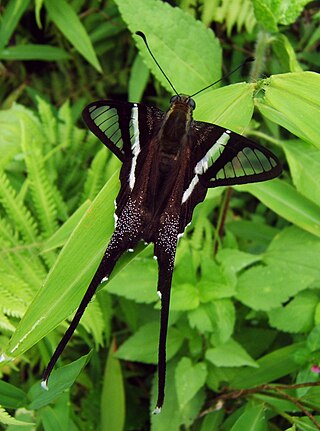
Lamproptera curius, the white dragontail, is a species of swallowtail butterfly native to parts of South Asia and Southeast Asia where it is common. It belongs to the dragontails genus, Lamproptera, of the swallowtail family, Papilionidae.

Rapala varuna, the indigo flash, is a species of lycaenid or blue butterfly found in the Indomalayan realm and the Australasian realm.
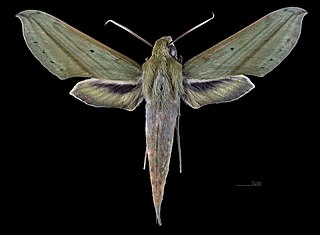
Xylophanes elara is a moth of the family Sphingidae first described by Herbert Druce in 1878. It is known from Paraguay, Suriname, Venezuela, Bolivia and Brazil.
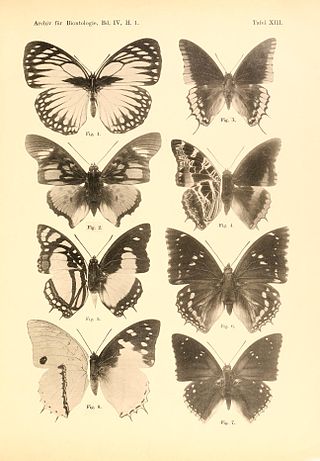
Charaxes acraeoides is a butterfly in the family Nymphalidae first described by Herbert Druce in 1908. It is found in Cameroon, Gabon, the Republic of the Congo, the Central African Republic and the Democratic Republic of the Congo.
Eupithecia cercina is a moth in the family Geometridae first described by Herbert Druce in 1893. It is found in Mexico.
Eupithecia cerynea is a moth in the family Geometridae first described by Herbert Druce in 1893. It is found in Guatemala.
Episcepsis demonis is a moth of the family Erebidae. It was described by Herbert Druce in 1896. It is found in Panama and Peru.
Apatelodes mehida is a moth in the family Apatelodidae first described by Herbert Druce in 1904. It is found in south-eastern Peru.
Cosipara delphusa is a moth in the family Crambidae. It was described by Herbert Druce in 1896. It is found in Mexico and Guatemala.
Pantographa gorgonalis is a moth in the family Crambidae. It was described by Herbert Druce in 1895. It is found in Guerrero, Mexico.
Pilocrocis cryptalis is a moth in the family Crambidae. It was described by Herbert Druce in 1895. It is found in Honduras, Costa Rica, Panama and French Guiana.
Pilocrocis cyrisalis is a moth in the family Crambidae. It was described by Herbert Druce in 1895. It is found in Panama and Costa Rica.
Polygrammodes nervosa is a moth in the family Crambidae. It was described by William Warren in 1889. It is found in Brazil and Ecuador.
Polygrammodes quatrilis is a moth in the family Crambidae. It was described by Herbert Druce in 1902. It is found in Venezuela and Colombia.
Syllepte chalybifascia is a moth in the family Crambidae. It was described by George Hampson in 1896. It is found in India (Nagas).
Syngamilyta samarialis is a moth in the family Crambidae. It was described by Herbert Druce in 1899. It is found in Costa Rica and Colombia.
Syntrita nimalis is a moth in the family Crambidae. It was described by William Schaus in 1924. It is found in Bolivia.
Trichaea nigrans is a moth in the family Crambidae. It was described by Herbert Druce in 1902. It is found in Peru and Bolivia.
Udea ochropera is a moth in the family Crambidae. It was described by George Hampson in 1913. It is found in Colombia and Mexico.
Pedoptila thaletes is a moth in the family Himantopteridae. It was described by Herbert Druce in 1907. It is found in the Republic of the Congo and Cameroon.
References
- ↑ Nuss, M.; et al. (2003–2014). "GlobIZ search". Global Information System on Pyraloidea. Retrieved July 15, 2014.
- ↑ Druce, Herbert (May 1902). "Descriptions of some new species of Lepidoptera". Annals and Magazine of Natural History. 7. 9 (53): 321–334. doi:10.1080/00222930208678598 – via Biodiversity Heritage Library.
 This article incorporates text from this source, which is in the public domain .

 | This Spilomelinae-related article is a stub. You can help Wikipedia by expanding it. |