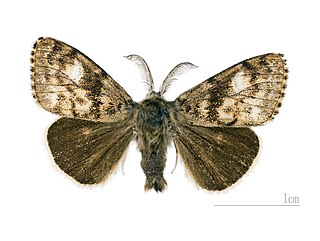
The flannel moths or crinkled flannel moths are a family of insects. They occur in North America and the New World tropics. The larvae are called puss caterpillars, and with their long hairs, resemble cotton balls. They have venomous spines that can cause a painful sting and inflammation lasting for several days. In some cases, the sting may cause headache, nausea, and shock-like symptoms. Perhaps the most notorious for stinging is the caterpillar of Megalopyge opercularis.

The Drepanidae is a family of moths with about 660 species described worldwide. They are generally divided in three subfamilies which share the same type of hearing organ. Thyatirinae, previously often placed in their own family, bear a superficial resemblance to Noctuidae. Many species in the Drepanid family have a distinctively hook-shaped apex to the forewing, leading to their common name of hook-tips.

The Pyraloidea are a moth superfamily containing about 16,000 described species worldwide, and probably at least as many more remain to be described. They are generally fairly small moths.
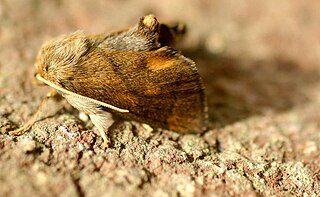
The Limacodidae or Euclidae are a family of moths in the superfamily Zygaenoidea or the Cossoidea; the placement is in dispute. They are often called slug moths because their caterpillars bear a distinct resemblance to slugs. They are also called cup moths because of the shape of their cocoons.

Callidulidae, the only known family of the superfamily Calliduloidea, is the family of Old World butterfly-moths, containing eight genera. They have a peculiar distribution, restricted to the Old World tropics of South East Asia to Australasia and Madagascar. The three subfamilies exhibit both day- and night-flying behaviour.

Ennominae is the largest subfamily of the geometer moth family (Geometridae) with some 9,700 described species in 1,100 genera. They are usually a fairly small moth species, though some grow to be considerably large. This subfamily has a global distribution. It includes some species that are notorious defoliating pests. The subfamily was first described by Philogène Auguste Joseph Duponchel in 1845.
Mantala is a genus of moths in the subfamily Arctiinae. It contains the single species Mantala tineoides, which is found on Borneo. The habitat consists of lowland and lower montane forests.
Trichaetoides is a genus of moths in the family Erebidae.
Ugia is a genus of moths in the family Erebidae erected by Francis Walker in 1858.
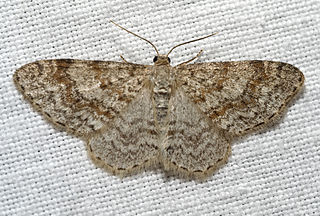
Asthenini is a tribe of geometer moths under subfamily Larentiinae first described by Warren in 1893. The tribe has been combined with Eupitheciini in the past, most notably by Jeremy Daniel Holloway in his work The Moths of Borneo.
Lymantriini is a tribe of moths of the family Erebidae. This tribe is a group of polyphagous moths that reside mostly in the tropical regions of Afro-Eurasia but also North America.
Gymnoscelis pseudotibialis is a moth in the family Geometridae. It is found on Borneo, Peninsular Malaysia and in Singapore. The habitat consists of montane areas.
Trichaetoides albifrontalis is a moth in the family Erebidae. It was described by Pagenstecher in 1885. It is found on Nias.
Trichaetoides albiplaga is a moth in the family Erebidae. It was described by Francis Walker in 1862. It is found on Borneo, Peninsular Malaysia and in Thailand. The habitat consists of both lowland and mountainous areas.
Trichaetoides apicalis is a moth in the family Erebidae. It was described by Francis Walker in 1856. It is found on Sumatra and Borneo.
Trichaetoides borealis is a moth in the family Erebidae. It was described by Rothschild in 1912. It is found on Borneo. The habitat consists of dry and wet heath forests and possibly swamp forests.
Trichaetoides chloroleuca is a moth in the family Erebidae. It was described by Francis Walker in 1859. It is found on Borneo, Sumatra, Peninsular Malaysia and in Singapore. It is mostly found in lowland localities.
Trichaetoides separabilis is a moth in the family Erebidae. It was described by Francis Walker in 1862. It is found on Borneo. The habitat consists of lowland alluvial forests and dipterocarp forests.
The Syntomini are a tribe of moths in the family Erebidae.