
The New World warblers or wood-warblers are a group of small, often colorful, passerine birds which make up the family Parulidae and are restricted to the New World. They are not closely related to Old World warblers or to Australian warblers. Most are arboreal, but some, like the ovenbird and the two waterthrushes, are primarily terrestrial. Most members of this family are insectivores.
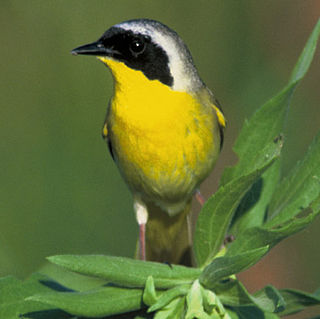
The yellowthroats are New World warblers in the genus Geothlypis. Most members of the group have localised ranges in Mexico and Central America, but the masked yellowthroat has an extensive South American distribution, and common yellowthroat, the only migratory species in the group, breeds over much of North America.
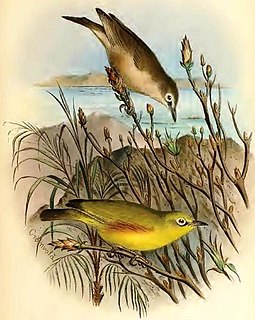
The Marianne white-eye, also known as Seychelles chestnut-sided white-eye or Seychelles yellow white-eye, is an extinct species of small bird in the white-eye family.

The olive-crowned yellowthroat is a species of bird in the family Parulidae. It is found in Colombia, Costa Rica, Ecuador, Honduras, Mexico, Nicaragua, and Panama. Its natural habitats are subtropical or tropical moist shrubland and heavily degraded former forest.
Esenbeckia is a genus of neotropical horse flies in the family Tabanidae. It contains the following species:
Mesothen is a genus of moths in the subfamily Arctiinae.
Syntomostola is a genus of arctiine tussock moths in the family Erebidae.
Scepastopyga is a genus of flies in the family Dolichopodidae from Papua New Guinea. There is only one described species, Scepastopyga semiflava, described by P. Grootaert and H. J. G. Meuffels in 1997. It is small, with a body length of about 2 mm, and is coloured yellow or brown without a metallic gloss.

Semioptila is a genus of moths in the family Himantopteridae.

Ponometia semiflava is a moth of the family Noctuidae. It is found from New York and New England to Florida, west to Arizona, north to British Columbia and Manitoba.

Box kite spiders is a common name for the Afrotropical Isoxya genus of orb-weaver spiders. Like the Spiny orb-weavers they have six prominent spines on their abdomen. They are small spiders, measuring 3 to 7 mm across. They have a sclerotised abdomen which is typical of the Gastricanthinae.
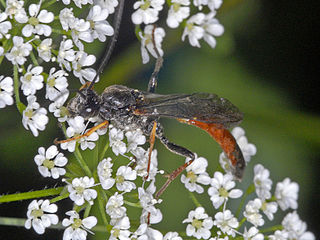
Alomya is a genus of the parasitic wasp family Ichneumonidae.
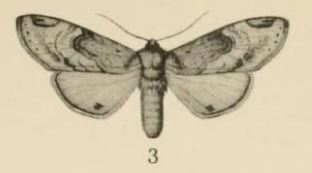
Stemmatophalera semiflava is a moth of the family Notodontidae. It is found in Congo, Ivory Coast, South Africa and in Tanzania.
Mesothen semiflava is a moth of the subfamily Arctiinae. It was described by Rothschild in 1911. It is found in Venezuela.
Otroea is a genus of longhorn beetles of the subfamily Lamiinae, containing the following species:
Otroea semiflava is a species of beetle in the family Cerambycidae. It was described by Pascoe in 1866. It is known from Moluccas.
Semioptila semiflava is a moth in the Himantopteridae family. It was described by George Talbot in 1928. It is found in the Democratic Republic of the Congo.
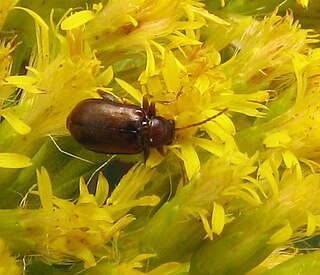
Luperaltica is a genus of flea beetles in the family Chrysomelidae. There are at least four described species in Luperaltica.
Luperaltica semiflava is a species of flea beetle in the family Chrysomelidae. It is found in North America.
Belvosia semiflava is a species of bristle fly in the family Tachinidae. It is found in North America.

