
The Tst26 toxin is a voltage-gated potassium channel blocker present in the venom of Tityus stigmurus , a species of Brazilian scorpion. Tst26 selectively blocks Kv1.2 and Kv1.3 channels. [1]
The Tst26 toxin is a voltage-gated potassium channel blocker present in the venom of Tityus stigmurus , a species of Brazilian scorpion. Tst26 selectively blocks Kv1.2 and Kv1.3 channels. [1]
Tst26 is named after the species it was discovered from and a characteristic of the process in which it was obtained. [2] Venom from Tityus stigmurus was analysed using high-performance liquid chromatography (HPLC). Peptides were separated based on the elution time from HPLC, and when the sample which elutes at 26 minutes was sequenced a distinct amino acid sequence was discovered. When this sequence was further characterized, it was revealed to be a unique potassium blocker and was named Tst26. Tst was derived from the abbreviation of the species of scorpion it was discovered from, Tityus stigmurus, and 26 was derived from the elution time of the sample it was obtained from. Tst26 has high sequence similarity with other peptides from the α-KTx 4 family and therefore this toxin has the systematic name α-KTx 4.6. [2]
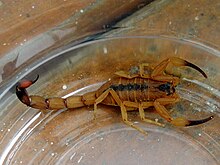
This toxin was discovered in the venom of the Tityus stigmurus . [2] Tityus stigmurus is a species of Brazilian scorpion found predominantly in the northeastern regions of Brazil. [3]
The chemical structure of Tst26 is similar to the structure of other potassium blocking peptides from scorpion venom. Tst26 comprises 37 amino acids that are tightly connected through three disulfide bridges. The peptide's experimental molecular mass of 3941.0 Da corresponds very well with its theoretical molecular mass of 3940.8 Da. [2] The presence of lysine and tyrosine at position 27 and 36 respectively allows for potassium channel recognition. [2]
Tst26 selectively blocks Kv1.2 and Kv1.3 voltage gated potassium channels and has high affinity to both channels. It has an affinity (Kd) of 1.9 nM for Kv1.2 and of 10.7 nM for Kv1.3. Tst26 did not affect any of the other tested channels Kv1.1, Kv1.4, Kv1.5, hERG, IKCa1, BKCa and Nav1.5. [2]
Tst26 selectively blocks Kv1.2 and Kv1.3 receptors, and it is assumed that Tst26 blocker works as a pore blocker owing to its similarity with other blockers in its family. This toxin does not affect the voltage-dependence of (steady state) activation or inactivation of the potassium channels but did slow down the inactivation of Kv1.3 channels. [2]
Tityustoxin is a toxin found in the venom of scorpions from the subfamily Tityinae. By binding to voltage-dependent sodium ion channels and potassium channels, they cause sialorrhea, lacrimation and rhinorrhea.
Butantoxin (BuTX) is a compound of the venom of three Brazilian and an Argentinean scorpion species of the genus Tityus. Butantoxin reversibly blocks the voltage-gated K+ channels Shaker B and Kv1.2, and the Ca2+-activated K+ channelsKCa 1.1 and KCa 3.1.

Pi3 toxin is a purified peptide derivative of the Pandinus imperator scorpion venom. It is a potent blocker of voltage-gated potassium channel, Kv1.3 and is closely related to another peptide found in the venom, Pi2.
Tamulotoxin is a venomous neurotoxin from the Indian Red Scorpion.
Spinoxin is a 34-residue peptide neurotoxin isolated from the venom of the Malaysian black scorpion Heterometrus spinifer. It is part of the α-KTx6 subfamily and exerts its effects by inhibiting voltage-gated potassium channels, specifically Kv1.2 and Kv1.3.
Ts15 is produced by the Brazilian yellow scorpion Tityus serrulatus. It targets voltage-gated potassium channels, primarily the subtypes Kv1.2 and Kv1.3.
HgeTx1 (systematic name: α-KTx 6.14) is a toxin produced by the Mexican scorpion Hoffmanihadrurus gertschi that is a reversible blocker of the Shaker B K+-channel, a type of voltage-gated potassium channels.
Tityustoxin peptide 2 (TsPep2) is a peptide isolated from the venom of the Tityus serrulatus. It belongs to a class of short peptides, together with Tityustoxin peptide 1 and Tityustoxin peptide 3.
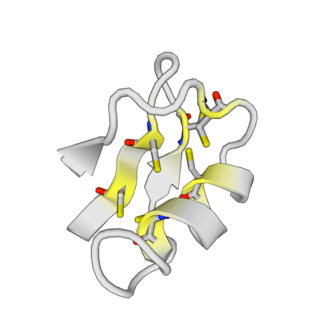
ImKTx88 is a selective inhibitor of the Kv1 ion channel family that can be isolated from the venom of the Isometrus maculatus. This peptide belongs to the α-KTx subfamily and is classified as a pore-blocking toxin.
Pi5 toxin is a peptide found in the venom of the African emperor scorpion Pandinus imperator. Pi5 inhibits human Kv1.2 and Kv1.3 channels as well as Drosophila Shaker B potassium channels.
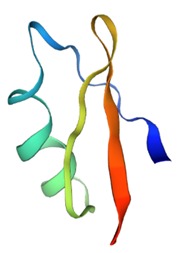
OdK2 is a toxin found in the venom of the Iranian scorpion Odonthobuthus doriae. It belongs to the α-KTx family, and selectively blocks the voltage-gated potassium channel Kv1.3 (KCNA3).

OSK3, from the venom of the scorpion Orthochirus scrobiculosus, is a potassium channel blocker that belongs to the α-KTx8 subfamily and targets the voltage-gated potassium channels KCNA2 (Kv1.2), and KCNA3 (Kv1.3).
BmKTX is a scorpion neurotoxin which blocks the voltage gated potassium channel Kv1.3.
Ts8 is a neurotoxin present in the venom of the Brazilian yellow scorpion, Tityus serrulatus. Ts8 is a selective inhibitor of the voltage-gated potassium channel Kv4.2
Tb1 is a neurotoxin that is naturally found in the venom of the Brazilian scorpion Tityus bahiensis. Presumably by acting on voltage-gated sodium channels, it triggers excessive glutamate release, which can lead to both behavioral and electrographic epileptiform alterations, as well as neuronal injury.
κ-KTx2.5 is a toxin found in the venom of the scorpion, Opisthacanthuscayaporum. The toxin belongs to the κ-KTx family, a channel blocker family that targets voltage-gated potassium channels (Kv) 1.1 and 1.4.
Cm28, a scorpion toxin from Centruroides margaritatus, selectively blocks voltage-gated potassium channels KV1.2 and KV1.3 with high affinity. It also suppresses the activation of human CD4+ effector memory T cells, suggesting its potential as a therapeutic agent for autoimmune diseases. Phylogenetic analysis reveals that Cm28 belongs to a new α-KTx subfamily, highlighting its unique structural and functional properties for potential drug development.
ImKTX58 is a peptide toxin from the venom of the scorpion species Isometrus maculatus. It is known for its selective inhibition of Kv1.3 channels, on which it acts as a pore-blocker.

Hg1 is a Kunitz-type peptide ion channel toxin derived from the scorpion Hadrurus gertschi. Its mode of action is that it selectively inhibits the potassium channel Kv1.3 and, with a lower affinity, channels Kv1.1 and Kv1.2.
CboK7, also known as α-KTx 2.24, is a toxin produced by a species of scorpion, Centruroides bonito. It blocks voltage-gated K+ channels, with the highest affinity for Kv1.2 channels.