Ampelopsis, commonly known as peppervine or porcelainberry, is a genus of climbing shrubs, in the grape family Vitaceae. The name is derived from the Ancient Greek: ἅμπελος (ampelos), which means "vine". The genus was named in 1803. It is disjunctly distributed in eastern Asia and eastern North America extending to Mexico. Ampelopsis is primarily found in mountainous regions in temperate zones with some species in montane forests at mid-altitudes in subtropical to tropical regions. Ampelopsis glandulosa is a popular garden plant and an invasive weed.

Thespesia is a genus of 13 flowering shrubs and trees in the Hibiscus family, Malvaceae, although within the family they are more closely related to cotton plants (Gossypium). The genus is distributed from the South Pacific through Asia, Africa, and the Caribbean.

Xanthocercis is a tree genus in the family Fabaceae. Species include:
Festuca elatior L. is the former name of a species of grass. Because of confusion in the application of this name, it was rejected by the International Botanical Congress.
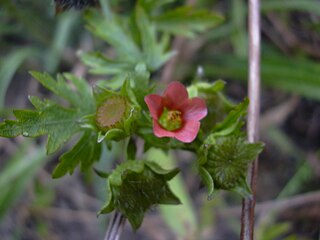
Modiola is a monotypic genus of plants in the mallow family containing the single species Modiola caroliniana, which is known by several common names, including bristly-fruited mallow, Carolina bristlemallow, babosilla, and redflower mallow. It is a creeping perennial which is probably native to South America but which is widely naturalized throughout the tropical and warmer temperate world.

Poa palustris is a species of grass native to Asia, Europe and Northern America. This plant is used as fodder and forage, and it also used for erosion control or revegetation.
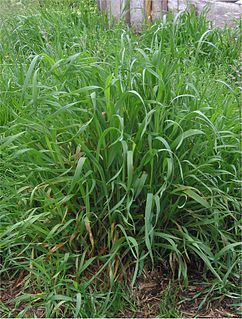
Elytrigia is a genus of about 20–40 species of grasses, native to temperate regions of the Old World, in Europe, Asia, and northwest Africa. The species are sometimes included in the related genera Agropyron or Elymus, while species in the genera Pascopyrum and Pseudoroegneria are included in Elytrigia by some authors. The genus name has also been spelled Elytrigium.

Digitaria sanguinalis is a species of grass known by several common names, including hairy crabgrass, hairy finger-grass, large crabgrass, crab finger grass, purple crabgrass. It is one of the better-known species of the genus Digitaria, and one that is known nearly worldwide as a common weed. It is used as animal fodder, and the seeds are edible and have been used as a grain in Germany and especially Poland, where it is sometimes cultivated. This has earned it the name Polish millet.

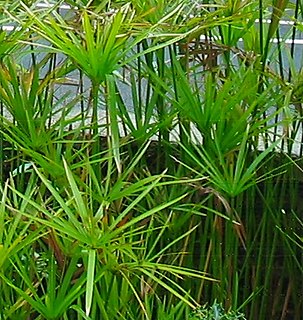
Panicum decompositum, known by the common names native millet, Australian millet, papa grass, and umbrella grass, is a species of grass native to the inland of Australia. It occurs in every mainland state.
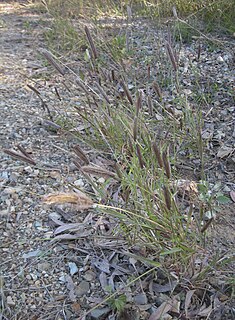
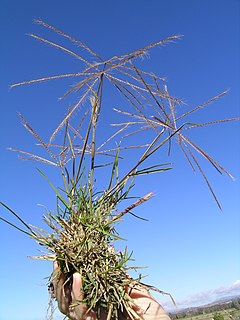
Chloris virgata is a species of grass known by the common names feather fingergrassfeathery Rhodes-grass and feather windmillgrass. It is native to many of the warmer temperate, subtropical, and tropical regions of the world, including parts of Eurasia, Africa, and the Americas, and it is present in many other areas as a naturalized species, including Hawaii, Australia, and the Canary Islands.

Piptanthus is a genus of flowering plants in the legume family, Fabaceae, and the subfamily Faboideae.

Triglochin striata is a plant native to temperate and subtropic Australia with specimens recorded from Perth in Western Australia through to Mackay in North Queensland. It is also native to several regions in the Americas. It is a perennial with parallel lines on its narrow linear leaves which gives rise to its common name streaked arrow grass. Other common names include three-rib arrowgrass or three-ribbed arrow-grass.
Paspalum distichum is a species of grass. Common names include knotgrass, water finger-grass, couch paspalum, eternity grass, gingergrass, and Thompson grass. Its native range is obscure because it has long been present on most continents, and in most areas it is certainly an introduced species. Its native range probably includes parts of the tropical Americas.

Polypogon australis is a species of grass known by the common names Chilean beard grass and Chilean rabbitsfoot grass. It is native to Chile and Argentina. It is also known in parts of the western United States where it is an introduced species and invasive species that grows in moist habitat types such as ditches.

Bothriochloa ischaemum is a species of perennial grass in the family Poaceae, found throughout much of the world. It is commonly known as yellow bluestem. Two varieties are recognized, of which Bothriochloa ischaemum var. ischaemum is native to Europe, Asia, and Africa and naturalized elsewhere, and var. songarica is native to Asia and naturalized elsewhere. Var. songarica is an invasive weed in Texas, where it is known as "King Ranch bluestem"; it has displaced native grasses in large areas of central and south Texas.
Dalea carthagenensis is a species of flowering plant in the legume family known by the common name Cartagena prairie-clover. It is native to the Americas, where it is found in South America, Central America, the West Indies, and the US state of Florida.
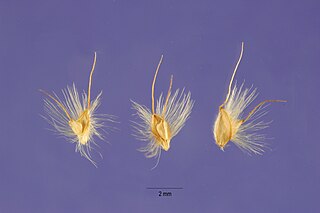
Chloris elata is a species of grass known by the common name tall windmill grass.

Blitum is a genus of flowering plants in the amaranth family Amaranthaceae, subfamily Chenopodioideae. It is closely related to genus Spinacia. Its 12 species were traditionally placed in the genera Chenopodium, Monolepis, or Scleroblitum. The species of genus Blitum occur in Asia, Europe, North Africa, the Americas, and Australia.

Festuca octoflora, also called six-weeks fescue, pullout grass, sixweeks fescue, eight-flower sixweeks grass, eight-flowered fescue; is an annual plant in the grass family (Poaceae). The common name "six week fescue" is because it supplies about 6 weeks of cattle forage after a rain.