Related Research Articles

Aspartic acid (symbol Asp or D; the ionic form is known as aspartate), is an α-amino acid that is used in the biosynthesis of proteins. Like all other amino acids, it contains an amino group and a carboxylic acid. Its α-amino group is in the protonated –NH+
3 form under physiological conditions, while its α-carboxylic acid group is deprotonated −COO− under physiological conditions. Aspartic acid has an acidic side chain (CH2COOH) which reacts with other amino acids, enzymes and proteins in the body. Under physiological conditions (pH 7.4) in proteins the side chain usually occurs as the negatively charged aspartate form, −COO−. It is a non-essential amino acid in humans, meaning the body can synthesize it as needed. It is encoded by the codons GAU and GAC.
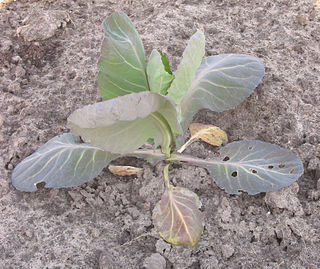
Nitrogen deficiency is a deficiency of nitrogen in plants. This can occur when organic matter with high carbon content, such as sawdust, is added to soil. Soil organisms use any nitrogen available to break down carbon sources, making nitrogen unavailable to plants. This is known as "robbing" the soil of nitrogen. All vegetables apart from nitrogen fixing legumes are prone to this disorder.

Melamine is an organic compound with the formula C3H6N6. This white solid is a trimer of cyanamide, with a 1,3,5-triazine skeleton. Like cyanamide, it contains 67% nitrogen by mass, and its derivatives have fire retardant properties due to its release of nitrogen gas when burned or charred. Melamine can be combined with formaldehyde and other agents to produce melamine resins. Such resins are characteristically durable thermosetting plastic used in high pressure decorative laminates such as Formica, melamine dinnerware, laminate flooring, and dry erase boards. Melamine foam is used as insulation, soundproofing material and in polymeric cleaning products, such as Magic Eraser.

Aquarium fish feed is plant or animal material intended for consumption by pet fish kept in aquariums or ponds. Fish foods normally contain macronutrients, trace elements and vitamins necessary to keep captive fish in good health. Approximately 80% of fishkeeping hobbyists feed their fish exclusively prepared foods that most commonly are produced in flake, pellet or tablet form. Pelleted forms, some of which sink rapidly, are often used for larger fish or bottom feeding species such as loaches or catfish. Some fish foods also contain additives such as sex hormones or beta carotene to artificially enhance the color of ornamental fish.
High-quality feed block or HQFB, is a solid block consisting of molasses, non-protein nitrogen (NPN), rumen by-pass protein, minerals and lipids. It is provided to livestock ruminants in a manner similar to a salt lick.
In animal husbandry, feed conversion ratio (FCR) or feed conversion rate is a ratio or rate measuring of the efficiency with which the bodies of livestock convert animal feed into the desired output. For dairy cows, for example, the output is milk, whereas in animals raised for meat the output is the flesh, that is, the body mass gained by the animal, represented either in the final mass of the animal or the mass of the dressed output. FCR is the mass of the input divided by the output. In some sectors, feed efficiency, which is the output divided by the input, is used. These concepts are also closely related to efficiency of conversion of ingested foods (ECI).
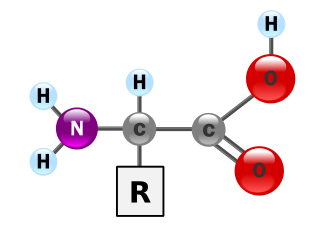
Proteins are essential nutrients for the human body. They are one of the building blocks of body tissue and can also serve as a fuel source. As a fuel, proteins provide as much energy density as carbohydrates: 4 kcal per gram; in contrast, lipids provide 9 kcal per gram. The most important aspect and defining characteristic of protein from a nutritional standpoint is its amino acid composition.
Soy molasses is brown viscous syrup with a typical bittersweet flavor. A by-product of aqueous alcohol soy protein concentrate production, soy molasses is a concentrated, desolventized, aqueous alcohol extract of defatted soybean flakes.
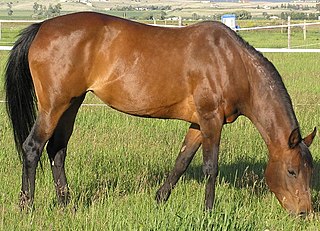
Equine nutrition is the feeding of horses, ponies, mules, donkeys, and other equines. Correct and balanced nutrition is a critical component of proper horse care.
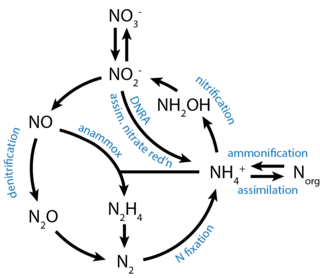
Putrefying/decay bacteria are bacteria involved in putrefaction of living matter. Along with other decomposers, they play a critical role in recycling nitrogen from dead organisms. Putrefying bacteria also play a role in putrefaction and fermentation of proteins in the human gastrointestinal tract.
Fed-batch culture is, in the broadest sense, defined as an operational technique in biotechnological processes where one or more nutrients (substrates) are fed (supplied) to the bioreactor during cultivation and in which the product(s) remain in the bioreactor until the end of the run. An alternative description of the method is that of a culture in which "a base medium supports initial cell culture and a feed medium is added to prevent nutrient depletion". It is also a type of semi-batch culture. In some cases, all the nutrients are fed into the bioreactor. The advantage of the fed-batch culture is that one can control concentration of fed-substrate in the culture liquid at arbitrarily desired levels.
In China, the adulteration and contamination of several food and feed ingredients with inexpensive melamine and other compounds, such as cyanuric acid, ammeline and ammelide, are common practice. These adulterants can be used to inflate the apparent protein content of products, so that inexpensive ingredients can pass for more expensive, concentrated proteins. Melamine by itself has not been thought to be very toxic to animals or humans except possibly in very high concentrations, but the combination of melamine and cyanuric acid has been implicated in kidney failure. Reports that cyanuric acid may be an independently and potentially widely used adulterant in China have heightened concerns for both animal and human health.

Animal feed is food given to domestic animals, especially livestock, in the course of animal husbandry. There are two basic types: fodder and forage. Used alone, the word feed more often refers to fodder. Animal feed is an important input to animal agriculture, and is frequently the main cost of the raising or keeping of animals. Farms typically try to reduce cost for this food, by growing their own, grazing animals, or supplementing expensive feeds with substitutes, such as food waste like spent grain from beer brewing.
Non-protein nitrogen is a term used in animal nutrition to refer collectively to components such as urea, biuret, and ammonia, which are not proteins but can be converted into proteins by microbes in the ruminant stomach. Due to their lower cost compared to plant and animal proteins, their inclusion in a diet can result in economic gain, but at too high levels cause a depression in growth and possible ammonia toxicity, as microbes convert NPN to ammonia first before using that to make protein.

The environmental impact of meat production varies because of the wide variety of agricultural practices employed around the world. All agricultural practices have been found to have a variety of effects on the environment. Some of the environmental effects that have been associated with meat production are pollution, greenhouse gas emissions through fossil fuel usage, animal methane, effluent waste, and water and land consumption. Meat is obtained through a variety of methods, including organic farming, free range farming, intensive livestock production, subsistence agriculture, hunting, and fishing.
Animal nutrition focuses on the dietary nutrients needs of animals, primarily those in agriculture and food production, but also in zoos, aquariums, and wildlife management.

The goat or domestic goat is a domesticated species of goat-antelope typically kept as livestock. It was domesticated from the wild goat of Southwest Asia and Eastern Europe. The goat is a member of the animal family Bovidae and the tribe Caprini, meaning it is closely related to the sheep. There are over 300 distinct breeds of goat. It is one of the oldest domesticated species of animal, according to archaeological evidence that its earliest domestication occurred in Iran at 10,000 calibrated calendar years ago.

Meat and bone meal (MBM) is a product of the rendering industry. It is typically about 48–52% protein, 33–35% ash, 8–12% fat, and 4–7% water. It is primarily used in the formulation of animal feed to improve the amino acid profile of the feed. Feeding of MBM to cattle is thought to have been responsible for the spread of BSE ; therefore, in most parts of the world, MBM is no longer allowed in feed for ruminant animals. However, it is still used to feed monogastric animals.

Teladorsagia circumcincta is a nematode that is one of the most important parasites of sheep and goats. It was previously known as Ostertagia circumcincta and is colloquially known as the brown stomach worm. It is common in cool, temperate areas, such as south-eastern and south-western Australia and the United Kingdom. There is considerable variation among lambs and kids in susceptibility to infection. Much of the variation is genetic and influences the immune response. The parasite induces a type I hypersensitivity response which is responsible for the relative protein deficiency which is characteristic of severely infected animals. There are mechanistic mathematical models which can predict the course of infection. There are a variety of ways to control the infection and a combination of control measures is likely to provide the most effective and sustainable control.

Hyparrhenia rufa is a species of grass known by the common names jaraguá, jaraguá grass, and giant thatching grass. It is native to Africa and it is widespread in the world as a cultivated forage and fodder for livestock and a naturalized and sometimes invasive species.
References
- ↑ Kioumarsi, H., Yahaya, Z.S., Rahman, W.A., 2008. Introduce molasses/mineral feed blocks beside the use of medicated blocks on growth, carcass characteristics, blood metabolites, and control of gastro-intestinal nematode infection in grazing goats. Presented during the 1st Annual PPSK/IPS postgraduate Colloqium. Pinang, Malaysia. pp: 51-52. (Oral presentation)
- ↑ Kioumarsi, H., Yahya, Z.S., Rahman, W.A., Chandraw, P., 2010. A New Strategy that Can Improve Commercial Productivity of Raising Boer Goats in Malaysia. . Asian J. Anim. Vet. Adv. 6: 476-481
- ↑ Kioumarsi, H., Yahaya, Z.S., Rahman, W.A., 2011. The Effect of Molasses/Mineral Feed Blocks along with the Use of Medicated Blocks on Haematological and Biochemical Blood Parameters in Boer Goats. Asian J. Anim. Vet. Adv. 6: 1264-1270