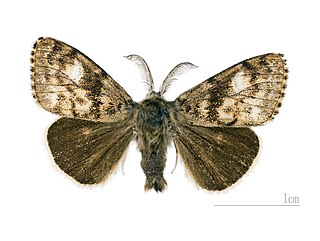
The Arctiinae are a large and diverse subfamily of moths, with around 11,000 species found all over the world, including 6,000 neotropical species. This group includes the groups commonly known as tiger moths, which usually have bright colours, footmen, which are usually much drabber, lichen moths, and wasp moths. Many species have "hairy" caterpillars that are popularly known as woolly bears or woolly worms. The scientific name of this subfamily refers to this hairiness. Some species within the Arctiinae have the word “tussock” in their common name due to people misidentifying them as members of the Lymantriinae based on the characteristics of the larvae.

The Arctiini are a tribe of tiger moths in the family Erebidae.
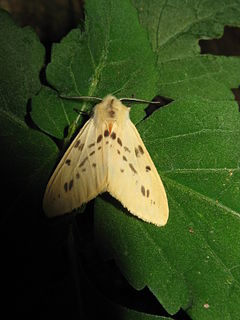
Lemyra is a genus of tiger moths in the family Erebidae. The genus contains many species from East and South Asia, Sundaland and Australia. It was described by Francis Walker in 1856.
Lemyra flavalis is a moth of the family Erebidae. It was described by Frederic Moore in 1865. It is found in China, Nepal, India, Bhutan and Myanmar.
Lemyra flaveola is a moth of the family Erebidae. It was described by John Henry Leech in 1899. It is found in western China.
Lemyra heringi is a moth of the family Erebidae. It was described by Franz Daniel in 1943. It is found in Yunnan, China.

Lemyra imparilis is a moth of the family Erebidae. It was described by Arthur Gardiner Butler in 1877. It is found in China, Taiwan, Japan and Korea.
Lemyra infernalis is a moth of the family Erebidae. It was described by Arthur Gardiner Butler in 1877. It is found in China, Taiwan, Japan and possibly Assam, India.

Lemyra moltrechti is a moth of the family Erebidae. It was described by Miyake in 1909. It is found in Taiwan.
Lemyra nigricosta is a moth of the family Erebidae. It was described by Thomas in 1990. It is found in Taiwan.
Lemyra pseudoflammeoida is a moth of the family Erebidae. It was described by Cheng-Lai Fang in 1983. It is found in Jiangxi, China.
Lemyra proteus is a moth of the family Erebidae. It was described by Joseph de Joannis in 1928. It is found in China and Vietnam.
Lemyra rhodophila is a moth of the family Erebidae. It was described by Francis Walker in 1864. It is found in China (Tibet), Pakistan, India, Myanmar and Nepal.
Lemyra rubidorsa is a moth of the family Erebidae. It was described by Frederic Moore in 1865. It is found in Pakistan (Kashmir), India and China.
Lemyra rubrocollaris is a moth of the family Erebidae. It was described by Reich in 1937. It is found in China (Jiangsu).
Lemyra sikkimensis is a moth of the family Erebidae. It was described by Frederic Moore in 1879. It is found in India and China.

Lemyra stigmata is a moth of the family Erebidae. It was described by Frederic Moore in 1865. It is found in China, Pakistan, India, Nepal, Bhutan, Myanmar, Thailand and Vietnam.
Spilarctia zhangmuna is a moth in the family Erebidae. It was described by Cheng-Lai Fang in 1982. It is found in Yunnan and Tibet in western China.

Utetheisa inconstans is a moth in the family Erebidae. It was described by Arthur Gardiner Butler in 1880. It is found in Japan and Taiwan.
Utetheisa specularis is a moth in the family Erebidae. It was described by Francis Walker in 1856. It is found in Indonesia.