Saraswat Brahmins are Hindu Brahmins, who are spread over widely separated regions spanning from Kashmir in North India to Konkan in West India to Kanara and Kerala in South India. The word Saraswat is derived from the Rigvedic Sarasvati River.
Deshastha Brahmin is a Hindu Brahmin subcaste mainly from the Indian state of Maharashtra and North Karnataka. Other than these states, according to authors K. S. Singh, Gregory Naik and Pran Nath Chopra, Deshastha Brahmins are also concentrated in the states of Telangana (which was earlier part of Hyderabad State and Berar Division), Andhra Pradesh and Madhya Pradesh (Which was earlier part of Central Provinces and Berar) Author Pran Nath Chopra and journalist Pritish Nandy say, "Most of the well-known saints from Maharashtra, Karnataka and Andhra Pradesh were Deshastha Brahmins". The mother tongue of Deshastha Brahmins is either Marathi, Kannada or Telugu.

Patidar, formerly known as Kanbi, is an Indian landlord and agrarian caste and community mostly found in Gujarat but also in at least 22 other states of India. The community comprises at multiple subcastes, most prominently the Levas and Kadvas. They form one of the dominant castes in Gujarat. The title of Patidar originally conferred to the land owning aristocratic class of Gujarati Kanbis; however, it was later applied en masses to the entirety of the peasant population who lay claim to a land owning identity, partly as a result of land reforms during the British Raj.
Reservation is a system of affirmative action in India that provides historically disadvantaged groups representation in education, employment, government schemes, scholarships and politics. Based on provisions in the Indian Constitution, it allows the Union Government and the States and Territories of India to set reserved quotas or seats, at particular percentage in Education Admissions, Employments, Political Bodies, Promotions, etc, for "socially and educationally backward citizens."
Gurjar or Gujjar is an ethnic nomadic, agricultural and pastoral community, residing mainly in India, Pakistan and Afghanistan, divided internally into various clan groups. They were traditionally involved in agriculture and pastoral and nomadic activities and formed a large homogeneous group. The historical role of Gurjars has been quite diverse in society: at one end they have been founders of several kingdoms and dynasties and, at the other end, some are still nomads with no land of their own.
Degam is a village in Navsari District in the state of Gujarat, India. The population is around 5580.
Rajasthani people or Rajasthanis are a group of Indo-Aryan peoples native to Rajasthan, a state in Northern India. Their language, Rajasthani, is a part of the western group of Indo-Aryan languages.
Gurjar Kshatriya Kadia, also known as Gurjar Kadia/ Gujjar Kadia, and Kadia Kshatriya are a Hindu community mostly in Gujarat and Maharashtra. They are members of the north Indian Gurjar(Gujjar) ethnic group. They are artisan community, occupation is masonry work and are related to larger artisan group of Kadias.

Kumhar or Kumbhar is a caste or community in India, Nepal and Pakistan. Kumhar have historically been associated with art of pottery.

Biggest village in a Gujarat by size and population.
Marathi Brahmins are communities native to the Indian state of Maharashtra. They are classified into mainly three sub-divisions based on their places of origin, "Desh", "Karad" and "Konkan". The Brahmin subcastes that come under Maharashtra Brahmins include Deshastha, Chitpavan (Konkanastha), Saraswat, Karhade, and Devrukhe.
The Pancholi are a gotra of the khatri or sindhi caste found in the state of Gujarat, India.
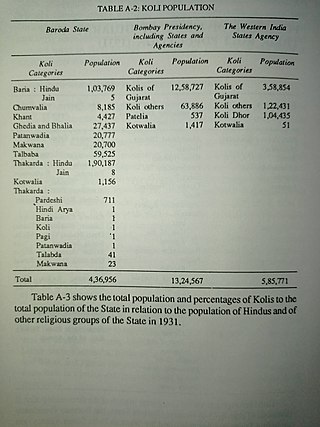
Baria, or Baraiya,Bareeya and Bariya is a clan (Gotra) of the Koli caste found in the Indian State of Gujarat and Dadra and Nagar Haveli and Daman and Diu. the Devgad Baria was their Stronghold or given their name to Baria State in Gujarat. according to the historian Y.V.S Nath, the ruling royal family of Baria State is original Koli by caste but later they claimed to be of Rajput origin to be in high status among other Princely States.
Maru is a surname of Indian origin found among the people from Kutch and Saurashtra regions in the state of Gujarat and Rajasthan in India. The Maru word is used to identify the region of Marwar, the diaspora of people who migrated from this region to other places, use this surname to link their ancestral home.
The Vishwakarma community are a social group of India, sometimes described as a caste. They prefer the alternate name, Vishwabrahmin, and claim themselves to be Brahmin or of high-status in the caste hierarchy, although these claims are not generally accepted outside the community. The community comprises five sub-groups—carpenters, blacksmiths, bronze smiths, goldsmiths and stonemasons— claim to be descendants of Vishvakarma, the builder and architect of heavenly realm, a Hindu deity.
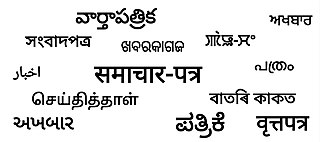
The Media in Gujarati language started with publication of Bombay Samachar in 1822. Initially the newspapers published business news and they were owned by Parsi people based in Bombay. Later Gujarati newspapers started published from other parts of Gujarat. Several periodicals devoted to social reforms were published in the second half of the 19th century. After arrival of Mahatma Gandhi, the Indian independence movement peaked and it resulted in proliferation of Gujarati media. Following independence, the media was chiefly focused on political news. After bifurcation of Bombay state, the area of service changed. Later there was an increase in readership due to growth of literacy and the media houses expanded its readership by publishing more number of editions. Later these media houses ventured into digital media also. The radio and television media expanded after 1990.
Kadia Kumbhar / Kadiya Kumbhar are a Hindu sub-group of the Kumbhar caste, which are found only in Gujarat, India. They are among the Socially and Educationally Backward Classes of Gujarat State.
The Aboti Brahmin are a Sakaldwipiya Brahmin community living in western part of India. They are mainly agricultural community who were recorded living in Rajasthan, India, around 1228 CE, where they were usually temple servants and had migrated from Dvaravati. Today, they are found in the state of Gujarat. They perform puja at the Dwarkadhish Temple in Dwarka during the Hindu festival of Janmashtami.
Starting in July 2015, the people of India's Patidar community, seeking Other Backward Class (OBC) status, held public demonstrations across the Indian state of Gujarat.
Varu is a surname of Indian origin, found among the people from Kutch and Saurashtra regions in the state of Gujarat in India and diaspora of people of India. Outside India, Varu surname occurs in people of United Kingdom, Papua New Guinea, Cook Islands & Canada.
