 | This article needs additional citations for verification .(November 2022) |
Vieste Cathedral (Italian : Concattedrale di Santa Maria Assunta) is a Roman Catholic co-cathedral in Vieste, a former bishopric in Apulia, southern Italy.
Contents

| | This article needs additional citations for verification .(November 2022) |
Vieste Cathedral (Italian : Concattedrale di Santa Maria Assunta) is a Roman Catholic co-cathedral in Vieste, a former bishopric in Apulia, southern Italy.
It was built in Apulian Romanesque style as a cathedral when Vieste was still a Latin Catholic diocese (until its merger into the present Roman Catholic Archdiocese of Manfredonia–Vieste–San Giovanni Rotondo on 1818.06.27).
It is dedicated to the Assumption of Mary. It has a basilica plan with a nave and two aisles. Its bell tower was rebuilt in Baroque style in the 18th century after the previous one collapsed.
The co-cathedral of Viesti became a minor basilica by decree of Pope John Paul II on 12 February 1981. [1]

A co-cathedral is a cathedral church which shares the function of being a bishop's seat, or cathedra, with another cathedral, often in another city. Instances of this occurred in England before the Protestant Reformation in the dioceses of 'Bath and Wells', and of 'Coventry and Lichfield'. These two dioceses were each named for both cities that served as bishop's seats.

Cathedrals, collegiate churches, and monastic churches like those of abbeys and priories, often have certain complex structural forms that are found less often in parish churches. They also tend to display a higher level of contemporary architectural style and the work of accomplished craftsmen, and occupy a status both ecclesiastical and social that an ordinary parish church rarely has. Such churches are generally among the finest buildings locally and a source of regional pride. Many are among the world's most renowned works of architecture. These include St Peter's Basilica, Notre-Dame de Paris, Cologne Cathedral, Salisbury Cathedral, Antwerp Cathedral, Prague Cathedral, Lincoln Cathedral, the Basilica of Saint-Denis, Santa Maria Maggiore, the Basilica of San Vitale, St Mark's Basilica, Westminster Abbey, Saint Basil's Cathedral, Antoni Gaudí's incomplete Sagrada Família and the ancient cathedral of Hagia Sophia in Istanbul, now a mosque.

The province of Foggia is a province in the Italian region Apulia.

Francis William Petre, sometimes known as Frank Petre, was a New Zealand-born architect based in Dunedin. He was an able exponent of the Gothic revival style, one of its best practitioners in New Zealand. He followed the Catholic Church's initiative to build places of worship in Anglo-Saxon countries inspired by Romance forms of architecture. His basilica Cathedral of the Blessed Sacrament, in Christchurch was demolished in 2021.

The Cathedral Basilica of Saints Peter and Paul, head church of the Roman Catholic Archdiocese of Philadelphia, stands on 18th Street on the east side of Logan Square, at the Benjamin Franklin Parkway. It was designed by Napoleon LeBrun to plans by the Reverend Mariano Muller and the Reverend John Tornatore and built between 1846 and 1864. Its dome and Palladian facade, by John Notman, were added after 1850. The interior was decorated by Constantino Brumidi.

Vieste is a town, comune and former Catholic bishopric in the province of Foggia, in the Apulia region of southeast Italy. A marine resort in Gargano, Vieste has received Blue Flags for the purity of its waters from the Foundation for Environmental Education. The area covered by the comune is included in the Gargano National Park.

The Cathedral of the Holy Spirit, alternatively known as the St. Esprit Cathedral, located on Cumhuriyet Avenue 127/A, in the quarter of Pangaltı in Şişli district, the former Harbiye, between Taksim Square and Nişantaşı, is one of the main Catholic churches in Istanbul, Turkey. This 19th century cathedral is behind the walls of the French Notre Dame de Sion high school. While walking from Taksim towards Harbiye, some may notice a door with metal bars leading to the school's courtyard beyond which is a statue of Benedict XV. Past the door stands the cathedral.

The Archdiocese of Manfredonia–Vieste–San Giovanni Rotondo is a Latin Church non-Metropolitan Archdiocese of the Catholic Church in the civil province of Foggia, in Apulia, south-eastern Italy, which is part the ecclesiastical province of the Metropolitan Archdiocese of Foggia-Bovino
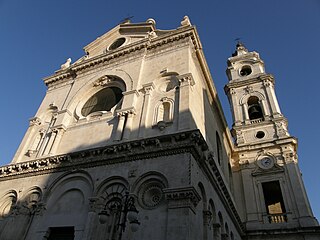
The Archdiocese of Foggia-Bovino is a Latin archdiocese of the Catholic Church in Apulia, southern Italy, created by promoting the bishopric of Foggia in 1979, and merging with the bishopric of Bovina in 1986, whose name was included in its title.
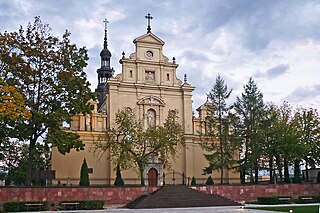
The Diocese of Kielce is a Latin diocese of the Catholic Church located in the city of Kielce in the ecclesiastical province of Kraków in Poland.

The Diocese of Koper is a Latin diocese of the Catholic Church in southwestern Slovenia. It is part of the ecclesiastical province of Ljubljana. Its cathedral is dedicated to the Assumption of Mary and is located in the Adriatic port town of Koper. A co-cathedral, the Co-Cathedral of Christ the Saviour, located in Nova Gorica, gained its status in 2004. The Latin name of the diocese, Dioecesis Iustinopolitana, is because Koper was in the past named Justinopolis in honour of the Byzantine emperor Justinian II.

Alatri Cathedral, otherwise the Basilica of Saint Paul, is a Roman Catholic cathedral in Alatri, Lazio, Italy, dedicated to Saint Paul. It was formerly the cathedral of the Diocese of Alatri. Since 30 September 1986 it has been a co-cathedral of the Diocese of Anagni-Alatri. Pope Pius XII declared it a basilica minor on 10 September 1950.

Bitonto Cathedral is a Roman Catholic cathedral in the city of Bitonto in the Province of Bari, Italy.
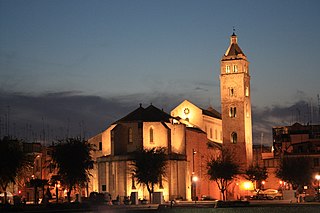
Barletta Cathedral is a Roman Catholic cathedral in Barletta, Apulia, southern Italy. Formerly the seat of the archbishops of Barletta and Nazareth, it is currently a co-cathedral in the Archdiocese of Trani-Barletta-Bisceglie. It was built in two different styles, Romanesque and Gothic, from the 12th century to the 14th century.

Bisceglie Cathedral is a Roman Catholic cathedral in Bisceglie, Apulia, Italy. Peter II of Trani began to build the cathedral in 1073, which he dedicated to his namesake, Saint Peter. Building was completed in 1295. Formerly the episcopal seat of the Diocese of Bisceglie, it has been since 1986 a co-cathedral in the Archdiocese of Trani-Barletta-Bisceglie.
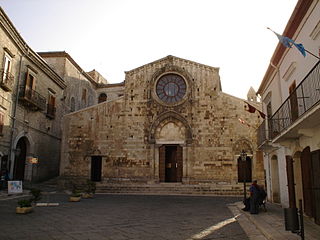
Bovino Cathedral is a Roman Catholic cathedral in Bovino, region of Apulia, Italy, dedicated to the Assumption of the Virgin Mary. Formerly the episcopal seat of the Diocese of Bovino, it has been since 1986 a co-cathedral in the Archdiocese of Foggia-Bovino.

Palestrina Cathedral is a Roman Catholic cathedral located in Palestrina, in the region of Lazio, Italy. It is the episcopal seat of the Suburbicarian Diocese of Palestrina, and dedicated to Saint Agapitus.

The Basilica di Sant’Andrea Apostolo is an 18th-century, Neoclassical-style, Roman Catholic co-cathedral in the town of Subiaco, region of Lazio, Italy.
Caiazzo Cathedral is a Roman Catholic church in Caiazzo, province of Caserta, Italy, dedicated to the Virgin Mary and Saint Stephen the Bishop. It was previously the cathedral of the diocese of Caiazzo, until in 1986 it became a co-cathedral in the present Diocese of Alife-Caiazzo, which was formed in that year by merging the two older dioceses of Caiazzo and Alife. In 2013 it was declared a minor basilica.

Basilicas are Catholic church buildings that have a designation, conferring special privileges, given by the Pope. Basilicas are distinguished for ceremonial purposes from other churches. The building need not be a basilica in the architectural sense. Basilicas are either major basilicas, of which there are four, all in the Diocese of Rome, or minor basilicas, of which there were 1,810 worldwide as of 2019.