
Ypres is a Belgian city and municipality in the province of West Flanders. Though the Dutch name Ieper is the official one, the city's French name Ypres is most commonly used in English. The municipality comprises the city of Ypres/Ieper and the villages of Boezinge, Brielen, Dikkebus, Elverdinge, Hollebeke, Sint-Jan, Vlamertinge, Voormezele, Zillebeke, and Zuidschote. Together, they are home to about 34,900 inhabitants.
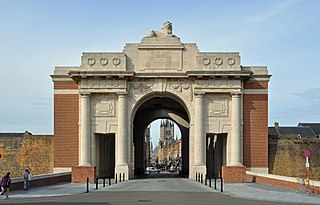
The Menin Gate, officially the Menin Gate Memorial to the Missing, is a war memorial in Ypres, Belgium, dedicated to the British and Commonwealth soldiers who were killed in the Ypres Salient of World War I and whose graves are unknown. The memorial is located at the eastern exit of the town and marks the starting point for one of the main roads that led Allied soldiers to the front line.
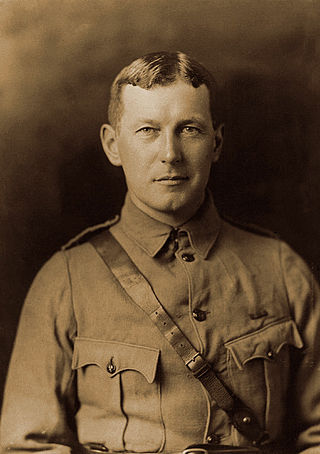
Lieutenant-Colonel John McCrae was a Canadian poet, physician, author, artist and soldier during World War I, and a surgeon during the Second Battle of Ypres, in Belgium. He is best known for writing the famous war memorial poem "In Flanders Fields". McCrae died of pneumonia near the end of the war. His famous poem is a threnody, a genre of lament.

The 36th (Ulster) Division was an infantry division of the British Army, part of Lord Kitchener's New Army, formed in September 1914. Originally called the Ulster Division, it was made up of mainly members of the Ulster Volunteer Force, who formed thirteen additional battalions for three existing regiments: the Royal Irish Fusiliers, the Royal Irish Rifles and the Royal Inniskilling Fusiliers. However, regular Officers and Soldiers and men from all around the United Kingdom made up the strength of the Division. The division served from October 1915 on Western Front as a formation of the British Army during the Great War.
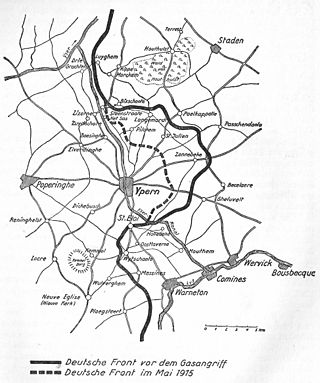
During the First World War, the Second Battle of Ypres was fought from 22 April – 25 May 1915 for control of the tactically important high ground to the east and south of the Flemish town of Ypres in western Belgium. The First Battle of Ypres had been fought the previous autumn. The Second Battle of Ypres was the first mass use by Germany of poison gas on the Western Front.

The Lancashire Fusiliers was a line infantry regiment of the British Army that saw distinguished service through many years and wars, including the Second Boer War, the First and Second World Wars, and had many different titles throughout its 280 years of existence. In 1968 the regiment was amalgamated with the other regiments of the Fusilier Brigade – the Royal Northumberland Fusiliers, Royal Warwickshire Fusiliers and the Royal Fusiliers – to form the current Royal Regiment of Fusiliers.

The Connaught Rangers was an Irish line infantry regiment of the British Army formed by the amalgamation of the 88th Regiment of Foot and the 94th Regiment of Foot in July 1881. Between the time of its formation and Irish independence, it was one of eight Irish regiments raised largely in Ireland. Its home depot was in Galway. It was disbanded following the establishment of the independent Irish Free State in 1922, along with the other five regiments that had their traditional recruiting grounds in the counties of the new state.

Edward Noel Mellish was an English recipient of the Victoria Cross, the highest and most prestigious award for gallantry in the face of the enemy that can be awarded to British and Commonwealth forces.

The Essex Yeomanry was a Reserve unit of the British Army that originated in 1797 as local Yeomanry Cavalry Troops in Essex. Reformed after the experience gained in the Second Boer War, it saw active service as cavalry in World War I and as artillery in World War II. Its lineage is maintained by 36 Signal Squadron, part of 71 (Yeomanry) Signal Regiment, Royal Corps of Signals.

Major General Sir William Bernard Hickie, was an Irish-born senior British Army officer and an Irish nationalist politician.

Bedford House Cemetery is a Commonwealth War Graves Commission burial ground for the dead of the First World War located near Zillebeke, itself near Ypres, on the Western Front in Belgium.

The Crucified Soldier refers to the widespread story of an Allied soldier serving in the Canadian Corps who may have been crucified with bayonets on a barn door or a tree, while fighting on the Western Front during World War I. Three witnesses said they saw an unidentified crucified Canadian soldier near the battlefield of Ypres, Belgium, on or around 24 April 1915, but eyewitness accounts were somewhat contradictory, no crucified body was recovered and the identity of the crucified soldier was not discovered at the time.

Alfred St George Hamersley was a nineteenth-century solicitor and entrepreneur of great renown, an English MP, and an English rugby union international who played in the first ever international match. He went on to captain his country's team, and later was instrumental in establishing the sport in the south of New Zealand and in British Columbia.

Westwell is a small village and civil parish about 2 miles (3 km) southwest of the market town of Burford in Oxfordshire. It is the westernmost village in the county, close to the border with Gloucestershire.

The Nicholson War Memorial in Leek, Staffordshire, England is a 1925 war memorial. It was commissioned by local manufacturer Sir Arthur Nicholson and his wife Lady Marianne, née Falkner, in memory of their son Lieutenant Basil Lee Nicholson, who was killed in action at Ypres, Belgium, in 1915, at the age of 24; and in memory of all the other local men who died fighting in World War I. It now has plaques commemorating and naming 535 Leek and district men and women who died during World War I and World War II.
The 1918 Birthday Honours were appointments by King George V to various orders and honours to reward and highlight good works by citizens of the British Empire. The appointments were made to celebrate the official birthday of The King, 3 June and were published in The London Gazette on the same day, followed by a supplement.

The Rangers was a volunteer unit of the British Army, originally formed in 1860. It provided a detachment for service in the Second Boer War, saw intensive action on the Western Front in the First World War, and served as motorised infantry during the Second World War during the campaigns in Greece and the Western Desert.
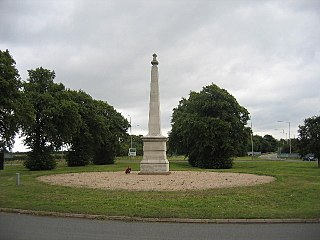
The 29th Division War Memorial is a war memorial beside the junction of the A45 and the B4455 near Stretton-on-Dunsmore, near Rugby, Warwickshire. It commemorates the service of the British 29th Division during the First World War. The memorial became a Grade II listed building in 1987, upgraded to Grade II* in 2015, and it is described by Historic England as "probably the most significant single memorial in Britain associated with the Gallipoli campaign".
The Royal London Militia was an auxiliary regiment organised in the City of London during the French Revolutionary War from the former London Trained Bands. It later became part of the Royal Fusiliers. After conversion to the Special Reserve (SR) under the Haldane Reforms it was one of just a handful of SR units to see combat during World War I, fighting in many actions on the Western Front from 1916 until the Armistice in 1918. After a shadowy postwar existence the unit was finally disbanded in 1953.


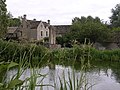 Memorial beside the pond, in 2003
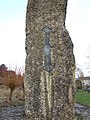 Brass numeral with inscriptions, in 2007
