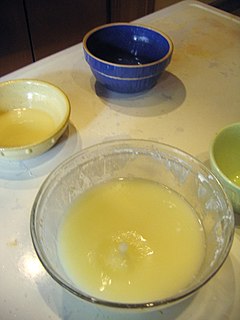
A whey protein isolate (often whey isolate) is a dietary supplement and food ingredient created by separating components from whey. Whey is a milk by-product from the cheese-making process. Whey can be processed to yield whey protein in three forms: whey isolate, whey concentrate, or whey hydrolysate. The difference between the whey protein forms is the composition of the product, particularly the protein content. Whey isolates contain the highest amount of protein and can be virtually lactose free, carbohydrate free, fat free, and cholesterol free.[1]
Whey proteins are highly bioavailable, are very quickly absorbed into the body, and have a high concentration of branched-chain amino acids (BCAAs) which are highly concentrated in muscle tissue, and are used to fuel working muscles and stimulate protein synthesis.[2]
Whey isolates have had their base component (water) removed and are generally considered almost lactose- and cholesterol-free — they are typically at least 90% protein.[3]
Two separation methods are widely used. One method utilizes ion exchangers which extract native whey protein from the whey stream according to the surface charge characteristics of the molecule, also known as the zeta-potential. This method uses mild pH adjustments to activate and subsequently deactivate the attraction between the ion exchange resin and the protein molecules. In between the temporary binding of protein to the resin, non-protein components are thoroughly washed from the reactor. This process may or may not damage the proteins, but no scientific evidence exists to suggest that it does. Although strong acids and bases are used for the adjustment, the pH rise itself is quite small and within the range common in foods. Changes in protein conformation within this range are reversible and are not considered denaturation. Ion exchange is highly specific to native whey proteins and is generally more selective in what is retained during the process. This is why the process is best known for creating highly pure whey proteins.
The second method, membrane filtration, typically a combination of microfiltration and ultrafiltration, uses molecular size as the basis for separating components from the whey stream. In the process, pressure is applied across a membrane surface which forces smaller molecules through the membrane while larger molecules are retained. Both methods yield a very high protein to non-protein product ratio, although membrane filtration is somewhat less selective allowing any molecule within a size range to be retained. One compositional difference between whey protein isolates made from cheese whey via membrane filtration compared to ion exchange is that membrane filtration includes significant levels of the casein fragment caseino-glycomacropeptide (cGMP). This fragment has a less complete amino acid profile and is low in branched chain amino acids.
As a dietary supplement, whey and other protein powders can be reconstituted at the time of usage by the addition of a solvent such as water, juice, milk, or other liquid. As a food ingredient, whey powders are easily mixed or dissolved into a formulated food.
Function
Whey protein is popular among athletes today because of its ability to be digested very rapidly and help return the post-workout body back from a catabolic (muscle-wasting) state to an anabolic (muscle-building) state.[medical citation needed] Whey protein isolates are also widely used in infant formula to provide amino acids for optimal growth and development,[medical citation needed] as well as for protein fortification of bars, beverages, dairy products, extruded snacks and cereals, and other food products. To anyone who is lactose-intolerant, whey protein isolate is the best choice.
Distribution
Powdered dehydrated concentrates and isolates have reduced packaging and shipping requirements, and extended shelf lives. They are readily available.
Whey is the liquid remaining after milk has been curdled and strained. It is a byproduct of the manufacture of cheese or casein and has several commercial uses. Sweet whey is a byproduct resulting from the manufacture of rennet types of hard cheese, like cheddar or Swiss cheese. Acid whey is a byproduct brought out during the making of acid types of dairy products, such as cottage cheese or strained yogurt.
A biomolecule or biological molecule is a loosely used term for molecules present in organisms that are essential to one or more typically biological processes, such as cell division, morphogenesis, or development. Biomolecules include large macromolecules such as proteins, carbohydrates, lipids, and nucleic acids, as well as small molecules such as primary metabolites, secondary metabolites and natural products. A more general name for this class of material is biological materials. Biomolecules are an important element of living organisms, those biomolecules are often endogenous, produced within the organism but organisms usually need exogenous biomolecules, for example certain nutrients, to survive.
Calcium ions (Ca2+) contribute to the physiology and biochemistry of organisms' cells. They play an important role in signal transduction pathways, where they act as a second messenger, in neurotransmitter release from neurons, in contraction of all muscle cell types, and in fertilization. Many enzymes require calcium ions as a cofactor, including several of the coagulation factors. Extracellular calcium is also important for maintaining the potential difference across excitable cell membranes, as well as proper bone formation.
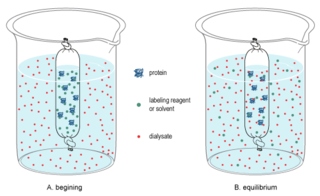
In biochemistry, dialysis is the process of separating molecules in solution by the difference in their rates of diffusion through a semipermeable membrane, such as dialysis tubing.
Protein purification is a series of processes intended to isolate one or a few proteins from a complex mixture, usually cells, tissues or whole organisms. Protein purification is vital for the specification of the function, structure and interactions of the protein of interest. The purification process may separate the protein and non-protein parts of the mixture, and finally separate the desired protein from all other proteins. Separation of one protein from all others is typically the most laborious aspect of protein purification. Separation steps usually exploit differences in protein size, physico-chemical properties, binding affinity and biological activity. The pure result may be termed protein isolate.
Enterocytes, or intestinal absorptive cells, are simple columnar epithelial cells which line the inner surface of the small and large intestines. A glycocalyx surface coat contains digestive enzymes. Microvilli on the apical surface increase its surface area. This facilitates transport of numerous small molecules into the enterocyte from the intestinal lumen. These include broken down proteins, fats, and sugars, as well as water, electrolytes, vitamins, and bile salts. Enterocytes also have an endocrine role, secreting hormones such as leptin.
An ion-exchange resin or ion-exchange polymer is a resin or polymer that acts as a medium for ion exchange. It is an insoluble matrix normally in the form of small microbeads, usually white or yellowish, fabricated from an organic polymer substrate. The beads are typically porous, providing a large surface area on and inside them the trapping of ions occurs along with the accompanying release of other ions, and thus the process is called ion exchange. There are multiple types of ion-exchange resin. Most commercial resins are made of polystyrene sulfonate.
Whey protein is a mixture of proteins isolated from whey, the liquid material created as a by-product of cheese production. The proteins consist of α-lactalbumin, β-lactoglobulin, serum albumin and immunoglobulins. Whey protein is commonly marketed as a dietary supplement, and various health claims have been attributed to it. A review published in 2010 in the European Food Safety Authority Journal concluded that the provided literature did not adequately support the proposed claims. For muscle growth, whey protein has been shown to be slightly better compared to other types of protein, such as casein or soy.
Ion exchange is a reversible interchange of one kind of ion present on an insoluble solid with another of like charge present in a solution surrounding the solid with the reaction being used especially for softening or making water demineralised, the purification of chemicals and separation of substances.
Ion chromatography separates ions and polar molecules based on their affinity to the ion exchanger. It works on almost any kind of charged molecule—including large proteins, small nucleotides, and amino acids. However, ion chromatography must be done in conditions that are one unit away from the isoelectric point of a protein.
Sephadex is a cross-linked dextran gel used for gel filtration. It was launched by Pharmacia in 1959, after development work by Jerker Porath and Per Flodin. The name is derived from separation Pharmacia dextran. It is normally manufactured in a bead form and most commonly used for gel filtration columns. By varying the degree of cross-linking, the fractionation properties of the gel can be altered.
In medicine, the BUN-to-creatinine ratio is the ratio of two serum laboratory values, the blood urea nitrogen (BUN) (mg/dL) and serum creatinine (Cr) (mg/dL). Outside the United States, particularly in Canada and Europe, the term urea is often used. BUN only reflects the nitrogen content of urea and urea measurement reflects the whole of the molecule, urea is approximately twice that of BUN. In Canada and Europe the units are also different (mmol/L). The units of creatinine are also different (μmol/L), and this value is termed the urea-to-creatinine ratio. The ratio may be used to determine the cause of acute kidney injury or dehydration.
Soy protein is a protein that is isolated from soybean. It is made from soybean meal that has been dehulled and defatted. Dehulled and defatted soybeans are processed into three kinds of high protein commercial products: soy flour, concentrates, and isolates. Soy protein isolate has been used since 1959 in foods for its functional properties.
Gastrointestinal physiology is the branch of human physiology that addresses the physical function of the gastrointestinal (GI) tract. The function of the GI tract is to process ingested food by mechanical and chemical means, extract nutrients and excrete waste products. The GI tract is composed of the alimentary canal, that runs from the mouth to the anus, as well as the associated glands, chemicals, hormones, and enzymes that assist in digestion. The major processes that occur in the GI tract are: motility, secretion, regulation, digestion and circulation. The proper function and coordination of these processes are vital for maintaining good health by providing for the effective digestion and uptake of nutrients.
Chromatography is a physical method of separation that distributes the components you want to separate between two phases, one stationary, the other moving in a definite direction. Cold ethanol precipitation, developed by Cohn in 1946, manipulates pH, ionic strength, ethanol concentration and temperature to precipitate different protein fractions from plasma. Chromatographic techniques utilise ion exchange, gel filtration and affinity resins to separate proteins. Since the 1980s it has emerged as an effective method of purifying blood components for therapeutic use.
The cell membrane is a biological membrane that separates the interior of all cells from the outside environment which protects the cell from its environment. The cell membrane consists of a lipid bilayer, including cholesterols that sit between phospholipids to maintain their fluidity at various temperatures. The membrane also contains membrane proteins, including integral proteins that go across the membrane serving as membrane transporters, and peripheral proteins that loosely attach to the outer (peripheral) side of the cell membrane, acting as enzymes shaping the cell. The cell membrane controls the movement of substances in and out of cells and organelles. In this way, it is selectively permeable to ions and organic molecules. In addition, cell membranes are involved in a variety of cellular processes such as cell adhesion, ion conductivity and cell signalling and serve as the attachment surface for several extracellular structures, including the cell wall, the carbohydrate layer called the glycocalyx, and the intracellular network of protein fibers called the cytoskeleton. In the field of synthetic biology, cell membranes can be artificially reassembled.
Pea protein is a type of food. It is a source of protein derived and extracted in powder form from the yellow and green split peas, Pisum sativum, classified in the legume food group. It can be used as a supplement to increase an individual's protein or other nutrient intake, or as a substitute for other food products. It is also used as a functional ingredient in food-manufacturing, such as a thickener, foaming agent, or an emulsifier.
Sour cream or soured cream is a dairy product obtained by fermenting regular cream with certain kinds of lactic acid bacteria. The bacterial culture, which is introduced either deliberately or naturally, sours and thickens the cream. Its name comes from the production of lactic acid by bacterial fermentation, which is called souring. Crème fraîche is one type of sour cream with a high fat content and less sour taste.
Protein quality is the digestibility and quantity of essential amino acids for providing the proteins in correct ratios for human consumption. There are various methods that rank the quality of different types of protein, some of which are outdated and no longer in use, or not considered as useful as they once were thought to be. The Protein Digestibility Corrected Amino Acid Score (PDCAAS), which was recommended by the Food and Agriculture Organization of the United Nations (FAO), became the industry standard in 1993. FAO has recently recommended the newer Digestible Indispensable Amino Acid Score (DIAAS) to supersede PDCAAS. The dairy industry is in favor of this, because while PDCAAS truncates all protein types that exceed the essential amino acid (EAA) requirements to 1.0, DIAAS allows a higher than 1.0 ranking: while for example both soy protein isolate and whey isolate are ranked 1.0 according to PDCAAS, in the DIAAS system, whey has a higher score than soy.
This page is based on this Wikipedia article Text is available under the CC BY-SA 4.0 license; additional terms may apply. Images, videos and audio are available under their respective licenses.