A white squirrel may describe several species of squirrels.
White morphs are a common colouration in some populations Finlayson's squirrel.
Eurasian red squirrels and Japanese squirrels may also rarely exhibit nearly white coloration, although they are not considered true white morphs.
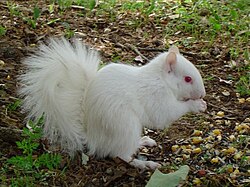
In some squirrels, white coloration is caused by pigmentation-loss mutations such as albinism or leucism.
One of the ways that squirrels affect human society is inspired by the fascination that people seem to have over local populations of white squirrels (often misidentified as being albino). [1] This manifests itself by the creation of social group communities that form from a commonly shared interest in these rare animals. Other impacts on human society inspired by white squirrels include the creation of organizations that seek to protect them from human predation, and the use of the white squirrel image as a cultural icon.
Although these squirrels are commonly referred to as "albinos", most of them are likely non-albino squirrels that exhibit a rare white fur coloration known as leucism that is as a result of a recessive gene found within certain eastern gray squirrel (Sciurus carolinensis) populations, and so technically they ought to be referred to as white squirrels, instead of albino. [1] [2]
A project run by Untamed Science is seeking to report and document the occurrence of both white squirrels, albinos, and other piebald morphs. Users are encouraged to submit their sightings. [3]