Woljeong-ri Station

Last updated
Woljeong-ri Station, December 2011 Weoljeongri station.jpg
Woljeong-ri Station, December 2011

Woljeong-ri Station is a closed railway station on the Gyeongwon Line in South Korea. It was closed by the Korean War. It is a noted place in the Korean Demilitarized Zone. [1]

Gyeongwon Line railway line station in South Korea

The Gyeongwon Line is a railway line serving northeastern Gyeonggi Province in South Korea. The line is operated by Korail. The name of the line came from Gyeongseong (Seoul) and Wonsan, the original terminus of the line, in what is now North Korea.

South Korea Republic in East Asia

South Korea is a country in East Asia, constituting the southern part of the Korean Peninsula and sharing a land border with North Korea. The name Korea is derived from Goguryeo which was one of the great powers in East Asia during its time, ruling most of the Korean Peninsula, Manchuria, parts of the Russian Far East and Inner Mongolia under Gwanggaeto the Great. Its capital, Seoul, is a major global city and half of South Korea's over 51 million people live in the Seoul Capital Area, the fourth largest metropolitan economy in the world.

Korean War 1950–1953 war between North Korea (and allies) and South Korea (and allies)

The Korean War was a war between North Korea and South Korea. The war began on 25 June 1950 when North Korea invaded South Korea following a series of clashes along the border.

Contents

History

Woljeong-ri Station is a historical building in the DMZ at Cheorwon. [2] This tourist attraction, which can only be visited on escorted security tours of the DMZ, is an abandoned train station on the northernmost end of Korail's Gyeongwon Line. [3]

Demilitarized zone Area in which agreements between military powers forbid military activities

A demilitarized zone, DMZ or DZ is an area in which treaties or agreements between nations, military powers or contending groups forbid military installations, activities or personnel. A DMZ often lies along an established frontier or boundary between two or more military powers or alliances. A DMZ may sometimes form a de facto international border, such as the 38th parallel between North and South Korea. Other examples of demilitarized zones are a 120-mile (190 km) wide area between Iraq and Kuwait, Antarctica and outer space.

Cheorwon County County in South Korea

Cheorwon County, also spelled Chorwon, is a county in Gangwon Province, South Korea. It is located right next to the border with North Korea.

Korail National railroad operator in South Korea

Korea Railroad Corporation, promoted as KORAIL (코레일), is the national railway operator in South Korea. Currently, KORAIL is a public corporation, managed by Ministry of Land, Infrastructure and Transportation.

Near the station was a small yard where rail stock was stored or shunted before leaving for Wonsan, now in North Korea, along the former Gyeongwon Line. Behind the station building, there remains the wreck of a train bombed during the Korean War. [3] The train was used by the North Korean army, and was bombed by U.N. forces. "The windows of the train car are twisted toward the sky and the frame and the body of the train are crooked and rusty." [4]

Wonsan Municipal City in Kangwŏn, North Korea

Wŏnsan, previously known as Wŏnsanjin (元山津), Port Lazarev, and Gensan (元山), is a port city and naval base located in Kangwŏn Province, North Korea, along the eastern side of the Korean Peninsula, on Sea of Japan and the provincial capital. The port was opened by occupying Japanese forces in 1880. Before the 1950–1953 Korean War, it fell within the jurisdiction of the then South Hamgyŏng province, and during the war it was the location of the Blockade of Wŏnsan. The population of the city was estimated at 329,207 in 2013. Notable people from Wŏnsan include Kim Ki Nam, diplomat and Secretary of the Korean Workers' Party.

The Gyeongwon Line was a railway line of the Chosen Government Railway in central Korea. It was the first east-west trunk line to be opened, connecting the capital Gyeongseong to the important east coast port of Wonsan. Following the partition of Korea, the line was divided between North and South Korea.

North Korea Sovereign state in East Asia

North Korea, officially the Democratic People's Republic of Korea, is a country in East Asia constituting the northern part of the Korean Peninsula, with Pyongyang the capital and the largest city in the country. To the north and northwest, the country is bordered by China and by Russia along the Amnok and Tumen rivers and to the south it is bordered by South Korea, with the heavily fortified Korean Demilitarized Zone (DMZ) separating the two. Nevertheless, North Korea, like its southern counterpart, claims to be the legitimate government of the entire peninsula and adjacent islands.

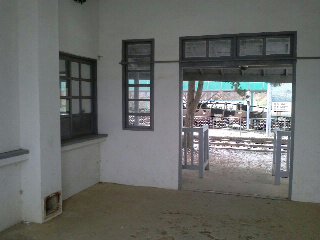
Inside Woljeong-ri Station Weoljeongri station inside.jpg
Inside Woljeong-ri Station
Train wreck and refurbished platform of Woljeong-ri Station Woljeong-ri Station.jpg
Train wreck and refurbished platform of Woljeong-ri Station

In 2012, as part of the history of its time, it had become a place where artists meet and exhibit their works. At the closed railway station, works by Noh Suntag, British artist Simon Morley, and a video installation artist by Kim Sylbee were on display. "Kim created the video installation Friendly Fire, which presents a science-fiction story of fratricidal tragedy, paralleling the situation on the Korean Peninsula." "It's parallel from our current situation but also my own projection of the future from reading history,” said Kim. “I called this project Friendly Fire; you're shooting not your enemy but your friend. There's kind of a more tender feeling in [the name]." [1]

Fratricide Act of killing ones brother

Fratricide is the act of killing one's brother.

In 2014, artists again visited the northernmost region of South Korea, for an art presentation, with the railroad division of the Gyeongwon Line building's abandoned space utilized as part of the project. Artist Choi Jae's blue neon light shining on the floor inside the building, reading, "No borders exist in nature", was an artistic work, which was part of the exhibit. [5]

See also

Related Research Articles

Korean Demilitarized Zone Demilitarized zone running across the Korean Peninsula

The Korean Demilitarized Zone is a strip of land running across the Korean Peninsula. It is established by the provisions of the Korean Armistice Agreement to serve as a buffer zone between North Korea and South Korea. The demilitarized zone (DMZ) is a border barrier that divides the Korean Peninsula roughly in half. It was created by agreement between North Korea, China and the United Nations Command in 1953. The DMZ is 250 kilometres long, and about 4 kilometres wide.

Military Demarcation Line geographical object

The Military Demarcation Line (MDL), sometimes referred to as the Armistice Line, is the land border or demarcation line between North Korea and South Korea. On either side of the line is the Korean Demilitarized Zone (DMZ). The MDL and DMZ were established by the Armistice at the end of the Korean War in 1953.

Paju Municipal city in Sudogwon, South Korea

Paju is a city in Gyeonggi Province, South Korea. Paju was made a city in 1997; it had previously been a county (gun).

Donghae Bukbu Line railway line

The Donghae Bukbu Line is a former railway line that connected the present-day city of Anbyon in Kangwon Province, North Korea, with Yangyang, Gangwon Province, South Korea. Since the division of Korea it has only carried trains for a brief period during 2007/8. The line originally connected to the Gyeongwon Line running from Gyeongseong to Wonsan.

Peace Village (North Korea) Village in Pyŏnghwa-ri, North Korea

Kijŏng-dong, Kijŏngdong, or Kijŏng tong, is a village in P'yŏnghwa-ri, Kaesong-si, North Korea. It is situated in the North's half of the Korean Demilitarized Zone (DMZ). Also known in North Korea as Peace Village, it has been widely referred to as 'Propaganda Village' by those outside North Korea, especially in South Korean and Western media.

Rail transport in South Korea

The rail transportation system in South Korea includes mainline railway lines and rapid transit system in some major cities.

Dorasan Station train station in South Korea

Dorasan Station is a railway station situated on the Gyeongui Line, which used to connect North Korea and South Korea and has since been restored. Dorasan Station is located approximately 650 meters from the southern boundary of the Korean Demilitarized Zone and is currently the northern terminus of Korail's Gyeongui Line, which is served by Tonggeun commuter trains. North of here the former Gyeongui Line continues as the Korean State Railway's P'yŏngbu Line, but this connection is not in regular service. The current purpose of the station is largely symbolic of the hope for eventual Korean reunification.

Kosong County County in Kangwŏn Province, North Korea

Kosŏng County is a kun, or county, in Kangwŏn province, North Korea. It lies in the southeasternmost corner of North Korea, immediately north of the Korean Demilitarized Zone. Prior to the end of the Korean War in 1953, it made up a single county, together with what is now the South Korean county of the same name. In a subsequent reorganization, the county absorbed the southern portion of Tongch'ŏn county.

Yangju station train station in South Korea

Yangju Station is a train station on Seoul Subway Line 1 and the Gyeongwon Line. The name comes from Yangju, the city where this station is located. Until December 2007, it was called Junae Station.

Baengmagoji Station railway station

Baengmagoji Station is a railway station on the Gyeongwon Line in South Korea. The station opened on 20 November 2012. This station is named after Baengmagoji, the site where the Battle of White Horse took place in 1952, during the Korean War.

Kangwon Line railway line

The Kangwŏn Line is a 145.8 km (90.6 mi) electrified standard-gauge trunk line of the Korean State Railway of North Korea, connecting Kowŏn on the P'yŏngra Line to P'yŏnggang, providing an east–west connection between the P'yŏngra and Ch'ŏngnyŏn Ich'ŏn lines.

DMZ Train South Korean tourist train system

DMZ Train is a South Korean tourist train operated by Korail. The train began operations in 2014 and transports tourists from Seoul to train terminals closest to the Korean Demilitarized Zone.

The September 2018 inter-Korean summit was the third inter-Korean summit in 2018.

DMZ Peace Train Music Festival

DMZ Peace Train Music Festival is a music festival held in Cheorwon County, Gangwon Province, South Korea. It is held close to the border with North Korea, and is intended to promote peace and unification at a place symbolizing division of the Korean Peninsula. It was held as relations between the two Koreas warmed up.

References

  1. 1 2 Dunbar, Jon (August 17, 2012). "Real DMZ Project brings art to Cheorwon". Korea.net . Retrieved February 25, 2015.
  2. Kim, Kwi-Gon. "The Demilitarized Zone (DMZ) of Korea: Protection, Conservation (page 3, Fig. 1.3 (b))". Google Books . Retrieved February 25, 2015.
  3. 1 2 http://english.visitkorea.or.kr/enu/ATR/SI_EN_3_6.jsp?cid=2040291
  4. Yoon, Sojung (July 28, 2014). "New train line to North Korea". Korea.net . Retrieved February 25, 2015.
  5. 분단 현장에서 '경계는 없다' 소리 없는 외침 (in Korean). Hankook Ilbo. August 28, 2014. Retrieved February 25, 2015.