Kalma 갈마 | ||||||||||||||||
|---|---|---|---|---|---|---|---|---|---|---|---|---|---|---|---|---|
| Korean name | ||||||||||||||||
| Hangul | 갈마역 | |||||||||||||||
| Hanja | 葛 麻 驛 | |||||||||||||||
| Revised Romanization | Galma-yeok | |||||||||||||||
| McCune–Reischauer | Kalma-yŏk | |||||||||||||||
| General information | ||||||||||||||||
| Location | Kalma-dong, Wŏnsan-si, Kangwŏn North Korea | |||||||||||||||
| Coordinates | 39°08′36″N127°28′01″E / 39.1434°N 127.4670°E Coordinates: 39°08′36″N127°28′01″E / 39.1434°N 127.4670°E | |||||||||||||||
| Owned by | Korean State Railway | |||||||||||||||
| Platforms | 3 (1 island) | |||||||||||||||
| Tracks | 9 through, 3 + 6 stub | |||||||||||||||
| History | ||||||||||||||||
| Opened | 16 August 1914 | |||||||||||||||
| Electrified | yes | |||||||||||||||
| Original company | Chosen Government Railway | |||||||||||||||
| Services | ||||||||||||||||
| ||||||||||||||||
Kalma Station (Chosŏn'gŭl : 갈마역) is a railway station in Kalma-dong, an industrial neighbourhood in the eastern part of Wŏnsan city, Kangwŏn province, North Korea, on the Kangwŏn Line of the Korean State Railway. It is also the start of the Wŏnsanhang Line to Wŏnsan Port. [1]
The Korean alphabet, known as Hangul, has been used to write the Korean language since its creation in the 15th century by King Sejong the Great. It may also be written as Hangeul following the standard Romanization.
Wŏnsan, previously known as Wŏnsanjin (元山津), Port Lazarev, and Gensan (元山), is a port city and naval base located in Kangwŏn Province, North Korea, along the eastern side of the Korean Peninsula, on Sea of Japan and the provincial capital. The port was opened by occupying Japanese forces in 1880. Before the 1950–1953 Korean War, it fell within the jurisdiction of the then South Hamgyŏng province, and during the war it was the location of the Blockade of Wŏnsan. The population of the city was estimated at 329,207 in 2013. Notable people from Wŏnsan include Kim Ki Nam, diplomat and Secretary of the Korean Workers' Party.
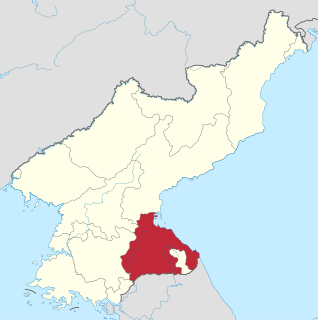
Kangwon Province is a province of North Korea, with its capital at Wŏnsan. Before the division of Korea in 1945, Kangwŏn Province and its South Korean neighbour Gangwon Province formed a single province that excluded Wŏnsan.
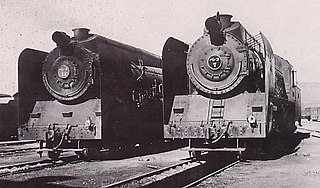
Kalma station handles freight traffic destined for and shipped from Wŏnsan city, [2] and serves several large industries, including the 4 June Rolling Stock Works, which is one of the DPRK's largest railway equipment factories. [3]
The 4 June Rolling Stock Works is a manufacturer of railway rolling stock in Wŏnsan, North Korea. It is a subordinate division of the DPRK Ministry of Railways. The plant covers an area of 640,000 m2 (6,900,000 sq ft), of which 180,000 m2 (1,900,000 sq ft), and employs 6,000 workers. It is capable of producing 3,000 new freight cars per year, as well as repairing 200 steam locomotives and 130 busses.
The station, along with the rest of the former Kyŏngwŏn Line, was opened by the Chosen Government Railway on 16 August 1914. [4]
The Gyeongwon Line is a railway line serving northeastern Gyeonggi Province in South Korea. The line is operated by Korail. The name of the line came from Gyeongseong (Seoul) and Wonsan, the original terminus of the line, in what is now North Korea.
The Chosen Government Railway was a state-owned railway company in Korea under Japanese rule. It was a department of the Railway Bureau of the Government-General of Korea, whose functions were the management and operation of railways in Korea, as well as the supervision of privately owned railway companies.
Munch'ŏn is a North Korean city located in Kangwŏn Province. It lies on the coast of the Sea of Japan and borders Wonsan.
Kalma may refer to:
Wŏnsan Station (Chosŏn'gŭl: 원산역) is railway station located in Yangji-dong, Wŏnsan city, Kangwŏn province, North Korea. It is on the Kangwŏn Line of the Korean State Railway. Locomotive and freight car maintenance facilities are located here.
Rajin Station is a railway station in Rajin-guyŏk, Rasŏn Special City, North Korea. It is the junction point and terminus of both the Hambuk and P'yŏngra lines of the Korean State Railway. It is also the starting point of a freight-only branchline to Rajin Port Station.
The Hamgyeong Line was a railway line of the Chosen Government Railway (Sentetsu) in Japanese-occupied Korea, running from Wonsan to Sangsambong. Construction began in 1914, and was completed in 1928. The line is now entirely within North Korea; the Korean State Railway has divided it between the Kangwŏn Line, the P'yŏngra Line, the Kangdŏk Line (Namgangdŏk−Suseong), and the Hambuk Line.
Ch'ŏngjin Ch'ŏngnyŏn Station is the central railway station in Ch'ŏngjin-si, North Hamgyŏng Province, North Korea. It is the junction point of the Hambuk Line and the P'yŏngra Line of the Korean State Railway, and is the beginning of the Ch'ŏngjinhang Line to Ch'ŏngjin Port.
Munch'ŏn Station (Chosŏn'gŭl: 문천역) is a railway station in Munch'ŏn-dong, greater Munch'ŏn city, Kangwŏn province, North Korea, on the Kangwŏn Line of the Korean State Railway. Originally called Munp'yŏng Station, the station, along with the rest of the Okp'yŏng–Wŏnsan section of the former Hamgyŏng Line, was opened by the Japanese on 1 August 1915. It received its current name after the establishment of the DPRK.
The Kangwŏn Line is a 145.8 km (90.6 mi) electrified standard-gauge trunk line of the Korean State Railway of North Korea, connecting Kowŏn on the P'yŏngra Line to P'yŏnggang, providing an east–west connection between the P'yŏngra and Ch'ŏngnyŏn Ich'ŏn lines.
Tŏgwŏn Station (Chosŏn'gŭl: 덕원역) is a railway station in Segil-dong, greater Wŏnsan city, Kangwŏn province, North Korea, on the Kangwŏn Line of the Korean State Railway. The station, along with the rest of the Okp'yŏng–Wŏnsan section of the former Hamgyŏng Line, was opened by the Chosen Government Railway on 1 August 1915. Also this station is the starting point of the Songdowŏn Line to Segil.
Koam Station is a railway station in Koam-dong, greater Munch'ŏn city, Kangwŏn province, North Korea, on the Munch'ŏn Port Line of the Korean State Railway; the branchline connects to the Kangwŏn Line at Okp'yŏng.
Segil Station is a railway station in Segil-dong, Wŏnsan Municipal City, Kangwŏn province, North Korea, on Songdowŏn Line of the Korean State Railway. The Songdowŏn Line runs to Wŏnsan, where it connects to the Kangwŏn Line.
Songdowŏn Station is a railway station in greater Wŏnsan city, Kangwŏn province, North Korea, on the Songdowŏn Line of the Korean State Railway.
Wŏnsanhang Station is a freight-only railway station serving the port of Wŏnsan city, Kangwŏn province, North Korea, on the terminus of the Wŏnsan Port Line Line of the Korean State Railway.
The Pashi or Pasi class locomotives were a group made up of five distinct classes of steam tender locomotives built for the Chosen Government Railway (Sentetsu) with 4-6-2 wheel arrangement. The "Pashi" name came from the American naming system for steam locomotives, under which locomotives with 4-6-2 wheel arrangement were called "Pacific".
The Songdowŏn Line is an electrified secondary railway line of the Korean State Railway in Wŏnsan Municipal City, North Korea, running from Tŏgwŏn on the Kangwŏn Line to Songdowŏn and Segil.
The Wŏnsanhang Line, or Wŏnsan Port Line, is a non-electrified freight-only secondary railway line of the Korean State Railway in Wonsan Municipal City, North Korea, running from Kalma to Wŏnsan Port.
The Gyeongwon Line was a railway line of the Chosen Government Railway in central Korea. It was the first east-west trunk line to be opened, connecting the capital Gyeongseong to the important east coast port of Wonsan. Following the partition of Korea, the line was divided between North and South Korea.