Wŏnsanhang 원산항 | |||||||||||
|---|---|---|---|---|---|---|---|---|---|---|---|
| Korean name | |||||||||||
| Hangul | 원산항역 | ||||||||||
| Hanja | 元 山 港 駅 | ||||||||||
| Revised Romanization | Wonsanhang-yeok | ||||||||||
| McCune–Reischauer | Wŏnsanhang-yŏk | ||||||||||
| General information | |||||||||||
| Location | Wŏnsan-si, Kangwŏn North Korea | ||||||||||
| Owned by | Korean State Railway | ||||||||||
| History | |||||||||||
| Original company | Chosen Government Railway | ||||||||||
| Services | |||||||||||
| |||||||||||
Wŏnsanhang Station (Wŏnsan Port Station) is a freight-only railway station serving the port of Wŏnsan city, Kangwŏn province, North Korea, on the terminus of the Wŏnsan Port Line Line of the Korean State Railway. [1]
Wŏnsan, previously known as Wŏnsanjin (元山津), Port Lazarev, and Gensan (元山), is a port city and naval base located in Kangwŏn Province, North Korea, along the eastern side of the Korean Peninsula, on Sea of Japan and the provincial capital. The port was opened by occupying Japanese forces in 1880. Before the 1950–1953 Korean War, it fell within the jurisdiction of the then South Hamgyŏng province, and during the war it was the location of the Blockade of Wŏnsan. The population of the city was estimated at 329,207 in 2013. Notable people from Wŏnsan include Kim Ki Nam, diplomat and Secretary of the Korean Workers' Party.
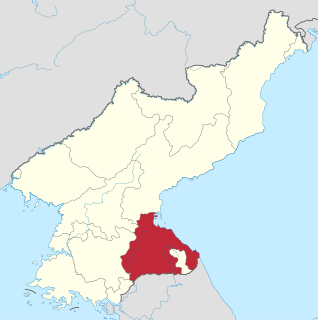
Kangwon Province is a province of North Korea, with its capital at Wŏnsan. Before the division of Korea in 1945, Kangwŏn Province and its South Korean neighbour Gangwon Province formed a single province that excluded Wŏnsan.
North Korea, officially the Democratic People's Republic of Korea, is a country in East Asia constituting the northern part of the Korean Peninsula, with Pyongyang the capital and the largest city in the country. The name Korea is derived from Goguryeo which was one of the great powers in East Asia during its time, ruling most of the Korean Peninsula, Manchuria, parts of the Russian Far East and Inner Mongolia, under Gwanggaeto the Great. To the north and northwest, the country is bordered by China and by Russia along the Amnok and Tumen rivers; it is bordered to the south by South Korea, with the heavily fortified Korean Demilitarized Zone (DMZ) separating the two. Nevertheless, North Korea, like its southern counterpart, claims to be the legitimate government of the entire peninsula and adjacent islands.
In addition to the port's bulk cargo terminal, this line also serves the Wŏnsan Chemical Factory.
Bulk cargo is commodity cargo that is transported unpackaged in large quantities. It refers to material in either liquid or granular, particulate form, as a mass of relatively small solids, such as petroleum/crude oil, grain, coal, or gravel. This cargo is usually dropped or poured, with a spout or shovel bucket, into a bulk carrier ship's hold, railroad car/railway wagon, or tanker truck/trailer/semi-trailer body. Smaller quantities can be boxed and palletised. Bulk cargo is classified as liquid or dry.
The Gyeongwon Line is a railway line serving northeastern Gyeonggi Province in South Korea. The line is operated by Korail. The name of the line came from Gyeongseong (Seoul) and Wonsan, the original terminus of the line, in what is now North Korea.
Kosŏng County is a kun, or county, in Kangwŏn province, North Korea. It lies in the southeasternmost corner of North Korea, immediately north of the Korean Demilitarized Zone. Prior to the end of the Korean War in 1953, it made up a single county, together with what is now the South Korean county of the same name. In a subsequent reorganization, the county absorbed the southern portion of Tongch'ŏn county.
Cheorwon Station is a closed railway station on the Gyeongwon Line in South Korea. This station was also the starting point of the former Geumgangsan Line.

Woljeong-ri Station is a closed railway station on the Gyeongwon Line in South Korea. It was closed by the Korean War. It is a noted place in the Korean Demilitarized Zone.
Pyongyang Station is the central railway station of P'yŏngyang, North Korea. It is located in Yŏkchŏn-dong, Chung-guyŏk.
Wŏnsan Station (Chosŏn'gŭl: 원산역) is railway station located in Yangji-dong, Wŏnsan city, Kangwŏn province, North Korea. It is on the Kangwŏn Line of the Korean State Railway. Locomotive and freight car maintenance facilities are located here.
The Hamgyeong Line was a railway line of the Chosen Government Railway (Sentetsu) in Japanese-occupied Korea, running from Wonsan to Sangsambong. Construction began in 1914, and was completed in 1928. The line is now entirely within North Korea; the Korean State Railway has divided it between the Kangwŏn Line, the P'yŏngra Line, the Kangdŏk Line (Namgangdŏk−Suseong), and the Hambuk Line.
Munch'ŏn Station (Chosŏn'gŭl: 문천역) is a railway station in Munch'ŏn-dong, greater Munch'ŏn city, Kangwŏn province, North Korea, on the Kangwŏn Line of the Korean State Railway. Originally called Munp'yŏng Station, the station, along with the rest of the Okp'yŏng–Wŏnsan section of the former Hamgyŏng Line, was opened by the Japanese on 1 August 1915. It received its current name after the establishment of the DPRK.
The Hambuk Line is an electrified standard-gauge trunk line of the Korean State Railway in North Korea, running from Ch'ŏngjin) on the P'yŏngra Line to Rajin, likewise on the P'yŏngra line.
The Kangwŏn Line is a 145.8 km (90.6 mi) electrified standard-gauge trunk line of the Korean State Railway of North Korea, connecting Kowŏn on the P'yŏngra Line to P'yŏnggang, providing an east–west connection between the P'yŏngra and Ch'ŏngnyŏn Ich'ŏn lines.
Tŏgwŏn Station (Chosŏn'gŭl: 덕원역) is a railway station in Segil-dong, greater Wŏnsan city, Kangwŏn province, North Korea, on the Kangwŏn Line of the Korean State Railway. The station, along with the rest of the Okp'yŏng–Wŏnsan section of the former Hamgyŏng Line, was opened by the Chosen Government Railway on 1 August 1915. Also this station is the starting point of the Songdowŏn Line to Segil.
Kalma Station (Chosŏn'gŭl: 갈마역) is a railway station in Kalma-dong, an industrial neighbourhood in the eastern part of Wŏnsan city, Kangwŏn province, North Korea, on the Kangwŏn Line of the Korean State Railway. It is also the start of the Wŏnsanhang Line to Wŏnsan Port.
Koam Station is a railway station in Koam-dong, greater Munch'ŏn city, Kangwŏn province, North Korea, on the Munch'ŏn Port Line of the Korean State Railway; the branchline connects to the Kangwŏn Line at Okp'yŏng.
Segil Station is a railway station in Segil-dong, Wŏnsan Municipal City, Kangwŏn province, North Korea, on Songdowŏn Line of the Korean State Railway. The Songdowŏn Line runs to Wŏnsan, where it connects to the Kangwŏn Line.
Songdowŏn Station is a railway station in greater Wŏnsan city, Kangwŏn province, North Korea, on the Songdowŏn Line of the Korean State Railway.
The Chosen Government Railway was a state-owned railway company in Korea under Japanese rule. It was a department of the Railway Bureau of the Government-General of Korea, whose functions were the management and operation of railways in Korea, as well as the supervision of privately owned railway companies.
The Chosen Anthracite Company, Ltd. was a kabushiki kaisha in colonial Korea that operated collieries around Korea. It was founded in 1927 by the Mitsubishi zaibatsu of Japan by integrating the anthracite mining operations around Pyongyang, eventually becoming the largest coal-producing company in Korea - 74.9% of the coal distributed in Korea was produced by the Chosen Anthracite Company.
The Wŏnsanhang Line, or Wŏnsan Port Line, is a non-electrified freight-only secondary railway line of the Korean State Railway in Wonsan Municipal City, North Korea, running from Kalma to Wŏnsan Port.
The Gyeongwon Line was a railway line of the Chosen Government Railway in central Korea. It was the first east-west trunk line to be opened, connecting the capital Gyeongseong to the important east coast port of Wonsan. Following the partition of Korea, the line was divided between North and South Korea.
| This article about a railroad station in North Korea is a stub. You can help Wikipedia by expanding it. |