Sambang 삼방 | |||||||||||
|---|---|---|---|---|---|---|---|---|---|---|---|
| Korean name | |||||||||||
| Hangul | 삼방역 | ||||||||||
| Hanja | 三 防 驛 | ||||||||||
| Revised Romanization | Sambang-yeok | ||||||||||
| McCune–Reischauer | Sambang-yŏk | ||||||||||
| General information | |||||||||||
| Location | Sambang-ri, Sep'o, Kangwŏn North Korea | ||||||||||
| Coordinates | 38°42′28″N127°21′52″E / 38.7079°N 127.3644°E Coordinates: 38°42′28″N127°21′52″E / 38.7079°N 127.3644°E | ||||||||||
| Owned by | Korean State Railway | ||||||||||
| History | |||||||||||
| Opened | 16 August 1914 | ||||||||||
| Electrified | yes | ||||||||||
| Services | |||||||||||
| |||||||||||
Sambang Station is a railway station in Sambang-ri, Sep'o county, Kangwŏn province, North Korea, on the Kangwŏn Line of the Korean State Railway. [1]
Sep'o County is a kun, or county, in Kangwŏn province, North Korea. It was created as a separate entity following the division of Korea.
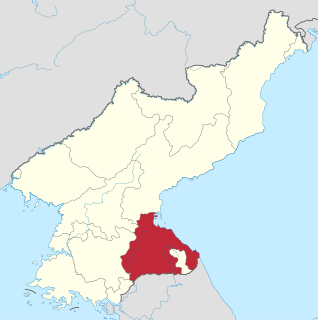
Kangwon Province is a province of North Korea, with its capital at Wŏnsan. Before the division of Korea in 1945, Kangwŏn Province and its South Korean neighbour Gangwon Province formed a single province that excluded Wŏnsan.
North Korea, officially the Democratic People's Republic of Korea, is a country in East Asia constituting the northern part of the Korean Peninsula, with Pyongyang the capital and the largest city in the country. The name Korea is derived from Goguryeo which was one of the great powers in East Asia during its time, ruling most of the Korean Peninsula, Manchuria, parts of the Russian Far East and Inner Mongolia, under Gwanggaeto the Great. To the north and northwest, the country is bordered by China and by Russia along the Amnok and Tumen rivers; it is bordered to the south by South Korea, with the heavily fortified Korean Demilitarized Zone (DMZ) separating the two. Nevertheless, North Korea, like its southern counterpart, claims to be the legitimate government of the entire peninsula and adjacent islands. Both North Korea and South Korea became members of the United Nations in 1991.
Originally called Sambanghyŏp Station (Chosŏn'gŭl: 삼방협역; Hanja: 三防峡駅), the station, along with the rest of the former Kyŏngwŏn Line, was opened by the Japanese on 16 August 1914. [2]
The Korean alphabet, known as Hangul, has been used to write the Korean language since its creation in the 15th century by King Sejong the Great. It may also be written Hangeul following the standard Romanization.
Hanja is the Korean name for Chinese characters. More specifically, it refers to those Chinese characters borrowed from Chinese and incorporated into the Korean language with Korean pronunciation. Hanja-mal or Hanja-eo refers to words that can be written with Hanja, and hanmun refers to Classical Chinese writing, although "Hanja" is sometimes used loosely to encompass these other concepts. Because Hanja never underwent major reform, they are almost entirely identical to traditional Chinese and kyūjitai characters, though the stroke orders for some characters are slightly different. For example, the characters 教 and 研 are written as 敎 and 硏. Only a small number of Hanja characters are modified or unique to Korean. By contrast, many of the Chinese characters currently in use in Japan and Mainland China have been simplified, and contain fewer strokes than the corresponding Hanja characters.
The Gyeongwon Line is a railway line serving northeastern Gyeonggi Province in South Korea. The line is operated by Korail. The name of the line came from Gyeongseong (Seoul) and Wonsan, the original terminus of the line, in what is now North Korea.
Wŏnsan Station (Chosŏn'gŭl: 원산역) is railway station located in Yangji-dong, Wŏnsan city, Kangwŏn province, North Korea. It is on the Kangwŏn Line of the Korean State Railway. Locomotive and freight car maintenance facilities are located here.
Anbyŏn Station is a railway station in Anbyŏn-ŭp, Anbyŏn County in Kangwŏn province, North Korea. It is located on the Kangwŏn Line, which connects Kowŏn to P'yŏnggang, and is the start of the Kŭmgangsan Ch'ŏngnyŏn Line, which runs to the Mount Kŭmgang Tourist Region and continues south across the DMZ to Chejin in South Korea, although the section between Kŭmgangsan and Chejin has been out of service since 2008.
P'yŏnggang Station is a railway station in P'yŏnggang-ŭp, P'yŏnggang county, Kangwŏn province, North Korea, on the Kangwŏn Line of the Korean State Railway. It is the terminus station of this line, although prior to the Korean War, the railway continued on to Sintal-li, which is nowadays the northern terminus of the Kyŏngwŏn Line in South Korea.
Kosan Station (Chosŏn'gŭl: 고산역) is a railway station in Kosan-ŭp, Kosan county, Kangwŏn province, North Korea, on the Kangwŏn Line of the Korean State Railway.
Munch'ŏn Station (Chosŏn'gŭl: 문천역) is a railway station in Munch'ŏn-dong, greater Munch'ŏn city, Kangwŏn province, North Korea, on the Kangwŏn Line of the Korean State Railway. Originally called Munp'yŏng Station, the station, along with the rest of the Okp'yŏng–Wŏnsan section of the former Hamgyŏng Line, was opened by the Japanese on 1 August 1915. It received its current name after the establishment of the DPRK.
Ch'ŏnnae Station is a railway station in Ch'ŏnnae-ŭp, Ch'ŏnnae county, Kangwŏn Province, North Korea. It is the terminus of the Ch'ŏnnae Line of the Kangwŏn Line of the Korean State Railway, which connects to the Kangwŏn Line at Ryongdam.
The Kangwŏn Line is a 145.8 km (90.6 mi) electrified standard-gauge trunk line of the Korean State Railway of North Korea, connecting Kowŏn on the P'yŏngra Line to P'yŏnggang, providing an east–west connection between the P'yŏngra and Ch'ŏngnyŏn Ich'ŏn lines.
Ryongdam Station is a railway station in Ryongdam-rodongjagu, Ch'ŏnnae county, Kangwŏn province, North Korea, on the Kangwŏn Line of the Korean State Railway; it is also the starting point of the Ch'ŏnnae Line to Ch'ŏnnae.
Tŏgwŏn Station (Chosŏn'gŭl: 덕원역) is a railway station in Segil-dong, greater Wŏnsan city, Kangwŏn province, North Korea, on the Kangwŏn Line of the Korean State Railway. The station, along with the rest of the Okp'yŏng–Wŏnsan section of the former Hamgyŏng Line, was opened by the Chosen Government Railway on 1 August 1915. Also this station is the starting point of the Songdowŏn Line to Segil.
Kalma Station (Chosŏn'gŭl: 갈마역) is a railway station in Kalma-dong, an industrial neighbourhood in the eastern part of Wŏnsan city, Kangwŏn province, North Korea, on the Kangwŏn Line of the Korean State Railway. It is also the start of the Wŏnsanhang Line to Wŏnsan Port.
Paehwa Station is a railway station in Paehwa-ri, Anbyŏn county, Kangwŏn province, North Korea, on the Kangwŏn Line of the Korean State Railway.
Namsan Station is a railway station in Namsal-li, Kosan county, Kangwŏn province, North Korea, on the Kangwŏn Line of the Korean State Railway.
Kwangmyŏng Station (Chosŏn'gŭl: 광명역) is a railway station in Kwangmyŏng-ri, Kosan county, Kangwŏn province, North Korea, on the Kangwŏn Line of the Korean State Railway.
Ryongjiwŏn Station is a railway station in Ryongjiwŏl-li, Kosan county, Kangwŏn province, North Korea, on the Kangwŏn Line of the Korean State Railway.
Tonggari Station (Chosŏn'gŭl: 동가리역) is a railway station in Kŭmch'ŏl-li, Kosan county, Kangwŏn province, North Korea, on the Kangwŏn Line of the Korean State Railway.
Rakch'ŏn Station (Chosŏn'gŭl: 락천역) is a railway station in Sambang-ri, Sep'o county, Kangwŏn province, North Korea, on the Kangwŏn Line of the Korean State Railway.
Sŏngsan Station is a railway station in Sŏngsal-li, Sep'o county, Kangwŏn province, North Korea, on the Kangwŏn Line of the Korean State Railway.
Kŏmbullang Station is a railway station in Sep'o county, Kangwŏn province, North Korea, on the Kangwŏn Line of the Korean State Railway.
Ri'mok Station is a railway station in Ri'mong-ri, Sep'o county, Kangwŏn province, North Korea, on the Kangwŏn Line of the Korean State Railway.
Pokkye Station is a railway station in Pokkye-ri, P'yŏnggang county, Kangwŏn province, North Korea, on the Kangwŏn Line of the Korean State Railway.
| This article about a railroad station in North Korea is a stub. You can help Wikipedia by expanding it. |