Related Research Articles

A commodity market is a market that trades in the primary economic sector rather than manufactured products, such as cocoa, fruit and sugar. Hard commodities are mined, such as gold and oil. Futures contracts are the oldest way of investing in commodities. Futures are secured by physical assets. Commodity markets can include physical trading and derivatives trading using spot prices, forwards, futures, and options on futures. Farmers have used a simple form of derivative trading in the commodity market for centuries for price risk management.
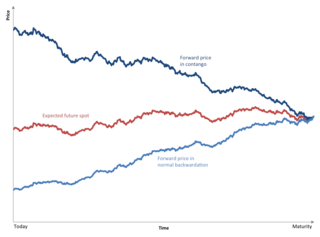
Contango is a situation where the futures price of a commodity is higher than the expected spot price of the contract at maturity. In a contango situation, arbitrageurs or speculators are "willing to pay more [now] for a commodity [to be received] at some point in the future than the actual expected price of the commodity [at that future point]. This may be due to people's desire to pay a premium to have the commodity in the future rather than paying the costs of storage and carry costs of buying the commodity today." On the other side of the trade, hedgers are happy to sell futures contracts and accept the higher-than-expected returns. A contango market is also known as a normal market, or carrying-cost market.
The Tokyo Stock Exchange, which is called Tosho or TSE/TYO for short, is a stock exchange located in Tokyo, Japan. It is the third largest stock exchange in the world by aggregate market capitalization of its listed companies, and the largest in Asia. It had 2,292 listed companies with a combined market capitalization of US$5.67 trillion as of February 2019.
In finance, a futures contract is a standardized legal agreement to buy or sell something at a predetermined price at a specified time in the future, between parties not known to each other. The asset transacted is usually a commodity or financial instrument. The predetermined price the parties agree to buy and sell the asset for is known as the forward price. The specified time in the future—which is when delivery and payment occur—is known as the delivery date. Because it is a function of an underlying asset, a futures contract is a derivative product.
A futures exchange or futures market is a central financial exchange where people can trade standardized futures contracts defined by the exchange. Futures contracts are derivatives contracts to buy or sell specific quantities of a commodity or financial instrument at a specified price with delivery set at a specified time in the future. Futures exchanges provides physical or electronic trading venues, details of standardized contracts, market and price data, clearing houses, exchange self-regulations, margin mechanisms, settlement procedures, delivery times, delivery procedures and other services to foster trading in futures contracts. Futures exchanges can be organized as non-profit member-owned organizations or as for-profit organizations. Futures exchanges can be integrated under the same brand name or organization with other types of exchanges, such as stock markets, options markets, and bond markets. Non-profit member-owned futures exchanges benefit their members, who earn commissions and revenue acting as brokers or market makers. For-profit futures exchanges earn most of their revenue from trading and clearing fees.

The Chicago Mercantile Exchange (CME) is a global derivatives marketplace based in Chicago and located at 20 S. Wacker Drive. The CME was founded in 1898 as the Chicago Butter and Egg Board, an agricultural commodities exchange. Originally, the exchange was a non-profit organization. The Merc demutualized in November 2000, went public in December 2002, and merged with the Chicago Board of Trade in July 2007 to become a designated contract market of the CME Group Inc., which operates both markets. The chairman and chief executive officer of CME Group is Terrence A. Duffy, Bryan Durkin is president. On August 18, 2008, shareholders approved a merger with the New York Mercantile Exchange (NYMEX) and COMEX. CME, CBOT, NYMEX, and COMEX are now markets owned by CME Group. After the merger, the value of the CME quadrupled in a two-year span, with a market cap of over $25 billion.

The Chicago Board of Trade (CBOT), established on April 3, 1848, is one of the world's oldest futures and options exchanges. On July 12, 2007, the CBOT merged with the Chicago Mercantile Exchange (CME) to form CME Group. CBOT and three other exchanges now operate as designated contract markets (DCM) of the CME Group.

The New York Mercantile Exchange (NYMEX) is a commodity futures exchange owned and operated by CME Group of Chicago. NYMEX is located at One North End Avenue in Brookfield Place in the Battery Park City section of Manhattan, New York City.

Osaka Exchange, Inc. is the second largest securities exchange in Japan, in terms of amount of business handled.

Nagoya Stock Exchange is a stock trading market in Nagoya, Japan. It is Japan's second largest exchange, behind the Tokyo Stock Exchange.
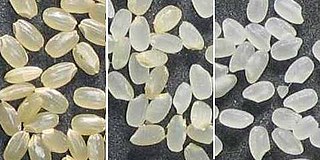
Japanese rice refers to a number of short-grain cultivars of Japonica rice including ordinary rice (uruchimai) and glutinous rice (mochigome).
Central Japan Commodity Exchange (C-COM) was a futures exchange based in Nagoya, Japan that closed in 2011.
Osaka Dojima Commodity Exchange (ODE) is a futures exchange based in Osaka, Japan.
Zhengzhou Commodity Exchange, established in 1990, is a futures exchange in Zhengzhou, one of the four futures exchanges in China. The ZCE is under the vertical management of China Securities Regulatory Commission (CSRC).
The Dalian Commodity Exchange (DCE) is a Chinese futures exchange based in Dalian, Liaoning province, China. It is a non-profit, self-regulating and membership legal entity established on February 28, 1993.
The Forward Markets Commission (FMC) was the chief regulator of commodity futures markets in India. As of July 2014, it regulated Rs 17 trillion worth of commodity trades in India. It is headquartered in Mumbai and this financial regulatory agency is overseen by the Ministry of Finance. The Commission allows commodity trading in 22 exchanges in India, of which 6 are national.
Commodity trading in China has a short but high-growth history. With an increasing product variety and deepening liquidity pools, the mainland's futures market is playing an increasingly important role in serving the national economy.
The Tokyo Financial Exchange is a futures exchange and established in April 1989 under the Financial Futures Trading Law of Japan. It principally deals in financial instrument markets that handles securities as well as market derivatives.
The international shipping industry can be divided into four closely related shipping markets, each trading in a different commodity: the freight market, the sale and purchase market, the newbuilding market and the demolition market. These four markets are linked by cash flow and push the market traders in the direction they want.
References
- 1 2 Yokohama Commodity Exchange web site Archived October 30, 2005, at the Wayback Machine , as at 2005 (site now gone)
- ↑ Exchange History page Archived September 11, 2006, at the Wayback Machine at the Tokyo Grain Exchange (as at May 2006)
- ↑ Japan's Commodities Exchanges Falter as Internet Trades Surge by Hector Forster and Fumishige Asanogold, Bloomberg news, 27 April 2006
