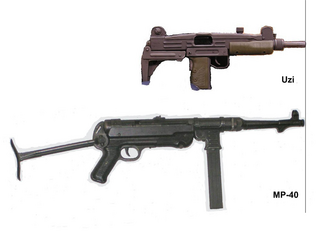
A submachine gun (SMG) is a magazine-fed, automatic carbine designed to fire pistol cartridges. The term "submachine gun" was coined by John T. Thompson, the inventor of the Thompson submachine gun.
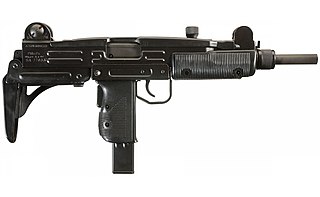
The Uzi is a family of Israeli open-bolt, blowback-operated submachine guns. Smaller variants are often considered to be machine pistols. The Uzi was one of the first weapons to use a telescoping bolt design which allows the magazine to be housed in the pistol grip for a shorter weapon.

The PM-84 Glauberyt is a Polish machine pistol. It is a personal weapon intended for combat and self-defense at ranges up to 150 m with single shot or fully automatic fire mode. It features a compact design, minimum overall dimensions, small weight, very good accuracy, and fire stability. It is designed for Heavy weapons platoons personnel and reconnaissance detachments, special anti-terrorist and police troops.

The vz. 58 is a 7.62×39mm rifle designed and manufactured in Czechoslovakia and accepted into service in the late 1950s as the 7,62 mm samopal vzor 58, replacing the vz. 52 self-loading rifle and the 7.62×25mm Tokarev Sa 24 and Sa 26 submachine guns.
A fully automatic firearm is said to fire from an open bolt if, when ready to fire, the bolt and working parts are held to the rear of the receiver, with no round in the chamber. When the trigger is actuated, the bolt travels forward, feeds a cartridge from the magazine or belt into the chamber, and fires that cartridge in the same movement. Like any other self-loading design, the action is cycled by the gas expended from the round, hence the necessity of a gas system; this excess of gas sends the bolt back to the rear, ejecting the empty cartridge case and preparing for the next shot. Generally, an open-bolt firing cycle is used for fully automatic weapons and not for semi-automatic weapons. Firearms using advanced primer ignition blowback inherently fire from open bolt only.

The Škorpion vz. 61 is a Czechoslovak 7.65 mm machine pistol developed in 1959 by Miroslav Rybář (1924–1970) and produced under the official designation Samopal vzor 61 by the Česká zbrojovka arms factory in Uherský Brod from 1961 to 1979.

The CZ Model 25 was perhaps the best known of a series of Czechoslovak designed submachine guns introduced in 1948. There were four generally very similar submachine guns in this series: the Sa 23, Sa 24, Sa 25, and Sa 26. The primary designer was Jaroslav Holeček (1923–1977), chief engineer of the Česká zbrojovka Uherský Brod arms factory.
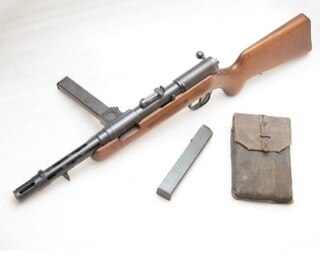
The MP35 was a submachine gun used by the Wehrmacht, Waffen-SS and German police both before and during World War II. It was developed in the early 1930s by Emil Bergmann and manufactured at the Bergmann company in Suhl.
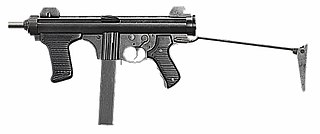
The Beretta Model 12 is a 9×19mm Parabellum caliber submachine gun designed by Beretta. The production started in 1962, the first users were the Italian Carabinieri and the Italian State Police even though in limited number, only in 1978 it was widely issued replacing the old Beretta MAB. In 1962 the Italian Army bought a limited number of Franchi LF57 submachine gun, judged better than the M12 but never issued to the troops, and only in 1992 the M12S2 variant was introduced also if in very limited number. The Italian Air Force, instead, bought a large number of M12S and M12S2 for the airport security units. However the weapon had a higher initial success in the Arab countries and South America. Its debut in combat came during the Tet Offensive in 1968 when the Marines guarding the U.S. embassy in Saigon repelled the assault by the Viet Cong using the Beretta M12. It is also used by various South American, African and Asian countries, and made under licence in Brazil by Taurus, in Belgium by FN Herstal and in Indonesia by PT Pindad.
The BXP is a 9×19mm submachine gun developed in the mid-1980s by the South African company Milkor (Pty) Ltd. It was qualified with Armscor in 1984 and then marketed by them for Milkor (Pty) Ltd. Due to international arms embargoes against South Africa due to apartheid, the country was forced to design and manufacture their own weapons. The weapon was intended for use by security forces.
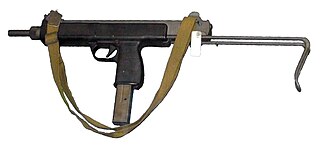
The Steyr MPi 69 is a 9×19mm submachine gun of the late 20th century made by the Austrian firm Steyr.
The Ruger MP9 is a 9×19mm submachine gun/machine pistol introduced by Sturm, Ruger & Co. in 1995. The MP9 was designed by Uziel Gal, the original designer of the Uzi.

The Socimi Type 821-SMG was a submachine gun manufactured in the 1980s by the firm of SOCIMI, Società Costruzioni Industriali Milano, SpA located in Milan, Italy.

The Colt 9mm SMG is a 9×19mm Parabellum submachine gun manufactured by Colt, based on the M16 rifle.

The KRISS Vector series are a family of weapons based upon the parent submachine gun design developed by the American company KRISS USA, formerly Transformational Defense Industries (TDI). They use an unconventional delayed blowback system combined with in-line design to reduce perceived recoil and muzzle climb.

The FMK-3 is a selective fire, blowback operated submachine gun of Argentine origin and was designed by Fabricaciones Militares in 1974. Around 30,000 were produced for the Argentine military by 1991.

The SIG MPX is a gas-operated submachine gun designed and manufactured by SIG Sauer, and is primarily chambered in 9×19mm Parabellum cartridge. It is gas-operated firearm, featuring a closed, rotating bolt. These design features, rare in submachine guns, were chosen to enhance the safety of the user and to have a more reliable firearm. It was designed in 2013 and was released to the general public in 2015. It features the SIG Sauer short stroke push-rod gas system to reduce the recoil and improve the reliability of the weapon.