Related Research Articles

Primož Trubar or Primus Truber was a Slovene Protestant Reformer of the Lutheran tradition, mostly known as the author of the first Slovene language printed book, the founder and the first superintendent of the Protestant Church of the Duchy of Carniola, and for consolidating the Slovene language. Trubar introduced Lutheranism in Slovenia, but after the Austrian Habsburgs introduced the Counter-Reformation only a small community remained. Trubar is a key figure of Slovene history and in many aspects a major historical personality.

Bled is a town on Lake Bled in the Upper Carniolan region of northwestern Slovenia. It is the administrative seat of the Municipality of Bled. It is most notable as a popular tourist destination in the Upper Carniola region and in Slovenia as whole, attracting visitors from abroad too.

The Ljubljanica, known in the Middle Ages as the Sava, is a river in the southern part of the Ljubljana Basin in Slovenia. The capital of Slovenia, Ljubljana, lies on the river. The Ljubljanica rises south of the town of Vrhnika and flows into the Sava River about 10 kilometres (6.2 mi) downstream from Ljubljana. Its largest affluent is the Mali Graben Canal. Including its source affluent the Little Ljubljanica, the river is 41 km (25 mi) in length. The Little Ljubljanica joins the Big Ljubljanica after 1,300 m (4,300 ft) and the river continues its course as the Ljubljanica.

Bohinjska Bistrica is the largest settlement and administrative centre of the Municipality of Bohinj, in the Upper Carniola region of northwestern Slovenia.

Zagorica nad Kamnikom is a settlement on the right bank of the Kamnik Bistrica River in the Municipality of Kamnik in the Upper Carniola region of Slovenia.

Setnik is a dispersed settlement east of Polhov Gradec in the Municipality of Dobrova–Polhov Gradec in the Upper Carniola region of Slovenia. It includes the hamlets of Zalog, Butajnova, Veliki Vrh, and Mali Vrh. Setnik is known as Setjək in the local dialect.
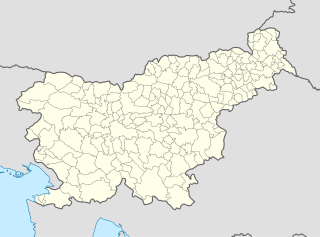
Mala Bukovica is a village south of Ilirska Bistrica in the Inner Carniola region of Slovenia.
Velika Bukovica is a village southwest of Ilirska Bistrica in the Inner Carniola region of Slovenia.

Mala Gora is a settlement in the hills north of the town of Kočevje in southern Slovenia. It was a village settled by Gottschee Germans. During the Second World War its original population was expelled. The area is part of the traditional region of Lower Carniola and is now included in the Southeast Slovenia Statistical Region.

Bele Vode is a settlement in the Municipality of Šoštanj in northern Slovenia. It lies in the Mozirje Hills northwest of the town of Šoštanj. The area is part of the traditional region of Styria. The entire municipality is now included in the Savinja Statistical Region. The settlement includes the hamlets of Kloše, Punčkov Vrh, Visočki Vrh, and Zaloka.

Marija Reka is a settlement in the Municipality of Prebold in east-central Slovenia. It lies in the hills south of Prebold. The area is part of the traditional region of Styria. The municipality is now included in the Savinja Statistical Region. The settlement includes the hamlets of Mala Reka, Velika Reka, and Jelenca.

Velika Račna is a village in the Municipality of Grosuplje in central Slovenia. The area is part of the historical region of Lower Carniola. The municipality is now included in the Central Slovenia Statistical Region. Kopanj Hill rises 70 m above the village to the north; geologically, the hill is a mix of karst limestone and dolomite. The hamlet of Kopanj is located on Kopanj Hill.

Velika Kostrevnica is a settlement in the Municipality of Šmartno pri Litiji in central Slovenia. It lies in a small valley southeast of Šmartno. The area is part of the historical region of Lower Carniola and is included in the Central Slovenia Statistical Region.
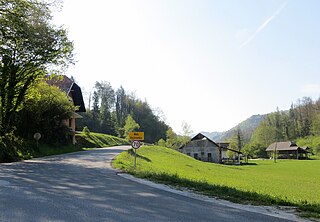
Mala Kostrevnica is a settlement immediately southeast of Šmartno pri Litiji in central Slovenia. The area is part of the historical region of Lower Carniola. The Municipality of Šmartno pri Litiji is included in the Central Slovenia Statistical Region.

Big Božna Creek or simply the Božna, also known as Božja Creek, or Big Creek is a stream in northwestern Slovenia. It is the left source tributary of the Gradaščica, the right one being Little Creek. It was recorded under the German names Salog bach or Sallog Bach in the 18th century.
Jelendol is a settlement south of Rakitnica in the Municipality of Ribnica in southern Slovenia. The area is part of the traditional region of Lower Carniola and is now included in the Southeast Slovenia Statistical Region.

Rožnik is a hill in the Rožnik District and Šiška District northwest of the Ljubljana city center. Together with Tivoli City Park, it forms Tivoli–Rožnik Hill–Šiška Hill Landscape Park. Extending from Tivoli Park, it is a popular hiking, running, and excursion destination for residents of Ljubljana.

Retovje Springs is a group of springs that join to form the Big Ljubljanica River.

The Trnovo Forest Plateau is a karst plateau that constitutes the extreme northwest end of the Dinaric Alps. The Trnovo Forest Plateau has a karst character, without surface watercourses and broken up by closed valleys, outcroppings, hills, caves, shafts, and smaller karst features: solution pans, rills, karrens, and other features. Significant karst features include ice caves. The vegetation inversion at Big Paradana Ice Cave in the eastern part of the plateau, measuring 385 meters (1,263 ft) by 1,550 meters (5,090 ft), is a locus classicus and in the past ice was harvested from it and exported via Gorizia and Trieste to Egypt.

The Menina Pasture Plateau is a pre-Alpine karst plateau in Slovenia.
References
- 1 2 Knific, Timotej. 1984. "Arheološki zemljevid Blejskega kota v zgodnjem srednjem veku." Kronika 32(2/3): 99–110, p. 102.
- ↑ Zaka Valley at Geopedia
- ↑ Andrič, Maja. "A Multi-Proxy Late-Glacial Palaeoenvironmental Record from Lake Bled, Slovenia." 2009. In: Krisztina Biczkó et al. (eds.), Palaeolimnological Proxies as Tools of Environmental Reconstruction in Fresh Water, pp. 121–141. Berlin: Springer, p. 124.
- ↑ Ogorelec, Bojan et al. 2006. "Recent Sediment of Lake Bled (NW Slovenia): Sedimentological and Geochemical Properties." In: Brian Kronvang et al. (eds.), The Interactions between Sediments and Water, pp. 141–169. Berlin: Springer, p. 143.
- 1 2 3 4 Čop, Dušan. 1998. "Ime Zaka in njegov izvor." Jezik in slovstvo 43(4): 173–174.
- ↑ Profil kopalne vode Kopalno območje Velika Zaka (Big Zaka Swimming Area). Ljubljana: Ministry of the Environment and Spatial Planning. (in Slovene)
- ↑ Profil kopalne vode Kopalno območje Mala Zaka (Little Zaka Swimming Area). Ljubljana: Ministry of the Environment and Spatial Planning. (in Slovene)
- 1 2 Bezlaj, France. 1977. "O imenih Sneberje, Sostro in drugo." Jezik in slovstvo 22(8): 225–227, p. 225.
- ↑ "Iz domovine." 1941. Karawanken-Bote 1(35): 4.