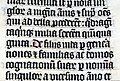
Bastarda or bastard is a term applied to a variety of scripts and typefaces originating in western Europe during the Renaissance.
One form of bastarda is "bastard Gothic": the blackletter manuscript hands used in various parts of continental Europe in the 14th and 15th centuries, mainly to write vernacular narratives. [1] Similar English scripts are sometimes distinguished as "bastarda Anglicana" or simply "Anglicana".
Spanish bastarda, by contrast, was a modified form of Italic script which remained in use there until as late as the 1830s. [2] The paleographer A. S. Osley characterized this bastarda as the "true successor" of the Italic hand, which had been supplanted by an early form of copperplate script outside Spain. [3]
Early printers produced a variety of typefaces based on local bastarda blackletter. [1] [4]
Over time, most of Europe's printers standardized on Antiqua (or "roman") typefaces, and bastarda type fell out of use in most countries. [1] Despite this trend, the German variety developed into the national Fraktur type, which remained in use until the mid-twentieth century. [5]
British typeface designer Jonathan Barnbrook has designed a contemporary interpretation of these early typefaces titled Bastard.