The CANT Z.1007 Alcione (Kingfisher) was an Italian three-engined medium bomber, with wooden structure. It was designed by Filippo Zappata, who also designed the CANT Z.506 and had "excellent flying characteristics and good stability". It was regarded by some as "the best Italian bomber of World War II" although its wooden structure was easily damaged by the climate, as experienced in North Africa and in Russia. It was used by the Italian Regia Aeronautica, Italian Co-Belligerent Air Force, Aeronautica Nazionale Repubblicana and Luftwaffe during World War II.

The Breda Ba.65 was an Italian all-metal single-engine, low-wing monoplane that was used by Aviazione Legionaria during the Spanish Civil War and Regia Aeronautica in the first half of World War II. It was the only Italian ground-attack aircraft that saw active service in this role. It saw service almost exclusively in the North African and Middle-Eastern theatre. In addition to more than 150 aircraft operated by the Italian forces, a total of 55 were exported and used by the air forces of Iraq, Chile and Portugal.

The Caproni Ca.314 was an Italian twin-engine attack/torpedo bomber aircraft, used in World War II.

The Breda Ba.25 was an Italian two-seat biplane trainer designed and built by the Breda company. It was the most widely used Italian basic trainer of the 1930s.

The Fiat CR.1 was an Italian biplane fighter aircraft of the 1920s. Of wood-and-fabric construction, it was designed by Celestino Rosatelli, from whom it gained the 'CR' designation. Its most distinctive feature was that the lower wings were longer than the upper ones.

The Breda A.9 was a biplane trainer produced in Italy in 1928 for the Regia Aeronautica. Conventional in design, it featured a single-bay, unstaggered wing cellule and fixed tailskid undercarriage. The student and instructor sat in tandem, open cockpits. A slightly smaller version, designated A.9-bis was developed for use in Italy's aeroclubs.
The Breda Ba.15 was a two-seat light aircraft produced in Italy in 1928.

The Caproni Ca.135 was an Italian medium bomber designed in Bergamo in Italy by Cesare Pallavicino. It flew for the first time in 1935, and entered service with the Peruvian Air Force in 1937, and with the Regia Aeronautica in January 1938.

The Savoia-Marchetti SM.62 was an Italian single-engine maritime patrol flying boat produced from 1926. It served with the Regia Aeronautica and with a number of foreign users, and was produced in Spain and the Soviet Union. Some of the Spanish aircraft were still in service during the Spanish Civil War.

The Breda Ba.201 was an Italian dive bomber designed during World War II, that never entered production.
The Piaggio P.32 was an Italian medium bomber of the late 1930s, produced by Piaggio, and designed by Giovanni Pegna. It was a modern design for its time, but was a failure due to lack of powerplants commensurate with its high wing loading.

The Savoia-Marchetti S.59 was a 1920s Italian reconnaissance/bomber flying boat designed and built by Savoia-Marchetti for the Regia Aeronautica.

The Caproni Vizzola F.4 was an Italian fighter aircraft prototype that was designed in 1937 and built from 1939. It was a single-seat, low-wing cantilever monoplane with retractable landing gear.
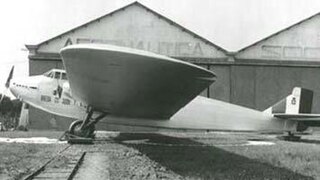
The Breda CC.20 was an Italian heavy bomber prototype of 1929 designed and built by the Breda company.

The Breda A.8 was a prototype twin-engined biplane, designed by Società Italiana Ernesto Breda, as a night bomber in 1927.

The twin-engined CANT Z.1011 was one of two bombers of about the same size and powered by the same engines, designed by Filippo Zappata in the mid-1930s. The other was the three-engined CANT Z.1007, which in the end was the type preferred by the Regia Aeronautica.

The CASA III was a 1920s Spanish two-seat monoplane, designed by Luis Sousa Peco and built by Construcciones Aeronáuticas SA (CASA) at Getafe near Madrid.

The Caproni Ca.134 was a biplane reconnaissance aircraft built by the Italian company Caproni in the 1930s.
The Macchi M.C.77 was a reconnaissance bomber flying boat built by Macchi in the thirties and remained at the prototype stage.
The Isotta Fraschini Asso 200 was a water-cooled inline engine developed by Isotta Fraschini in the late 1920s.