Dinghy sailing is the activity of sailing small boats by using five essential controls:

Dinghy racing is a competitive sport using dinghies, which are small boats which may be rowboats, have an outboard motor, or be sailing dinghies. Dinghy racing has affected aspects of the modern sailing dinghy, including hull design, sail materials and sailplan, and techniques such as planing and trapezing.
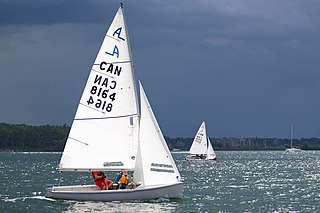
The Albacore is a 4.57 m (15 ft) two-person planing dinghy with fractional sloop rig, for competitive racing and lake and near-inshore day sailing. Hulls are made of either wood or fiberglass. The basic shape was developed in 1954 from an Uffa Fox design, the Swordfish. Recent boats retain the same classic dimensions, and use modern materials and modern control systems.
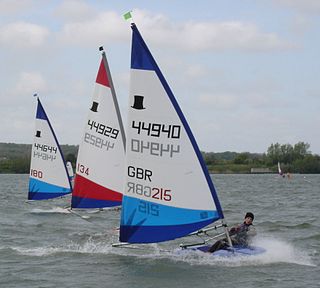
The Topper is an 11 foot 43 kg (95 lb) sailing dinghy designed by Ian Proctor. The Topper was a one-design boat until 2023 when a new version was produced, and is sailed mostly around the British Isles. It was recognised as a World Sailing Class. The boat previously constructed from polypropylene, and now roto moulded, is popular as a racing boat or for sail training. The class association (ITCA) organise racing events, which range from small travellers to major championships. The RYA run squads alongside the events; in these squads young sailors who are given specialist race coaching.

The OK Dinghy is an international class sailing dinghy, designed by Knud Olsen in 1956.

The Fireball is a British sailing dinghy that was designed by Peter Milne as a one-design racer and first built in 1962.
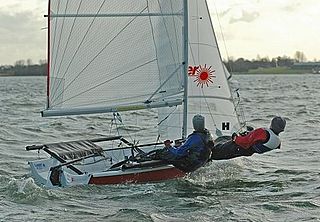
The Laser 4000 is a racing dinghy designed by Phil Morrison crewed by two persons. Its one-design weight-equalised system enables physically differing sailors to compete on a level playing field. It is most popular in Europe, particularly the UK, France and Italy.

The 18 ft Skiff is considered the fastest class of sailing skiffs. The class has a long history beginning with races on Sydney Harbour, Australia in 1892 and later in New Zealand. The boat has changed significantly since the early days, bringing in new technology as it became available. Because of the need of strength, agility and skill, the class is considered to be the top level of small boat sailing. Worldwide this boat is called the "18 Foot Skiff". It is the fastest conventional non-foiling monohull on the yardstick rating, with a score of 675, coming only third after the Tornado and Inter 20.

The Moth is a small development class of sailing dinghy. Originally a small, fast home-built sailing boat designed to plane, since 2000 it has become an expensive and largely commercially produced boat designed to hydroplane on foils though many are still built at home, typically at much lower cost.

The Cherub is a 12 feet long, high performance, two-person, planing dinghy first designed in 1951 in New Zealand by John Spencer. The class is a development class, allowing for significant variation in design between different boats within the rule framework. The minimum hull weight was originally 110 lbs.
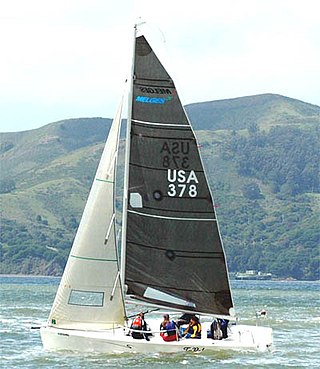
The term sportsboat first appeared in the late 1980s and early 1990s to describe trailer sailers that were optimised for high performance at the expense of accommodation and ballast. The very definition of the term "sportsboat" is evolving.
The 29erXX is a high performance sailing skiff, it was designed to allow light crews, particularly female crews, to sail twin trapeze boats and as a training boat for the more powerful 49er. The class gained International Sailing Federation Class status in May 2011, but lost it in 2014.
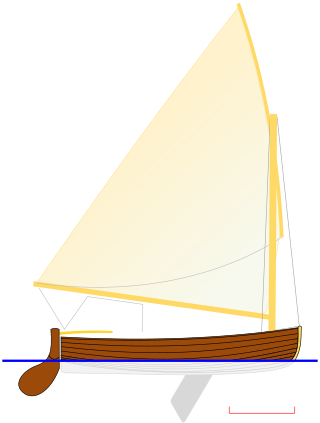
The Twelve Foot Dinghy was designed by George Cockshott, an amateur boat designer from Southport, England in response to a 1912 design contest. It became the first one-design racing dinghy to achieve international recognition. The class was granted the 'International' status by the IYRU in 1919 and remained this status until 1964 when it was revoked by the same authority. The class was selected as the dinghy class for the Olympics in 1920 & 1928. In 1924 the French wanted to use an alternate French design.
High-performance sailing is achieved with low forward surface resistance—encountered by catamarans, sailing hydrofoils, iceboats or land sailing craft—as the sailing craft obtains motive power with its sails or aerofoils at speeds that are often faster than the wind on both upwind and downwind points of sail. Faster-than-the-wind sailing means that the apparent wind angle experienced on the moving craft is always ahead of the sail. This has generated a new concept of sailing, called "apparent wind sailing", which entails a new skill set for its practitioners, including tacking on downwind points of sail.

The O'PEN Skiff, or O'pen Skiff, is a sailing dinghy that was designed by Vitali Design of Italy for children's sail training and as a one design racer. It was first built in 2006.

The RS100, first launched in 2009 by RS Sailing, is a singlehanded skiff. Possessing an asymmetric spinnaker the boat has two PY numbers of 981 for the 10.2 rig and 1004 for the 8.4 rig. The RS100 has a racing event circuit in the United Kingdom and in Europe, with the Eurotour beginning in 2011.

The Javelin is a high-performance skiff type dinghy sailed in Australia and New Zealand. The class was founded by designer John Spencer in 1961. Spencer also founded the Cherub Class. It is 14 feet long, sporting a large sail area, single trapeze and asymmetrical spinnaker. The Javelin is a development class, meaning that boats vary in shape within a framework of rules, rather than being all built to the same design. Bruce Farr is another well-known designer who drew successful Javelins.

The B&R 23 is a sailing boat designed in the early 1990s. It has an ultralight construction with a very large sail plane. Typical crew is a helmsman and two deck hands in trapezes. The boat is predominantly used for racing.
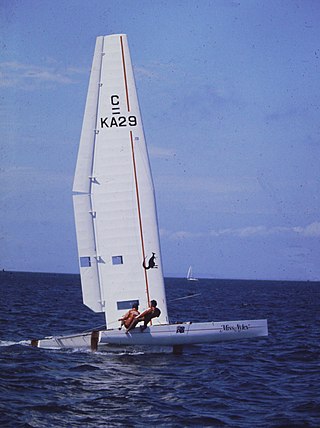
Miss Nylex is a C-Class racing catamaran, designed and built in Australia in the 1970s specifically to compete in the International Catamaran Challenge Trophy (ICCT). It has a single wingsail with two aerodynamic flaps, instead of the conventional mast and sail combination.
The Cape 31 is a South African planing sailboat that was designed by Mark Mills as a one design racer and first built in 2017.