Fokker F.III

Last updated

Fokker F.III
Fokker F.III van de KLM 2161 026473.jpg
Fokker F.III operated by KLM
RolePassenger transport
Manufacturer Fokker
Designer Reinhold Platz
First flightApril 1921
Primary usersDeutsche Aero Lloyd
KLM
Number builtc.66
Developed from Fokker F.II

The Fokker F.III was a single-engined high-winged monoplane aircraft produced in the 1920s by the Dutch aircraft manufacturer Fokker. It could carry five passengers. The aircraft was also built under licence in Germany as the Fokker-Grulich F.III.

Contents

The design was quite popular when it was shown at the 1921 Paris Air Show, and it proved to be a successful early airliner. Although quickly surpassed by later designs in the 1920s, it was used on many early air routes in Europe. It was also involved in KLM's first air accident, which led to radio being required on aircraft.

Design and development

Anthony Fokker behind the controls of the F.III; the engine cowling has been removed. Anthony Fokker zit in de cockpit van een Fokker F.III 2161 026475.jpg
Anthony Fokker behind the controls of the F.III; the engine cowling has been removed.
Fokker F.III Fokker F.III (7585198454) (tight crop, grayscale, contrast).jpg
Fokker F.III

The Fokker F.III [1] was a straightforward development of the F.II. A widened cabin allowed all five passengers to sit within; in the earlier aircraft, one passenger sat alongside the pilot in his exposed cockpit. The pilot now sat alongside the engine, which was offset laterally by about 100 mm (3.9 in); whether to port or starboard depended on the type of engine installed. Although this unusual arrangement meant that pilots were "burned on one side and frozen on the other," they had a much better view than from the F.II. The view was further improved by a cut-out in the wing leading edge for the pilot's head, allowing his seat to be raised. The external wing struts of the F.II were removed, leaving a clean cantilever wing. The trapezoidal windows seen in the Grulich built F.IIs were standard on the F.III.

Like its predecessor, the F.III was initially powered by a readily available, war surplus 138 kW (185 hp) BMW IIIa engine, but once again KLM re-engined theirs with the 172 kW (230 hp) Armstrong Siddeley Puma.

A seaplane version was developed by Fokker, called the F.IIIw. However, this design did not go into production. The design had twin floats, and it had a longer fuselage and rudder. Such was the pace of aircraft development no blueprints are known, only several photographs. [2]

An improved model known as the F.IIIs was also made, and this had new fuselage and tail fin. It was also called the Grulich V.I. [2]

Operational history

Civilian air travelers in 1920; F.III in the background. Passagiers voor een Fokker F.III 2161 026476.jpg
Civilian air travelers in 1920; F.III in the background.
German license-built Fokker-Grulich F.III Fokker-Grulich F.III 2161 026480.jpg
German license-built Fokker-Grulich F.III
Grulich V.1 or F.IIIs, an improved model with a redesigned fuselage and tail Grulich V.1, een verbouwde Fokker F.III 2161 026481.jpg
Grulich V.1 or F.IIIs, an improved model with a redesigned fuselage and tail

The F.III was first used by KLM when they reopened their Amsterdam-London service on 14 April 1921 (they did not, at this time operate over winter). Soon, F.IIIs were also flying on routes to Bremen, Brussels, Hamburg, and Paris. They proved to be very reliable aircraft. KLM received 14 F.IIIs from Fokker's German factory at Schwerin during 1921 and built two more itself from spares in the following year. This final pair used 268 kW (359 hp) Rolls-Royce Eagle VIII engines, with the pilot on the left.

Another operator of new F.IIIs was Deutsch-Russiche Luftverkehrs Gesellschaft ( Deruluft ) which used nine aircraft on their Berlin-Königsberg-Moscow route from May 1922. These machines, partially built in Schwerin and finished in the Netherlands at Veere, had Eagle engines. One was a Fokker-Grulich.

Deutsche Aero Lloyd gained a licence to build F.IIIs as they had for F.IIs and the company, with its southern subsidiary built and operated 18 of these Fokker-Grulich F.IIIs. Most of these used BMW engines, typically the 186 kW (249 hp) BMW IV in preference to the 138 kW (185 hp) BMW IIIa. Some of these were re-engined with the 239 kW (321 hp) BMW Va, and were designated F.IIIc.

Another operator from new was the Hungarian airline Malert , which received six Dutch-built aircraft for their Budapest-Vienna-Belgrade service from 1922 to 1929. These initially had BMW IIIa engines, but later ran with 172 kW (231 hp) Breitfeld & Daněk Hiero IV engines. They had larger wings, increased in area by about 14%. Deutsche Luft-Reederei also operated two, originally intended for KLM. Four F.IIIs probably went to the United States.

Later F.IIIs changed ownership frequently as airlines went bankrupt or merged. They were still flying commercially in Germany until about 1936.

Accidents and incidents

The F.III as involved into two air crashes, that due to developing nature of air travel had a big impact. For example, one disappearance lead to the radios being required on aircraft.

Operators

A Swiss airline poster featuring the F.III from 1927 CH-000957-X-1114 Mangold.tif
A Swiss airline poster featuring the F.III from 1927
Flag of Australia (converted).svg  Australia
Flag of the Free City of Danzig.svg Free City of Danzig
Flag of Denmark.svg  Denmark
Flag of Germany (3-2 aspect ratio).svg  Weimar Republic
Flag of Hungary (1915-1918, 1919-1946).svg  Hungary
Flag of the Netherlands.svg  Netherlands
Flag of the Soviet Union (1924-1936).svg  Soviet Union
Flag of Switzerland (Pantone).svg   Switzerland [2]

Specifications

Fokker F.III 3-view drawing from Les Ailes 23 June 1921 Fokker F.III 3-view Les Ailes June 23, 1921.png
Fokker F.III 3-view drawing from Les Ailes 23 June 1921

Data from FOKKER COMMERCIAL AIRCRAFT from the F.1 of 1918 up to the Fokker 100 of today., [1] Jane's all the World's Aircraft 1924, [4] Flight 26 May 1921 : The Fokker F III Commercial Monoplane [5]

General characteristics

Performance

Related Research Articles

<span class="mw-page-title-main">Fokker D.VII</span> 1918 fighter aircraft model by Fokker

The Fokker D.VII is a German World War I fighter aircraft designed by Reinhold Platz of the Fokker-Flugzeugwerke. Germany produced around 3,300 D.VII aircraft in the second half of 1918. In service with the Luftstreitkräfte, the D.VII quickly proved itself to be a formidable aircraft. The Armistice ending the war specifically required, as the fourth clause of the "Clauses Relating to the Western Front", that Germany was required to surrender all D.VIIs to the Allies. Surviving aircraft saw much service with many countries in the years after World War I.

<span class="mw-page-title-main">Junkers F 13</span> Type of airplane

The Junkers F 13 is the world's first all-metal transport aircraft, designed and produced by the German aircraft manufacturer Junkers.

<span class="mw-page-title-main">Fokker F.VII</span> Transport aircraft family by Fokker

The Fokker F.VII, also known as the Fokker Trimotor, was an airliner produced in the 1920s by the Dutch aircraft manufacturer Fokker, Fokker's American subsidiary Atlantic Aircraft Corporation, and several other companies under license. It was an airliner that could carry 6-12 people, depending on the version, and it used a variety of engines; early versions had one engine but three was more common.

<span class="mw-page-title-main">Deutsche Luft Hansa</span> 1926–1945 German flag carrier airline

Deutsche Luft Hansa A.G. was a German airline. It served as flag carrier of the country during the later years of the Weimar Republic and throughout Nazi Germany, when it had close links to the Nazi Party.

<span class="mw-page-title-main">Fokker F.VIII</span>

The Fokker F.VIII was a large twin-engined airliner designed and produced by the Dutch aircraft manufacturer Fokker in the 1920s.

<span class="mw-page-title-main">Junkers G 24</span> 1920s and 1930s German passenger aircraft

The Junkers G 24 was a German three-engine, all-metal low-wing monoplane passenger aircraft manufactured by Junkers from 1925. Junkers F 24 was the designation for single-engine versions of the same aircraft.

<span class="mw-page-title-main">Deruluft</span> Joint German-Soviet airline (1921–1937)

Deruluft was a joint German-Soviet airline, established on 11 November 1921. Deruluft opened its first permanent airlink between Moscow and Königsberg on 1 May 1922. It started a new route between Berlin and Leningrad on 6 June 1928, and maintained both routes until 31 March 1936. Deruluft was a successful business, but terminated on 31 March 1937 due to the changed political situation.

<span class="mw-page-title-main">Fokker F.IX</span>

The Fokker F.IX was an airliner developed in the Netherlands in the late 1920s, intended to provide KLM with an aircraft suitable for regular services to the Dutch East Indies. When the onset of the Great Depression forced the postponement of those plans, the market for this aircraft disappeared as well, although it did see military service in Czechoslovakia as a bomber.

<span class="mw-page-title-main">Fokker C.I</span>

The Fokker C.I was a German reconnaissance biplane under development at the end of World War I. The design was essentially an enlarged Fokker D.VII fighter with two seats and a 138 kW (185 hp) BMW IIIa engine. The C.I was originally developed to sell to the German Army. It never saw service in World War I, but Anthony Fokker managed to smuggle parts out of Germany at the time of the Armistice.

<span class="mw-page-title-main">BMW IIIa</span>

BMW IIIa was an inline six-cylinder SOHC valvetrain, water-cooled aircraft engine, the first-ever engine produced by Bayerische Motoren Werke AG, who, at the time, were exclusively an aircraft engine manufacturer. Its success laid the foundation for future BMW engine designs. It is best known as the powerplant of the Fokker D.VIIF, which outperformed any allied aircraft.

<span class="mw-page-title-main">Dornier Delphin</span> Type of aircraft

The Dornier Delphin was a 1920s German single-engine commercial flying boat built by Dornier Flugzeugwerke. As well as commercial users, single examples were acquired by the United States Navy and the British Royal Navy for evaluation.

<span class="mw-page-title-main">Fokker F.XXXVI</span> Type of aircraft

The Fokker F.XXXVI was a 1930s Dutch four-engined 32-passenger airliner designed and built by Fokker. It was the largest transport designed and built by Fokker. Only one was built, and it was used for some commercial routes starting in 1935, and later aviation training by the British Royal Air Force until 1940.

<span class="mw-page-title-main">Deutsche Luft-Reederei</span> 1919–1926 airline in Germany

Deutsche Luft-Reederei (D.L.R.), was a German airline established in December 1917 which started operating in 1919.

<span class="mw-page-title-main">Dornier Komet</span> Type of aircraft

The Dornier Komet (Comet), Merkur (Mercury), Do C, Do D, and Do T were a family of aircraft designed and manufactured by the German aircraft manufacturer Dornier Flugzeugwerke.

<span class="mw-page-title-main">Focke-Wulf A 17 Möwe</span> Type of aircraft

The Focke-Wulf A 17 Möwe was an airliner designed and produced by the German aircraft manufacturer Focke-Wulf. It was the company's first large commercial aircraft.
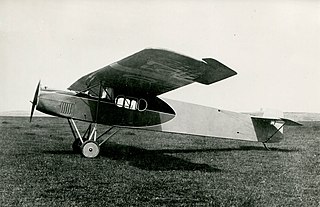
<span class="mw-page-title-main">Fokker F.II</span> Type of aircraft

The Fokker F.II was the first of a long series of commercial aircraft from the Fokker Aircraft Company, flying in 1919. In a biplane age, it presented a distinct clean, high-wing monoplane style that sold successfully across Europe and North America during the development of commercial passenger-carrying aviation.

<span class="mw-page-title-main">Fokker F.XIV</span> Type of aircraft

The Fokker F.XIV was a cargo plane built in the Netherlands in the late 1920s by Fokker. It was a high-wing cantilever monoplane of conventional trimotor layout. The sole example was tested by KLM but never put into service.
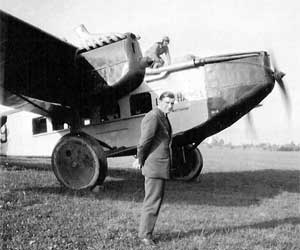
<span class="mw-page-title-main">Rohrbach Roland</span> Type of aircraft

The Rohrbach Ro VIII Roland was an semi-cantilever monoplane trimotor airliner designed and produced by the German aircraft manufacturer Rohrbach. It was capable of unrivalled performance in some categories; during its early years, the type held no less than 22 world records.

<span class="mw-page-title-main">Sablatnig P.III</span> Type of aircraft

The Sablatnig P.III was an airliner produced in Germany in the early 1920s.
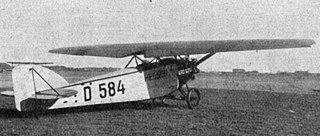
<span class="mw-page-title-main">Grulich S.1</span> Type of aircraft

The Grulich S.1 was a German parasol monoplane with a cantilever wing, built in the mid 1920s. It seated two and offered a choice between two engines.

References

  1. 1 2 de Leeuw, Rene, ed. (1994). FOKKER COMMERCIAL AIRCRAFT from the F.1 of 1918 up to the Fokker 100 of today. Illustrated by Serge Stone. Amsterdam: N. V. Konninklijke Nederlandse V. Fokker. pp. 22–29, 181–182.
  2. 1 2 3 4 5 "Fokker F.III". www.dutch-aviation.nl. Archived from the original on 30 December 2023. Retrieved 23 December 2023.
  3. "Lost Aeroplane. Unavailing Search For Dutch Machine". The Times. No. 43636. London. 26 April 1923. col F, p. 10.
  4. Grey, C.G., ed. (1924). Jane's all the World's Aircraft 1924. London: Sampson Low, Marston & company, ltd. pp. 175b –176b.
  5. "The Fokker F III Commercial Monoplane". Flight . Vol. XIII, no. 21. 26 May 1921. pp. 355–359. No. 648. Archived from the original on 8 January 2019. Retrieved 21 May 2019.

Further reading