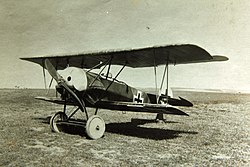
| Fokker D.VI | |
|---|---|
| | |
| General information | |
| Type | Fighter |
| Manufacturer | Fokker-Flugzeugwerke |
| Designer | |
| Primary user | Luftstreitkräfte |
| Number built | 59 |
The Fokker D.VI was a German fighter aircraft built in limited numbers at the end of World War I. The D.VI served in the German and Austro-Hungarian air services.
In late 1917, Fokker-Flugzeugwerke built two small biplane prototypes designated V.13. These aircraft combined a set of scaled-down D.VII wings with a fuselage and empennage closely mirroring those of the earlier Dr.I. [1] The first prototype utilized an 82 kW (110 hp) Oberursel Ur.II rotary engine, while the second featured a 119 kW (160 hp) Siemens-Halske Sh.III bi-rotary engine. [2]
Fokker submitted both prototypes at the Adlershof fighter trials in late January 1918. [3] At that time, Fokker reengined the first prototype with the 108 kW (145 hp) Oberursel Ur.III. [3] Pilots found the V.13s to be maneuverable and easy to fly. [4] Idflieg issued a production contract after the V.13s were ultimately judged to be the best rotary powered entries of the competition. [4]
The new aircraft, designated D.VI, passed its Typenprüfung (official type test) on 15 March 1918. [5] The production aircraft utilized the Oberursel Ur.II, which was the only readily available German rotary engine. Idflieg authorized low level production pending availability of the more powerful Goebel Goe.III. [5] Deliveries commenced in April and ceased in August, after only 59 aircraft had been completed. [6] Seven aircraft were delivered to the Austro-Hungarian Air Service (Luftfahrtruppen).
In service, the D.VI was hampered by the low power of the Oberursel Ur.II. [5] Moreover, the lack of castor oil and the poor quality of "Voltol," an ersatz lubricant, severely reduced engine life and reliability. [1] The D.VI remained in frontline service until September 1918, and continued to serve in training and home defense units until the Armistice.
General characteristics
Performance
Armament