| Albatros D.IV | |
|---|---|
 | |
| General information | |
| Type | Fighter |
| Manufacturer | Albatros Flugzeugwerke |
| Primary user | Luftstreitkräfte |
| Number built | 3 [1] |
The Albatros D.IV was an experimental German fighter aircraft built and tested during World War I.
| Albatros D.IV | |
|---|---|
| | |
| General information | |
| Type | Fighter |
| Manufacturer | Albatros Flugzeugwerke |
| Primary user | Luftstreitkräfte |
| Number built | 3 [1] |
The Albatros D.IV was an experimental German fighter aircraft built and tested during World War I.
The D.IV was designed to test a geared version of the 120 kW (160 hp) Mercedes D.III engine. Unlike the ungeared version, the geared engine was completely enclosed within the fuselage. The airframe basically combined the D.II wing cellule with the D.Va fuselage. [1]
Three examples were ordered in November 1916, but only one was flown. It was tested with several types of propeller, but excessive vibration problems and limited performance increase precluded further development. [1] [2]
Data fromGerman Aircraft of the First World War and The Complete Book of Fighters. [1] [2]
General characteristics
Performance
Aircraft of comparable role, configuration, and era
Related lists

The Albatros D.V is a fighter aircraft of the German aircraft manufacturer Albatros Flugzeugwerke. It was the final development of the Albatros D.I family and the last Albatros fighter to see operational service with the Luftstreitkräfte during the First World War.

The Fokker D.I was a development of the D.II fighter. The D.I was also flown in Austro-Hungarian service as a fighter trainer aircraft under the designation B.III. Confusing the matter further, both the D.II and D.I arrived at the Front in German service at similar times, in July–August 1916. The main designer was Martin Kreutzer.

The Albatros W.4 was a military floatplane designed and produced by the German aircraft manufacturer Albatros Flugzeugwerke.
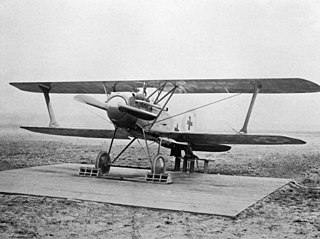
The Albatros D.X was a German prototype single-seat fighter biplane developed in 1918 in parallel with the Albatros D.IXme

The Albatros D.XII was a German single-seat fighter biplane first flown in March 1918. It was the last of the Albatros fighters completed and flown before the end of World War I and had the same slab-sided fuselage seen on the Albatros D.X.
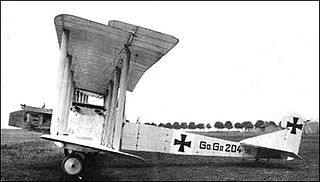
The Gotha G.II series was a heavy bomber used by the Luftstreitkräfte during World War I.

The Fokker D.III was a German single-seat fighter aircraft of World War I. It saw limited frontline service before being withdrawn from combat in December 1916.

The Siemens-Schuckert D.I was a single-seat fighter built by Siemens-Schuckert Werke in 1916. It was a German copy of the French Nieuport 17 that was obsolete by the time it was available in numbers, so that it served mainly as an advanced trainer.
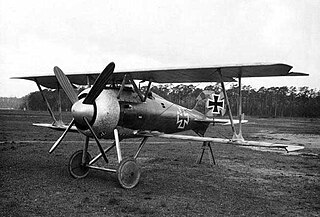
The Siemens-Schuckert D.III was a German single-seat fighter built by Siemens-Schuckert Werke. The D.III was a development of the earlier Siemens-Schuckert D.IIc prototype. The D.III was an (nearly) equal-span biplane powered by a 160 hp (119 kW) Siemens-Halske Sh.III bi-rotary engine. Idflieg placed an order for 20 aircraft in December 1917, followed by a second order of 30 aircraft in February 1918.

The Daimler D.I was a German fighter aircraft of World War I. It was a conventional biplane design with a very small interplane gap - the top wing nearly touched the top of the fuselage. Power was provided by a Daimler D.IIIb water-cooled V-8 engine.

The Hansa-Brandenburg CC was a single-seat German fighter flying boat of World War I. It was used by both the Kaiserliche Marine and the Austro-Hungarian Navy.

The Hansa-Brandenburg D.I, also known as the KD was a German fighter aircraft of World War I. Despite poor handling characteristics it was put into service by Austria-Hungary, where some aircraft served until the end of the war.
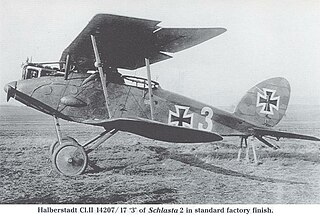
The Halberstadt CL.II was a German two-seat escort fighter/ground attack aircraft of World War I. It served in large numbers with the German Luftstreitkräfte in 1917-18.

The Roland D.VI was a German fighter aircraft built at the end of World War I. It lost a fly-off to the Fokker D.VII, but production went ahead anyway as insurance against problems with the Fokker.

The LFG Roland D.II was a German single-seat fighter of World War I. The type was manufactured by Luftfahrzeug Gesellschaft, and also by Pfalz Flugzeugwerke under license.
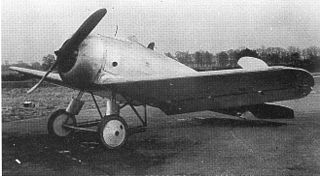
The Handley Page Type S, or HPS-1 was a prototype British carrier-based fighter developed for the United States Navy in the early 1920s. A low-wing monoplane, it was unsuccessful, only two being built and flown.
The Armstrong Whitworth F.K.5 and F.K.6 were experimental triplanes built as escort fighters by Armstrong Whitworth during the First World War. They carried two gunners in nacelles mounted on the centre wing. One example of each type was built, with no further development or production following.
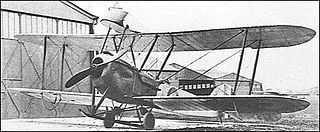
The Vickers F.B.11 was a prototype British three-seat escort fighter of the First World War. A large single-engined biplane, it carried one gunner in a nacelle mounted on the upper wing to give an allround field of fire. Only a single example was completed.
The LFG Roland C.VIII was a German reconnaissance aircraft of World War I. It was manufactured by Luft-Fahrzeug-Gesellschaft G.m.b.H.
The Märkische D.I was a prototype single-seat fighter biplane built in the last months of World War I.
