
The Albatros C.I,, was a twin-seat general-purpose biplanes designed and produced by the German aircraft manufacturer Albatros Flugzeugwerke. It was the first of the successful C-series aircraft operated by the Luftstreitkräfte.
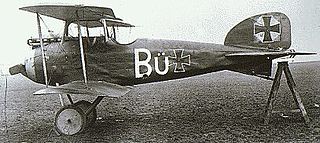
The Albatros D.I was an early fighter aircraft designed and produced by the German aircraft manufacturer Albatros Flugzeugwerke. It was the first of the Albatros D types which equipped the majority of the German and Austrian fighter squadrons (Jagdstaffeln) for the last two years of the First World War. Despite this, the D.I had a relatively brief operational career, having been rapidly eclipsed by rapid advances in fighter aircraft.
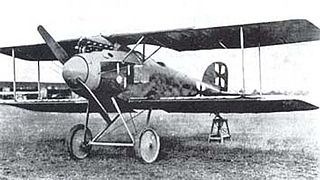
The Albatros D.II was a German fighter aircraft used during World War I. After a successful combat career in the early Jagdstaffeln, it was gradually superseded by the Albatros D.III.

The Albatros D.IV was an experimental German fighter aircraft built and tested during World War I.

The Albatros D.V is a fighter aircraft of the German aircraft manufacturer Albatros Flugzeugwerke. It was the final development of the Albatros D.I family and the last Albatros fighter to see operational service with the Luftstreitkräfte during the First World War.

The Pfalz D.III was a fighter aircraft used by the Luftstreitkräfte during the First World War. The D.III was the first major original design from Pfalz Flugzeugwerke. Though generally considered inferior to contemporary Albatros and Fokker fighters, the D.III was widely used by the Jagdstaffeln from late 1917 to mid-1918. It continued to serve as a training aircraft until the end of the war.

The Albatros W.4 was a military floatplane designed and produced by the German aircraft manufacturer Albatros Flugzeugwerke.
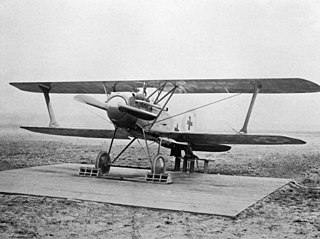
The Albatros D.X was a German prototype single-seat fighter biplane developed in 1918 in parallel with the Albatros D.IXme

The Albatros Dr.II was a German prototype single-seat fighter triplane, the sole example of which flew in the spring of 1918. It was similar in many respects to the D.X biplane, employing among other features the same 145 kW (195 hp) Benz Bz.IIIbo engine and twin 7.92 mm (.312 in) machine guns.

The Albatros D.XII was a German single-seat fighter biplane first flown in March 1918. It was the last of the Albatros fighters completed and flown before the end of World War I and had the same slab-sided fuselage seen on the Albatros D.X.

The Albatros C.XII was a military reconnaissance aircraft designed and produced by the German aircraft manufacturer Albatros Flugzeugwerke.

The Halberstadt D.II was a biplane fighter aircraft developed and manufactured by German aircraft company Halberstädter Flugzeugwerke.
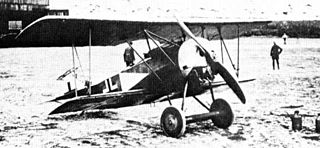
The Fokker D.VI was a German fighter aircraft built in limited numbers at the end of World War I. The D.VI served in the German and Austro-Hungarian air services.

The Fokker D.V was a German biplane fighter of World War I.

The Hansa-Brandenburg D.I, also known as the KD was a German fighter aircraft of World War I. Despite poor handling characteristics it was put into service by Austria-Hungary, where some aircraft served until the end of the war.

A Jagdstaffel was a fighter Staffel (squadron) of the German Imperial Luftstreitkräfte during World War I.
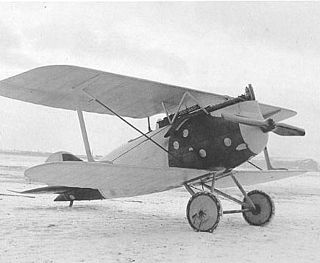
The Rumpler D.I was a fighter-reconnaissance aircraft produced in Germany at the end of World War I. It was a conventional single-bay biplane with wings of unequal span braced by I-struts. It featured an open cockpit and a fixed, tailskid undercarriage. The upper wing was fitted with aerodynamically balanced ailerons and fuselage had an oval cross-section.
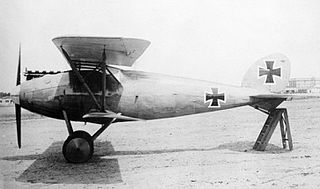
The Albatros C.XIII was a German two-seat, single-engine, biplane light fighter aircraft built in 1917. Only one was constructed.

The Albatros C.XIV was a German two seat, single engine, biplane fighter aircraft built in 1918. Only one was constructed.


