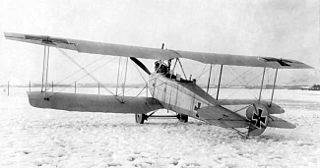
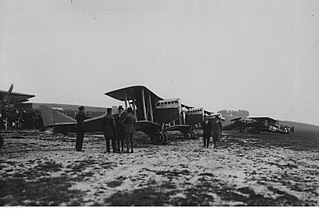
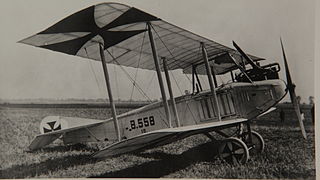
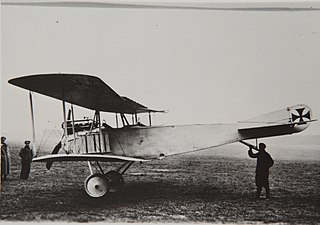
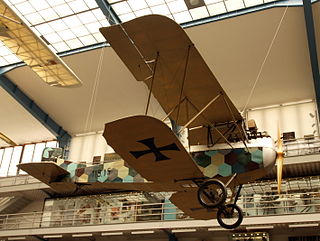
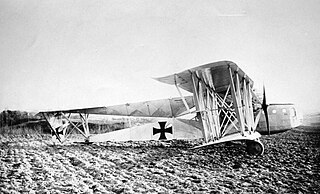
The Aviatik B.I is a German two-seat reconnaissance biplane designed and built by the Automobil und Aviatik AG company, who until then had produced copies of French designs.
The first of indigenous Aviatik biplanes, designed by Robert Wild, was the P.13, flown in April–May 1912.[1] It was built in several variants and featured large 3½-bay or 4-bay wings and[clarification needed] .[1] The type was widely used in competitions and gained high reputation. An improved design was the P.14 of 1913, with smaller 2½-bay wings and aerodynamic and structural refinements.[2] Also in 1913, an ultimate refined design P.15 was built, with 2-bay or 3-bay wings and a fail fin.[3]
The German air force became interested in Aviatik aircraft and ordered 101 P.13 and P.14s in 1913, then further orders followed.[3] The crew sat in open tandem cockpits with the observer in the front. Initially they were designated just as Aviatik B, with a service number and two last digits of a year (e.g. B.268/13). From September 1915 the aircraft P.15 type were designated as B.I (P.15b with 100hp engine) or B.II (P.15a with 120hp engine).[4] There is a supposition, that earlier B-class 100hp Aviatiks might have been designated B.I as well.[4] Aviatik B-class were unarmed, but in a course of the war, machine guns were sometimes used.
The B.I was manufactured in large numbers in Italy under licence by Società Aeronautica Meccanica Lombardia (SAML), which built 410 examples according to Aviatik's design. The firm then put two modified versions of their own into production, as designed by Robert Wild. The first of these, the SAML S.1 was powered by a Fiat A.12 engine and was armed with a Fiat-Revelli machine gun for the observer. The second version, the SAML S.2 was intended for the reconnaissance-bomber role and had a shorter wingspan, a fixed, forward-firing Fiat-Revelli machine gun in addition to the one in the rear cockpit, and a bomb load of 40kg (90lb). The 16 Squadriglie da Recognizione operated 660 S-1s and S-2s from 1917 onwards in Italy, Albania, and Macedonia. Two SAML S.1 participated in the Revolution of 1922 in Paraguay in the government side. They survived the conflict and they were the first planes of the new Military Aviation School, along a single Ansaldo SVA.5, an Ansaldo SVA.10 and a SPAD S.20. One S.1 was destroyed in an accident in 1928 but the other survived as a trainer during the Chaco War.
The Aviatik B.114/14 was the first aircraft shot down in aerial combat. On October 5, 1914, one was downed by a French Voisin III crewed by French pilot Sgt. Joseph Frantz and his mechanic/gunner, Louis Quénault. German pilot Wilhelm Schlichting was killed by gunfire, and his observer, Fritz von Zangen, perished in the subsequent crash.[5][6]
↑ Kroschel, Gunter; Stützer, Helmut (1994). Die deutschen Militärflugzeuge 1919-1934: mit 143 Vierseitenrissen im Massstab 1:144 (in German) (Lizenzausged.). Augsberg: Weltbild. ISBN3893506934.
Bibliography
Grosz, Peter M. Aviatik B-types. Berkhamsted: Albatros Productions, 2003. Windsock Datafile No.102. ISBN0-948414-95-2.
Herris, Jack (2023). Aviatik Aircraft of WWI: A Centennial Perspective on Great War Airplanes. Great War Aviation Centennial Series. Vol.10 (2nded.). n.p.: Aeronaut Books. ISBN978-1-953201-59-1.
Sapienza, Antonio Luis (April 1999). "Le role de aviation lors de la révolution de 1922 au Paraguay" [The Role of Aircraft during the 1922 Paraguayan Revolution]. Avions: Toute l'aéronautique et son histoire (in French) (73): 24–26. ISSN1243-8650.
External links
Wikimedia Commons has media related to Aviatik B.I.
The Gotha G.V was a heavy bomber used by the Luftstreitkräfte during World War I. Designed for long-range service and built by Gothaer Waggonfabrik AG, the Gotha G.V was used principally as a night bomber.
S.P.A. was an Italian automobile, military vehicle and aero-engine manufacturer founded in Turin by Matteo Ceirano and Michele Ansaldi. It was active between 1906 and 1926. In 1908, it merged with Fabbrica Ligure Automobili Genova (FLAG) and the new company, Società Ligure Piemontese Automobili, was headquartered in Genoa while manufacturing in Turin.
The Albatros C.III was a twin-seat general-purpose biplane designed and produced by the German aircraft manufacturer Albatros Flugzeugwerke. It was produced in greater numbers than any other C-type aircraft by Albatros as well as being the company's most-produced twin-seat aircraft.
The Aviatik C.I was an observation aircraft designed and produced by the German aircraft manufacturer Aviatik. It was the first aircraft produced by the company to be mass-produced as well as one of the first German military aircraft of the First World War to become fairly well known amongst the general public of the era.
The Ansaldo A.300 was an Italian general-purpose biplane aircraft built by the Ansaldo company of Turin from 1920 to 1929. It also served as a light bomber, transport, fighter and reconnaissance aircraft, and finally as an advanced trainer, with examples in service as late as 1940. 50 examples were also license-built in Poland at ZM E. Plage & T. Laśkiewicz, but were not a success due to poor quality.
The Aviatik (Berg) D.I, was a single-engine, single-seater biplane fighter that was developed and manufactured by the Austro-Hungarian branch of German aircraft company Aviatik. It was also known as Berg D.I or the Berg Fighter, because it was designed by Dipl. Ing. Julius von Berg, and to distinguish it from the D.I fighter built by the parent Aviatik firm in Germany.
The Ansaldo SVA was a family of Italian reconnaissance biplane aircraft of World War I and the decade after. Originally conceived as a fighter, the SVA was found inadequate for that role. Its impressive speed, range and operational ceiling, with its top speed making it one of the fastest of all Allied combat aircraft of the war, gave it the right properties to be an excellent reconnaissance aircraft and even light bomber. Production of the aircraft continued well after the war, the final examples were delivered during 1918.
Note: Not to be confused with the Austro-Hungarian Aviatik B.II series 32, 32.7 and 34 which were different aircraft.
Automobil und Aviatik AG was a German aircraft manufacturer during World War I. The company was established at Mülhausen in 1909 and soon became one of the country's leading producers of aircraft. It relocated to Freiburg in 1914 and to Leipzig in 1916 and established a subsidiary in Vienna as Österreichisch-Ungarische Flugzeugfabrik Aviatik. During the war, the company became best known for its reconnaissance aircraft, the B.I and B.II, although the Austro-Hungarian subsidiary also produced a number of its own designs, including fighters such as the D.I.
The Aviatik C.VI was a prototype German biplane observation aircraft built by Aviatik during World War I. Based on the earlier Aviatik C.V, the C.VI had a more powerful engine and other improvements. Only a single aircraft was built.
The Albatros B.III,, was a German World War I reconnaissance biplane, built by Albatros Flugzeugwerke as the Albatros LDD.
The Knoller C.II was a reconnaissance aircraft built in Austria-Hungary during World War I for use by the Austro-Hungarian army.
The Lohner B.I was a military reconnaissance aircraft produced in Austria-Hungary during World War I. As Lohner strove to perfect the design, a variety of increasingly powerful engines were fitted, reflected in a range of military designations from B.II through to B.VI until the definitive B.VII was finally produced. This last version was also produced in an armed variant, designated the C.I.
The Rumpler B.I was a military reconnaissance aircraft produced in Germany during World War I.
The Siemens-Schuckert R.I was a bomber aircraft built in Germany during World War I. It was originally ordered as the Siemens-Schuckert G.I prior to the German Inspectorate of Flying Troops adopting the "R" classification for multi-engine aircraft in late 1915. Some sources refer to the aircraft as the Siemens-Schuckert Steffen R.I, including the name of the brothers that designed it.
The Siemens-Schuckert R.VI was a bomber aircraft built in Germany during World War I. It was one of six aircraft based on the Siemens-Schuckert R.I, which were originally intended to be identical. Each developed in a different direction and were designated as different aircraft types by the German Inspectorate of Flying Troops.
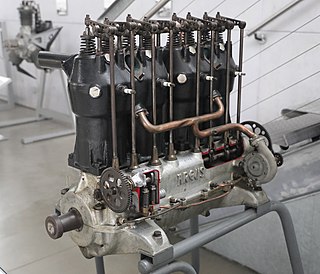
The Argus As I was a four-cylinder, water-cooled, aircraft engine produced in Germany by Argus Motoren from 1911 until about 1913.
The Gotha B types of the Gothaer Waggonfabrik were two-seat reconnaissance/trainer aircraft of the German Air Force in the First World War.
The Halberstadt B-types of the Halberstädter Flugzeugwerke were two-seat unarmed reconnaissance/training aircraft of the German Air Force in the First World War.
This page is based on this Wikipedia article Text is available under the CC BY-SA 4.0 license; additional terms may apply. Images, videos and audio are available under their respective licenses.