| C.I | |
|---|---|
| Aviatik C.I trainer (late series) | |
| General information | |
| Type | Reconnaissance aircraft |
| Manufacturer | Aviatik |
| History | |
| Introduction date | 1915 |
| First flight | 1915 |
| Retired | 1917 |
The Aviatik C.I was an observation aircraft designed and produced by the German aircraft manufacturer Aviatik. It was the first aircraft produced by the company to be mass-produced as well as one of the first German military aircraft of the First World War to become fairly well known amongst the general public of the era. [1]
It was a development of the Aviatik B.I and B.II models, being one of first aircraft of the new German C class of armed biplanes. On the C.I, the observer sat in front of the pilot; this arrangement was unique amongst the C class, which opted to place the pilot in the forward position instead. [1] The positions of the pilot and observer were reversed in last series of 50, ordered in 1917 solely for training purposes. [2] There was only a single aircraft completed of the refined C.Ia version in May 1916, with armament still in a forward cab, serving as a prototype for the C.III. [2]
Operationally, the C.I was introduced in 1915; it was typically flown in flights of three to six aircraft; the destruction of one aircraft on 7 November 1915 was considered a such a feat that the Royal Flying Corps pilot responsible was awarded the Victoria Cross. [3] In response to demands for greater performance, Aviatik developed several derivatives of the aircraft, including the Aviatik C.II and the C.III, which were equipped with more powerful engines and various refinements, although the airframes would typically have little modification. 548 Aviatik C.I were built in total: 402 by Aviatik (including 51 trainers and 1 C.Ia) and 146 by Hannover. [4]
Prior to the outbreak of the First World War, the German aircraft manufacturer Aviatik had built up a favourable relationship for its early aircraft. [1] Following the start of the conflict, the company quickly turned its attention to Germany's wartime needs. The resulting aircraft from this endeavour, designed C.I, was the company's first aircraft be produced on a large scale. [1] Developed during late 1914 and early 1915, the C.I was powered by a single Mercedes D.III six-cylinder in-line piston engine and armed with a single machine gun for self-defence purposes. The latter was operated by the aerial observer and clipped on a sliding mounting fitted on a rail at either side of the cockpit; a quick-release mechanism allowed for it to be readily swapped from one side of the cockpit to the other as required. [5] [1] Unusually amongst German aircraft of the era, the observer was positioned in front of the pilot; this arrangement restricted the range of fire of the machine gun along with the field of vision for performing observations. Due to these shortcomings, the seating arrangement was reversed on later-built aircraft. [1]
In terms of its construction, the C.I was relatively orthodox for the era. [1] The fuselage had a box-girder structure comprising four spruce longerons and members that were braced using stranded steel cables. It had a rounded top decking that tapered towards the rear to form a vertical knife-edge while the forward end terminated in a sheet plate that was fretted with lightening holes. [6] This plate, in conjunction with the first two formers, supported the engine bearers, which were further braced sing steel tubing. The engine was surrounded by curved aluminium panels, although the cylinder block remained exposed; aluminium sheeting also covered the sides and underside of the nose while the majority of the fuselage was covered by fabric. [7] The exhaust manifold was an obstruction to forward visibility. Early-build C.Is had their radiators, however, the majority of aircraft were fitted with an improved Teeves and Braun-built unit that was mounted on the front of the center-section wing struts. [7]
The wings were rectangular, covered with fabric, and comprised all-wood construction except for the compression struts, which were made of steel tubing. [7] The primary spars were produced in two halves and joined together with hardwood tongues to form hollow box-spars; the trailing edge of the wing formed its characteristic scalloped outline. A set of unbalanced parallel-chord were hinged directly to the rear spar at the upper wing tips. [7] The inverted trestle-type cabane strut and every interplane strut was composed of streamlined steel tubing and braced with stranded wires. The interplane bay featured unusual bracing, the forward wire being anchored to the rear spar junction of the fuselage while the rear wire was anchored to the inner struts and terminally anchored to the top longeron; this arrangement proved superior for the use of the aircraft's machine gun. [7]
A typical V-shaped undercarriage was used, the struts of which joined with a compact horizontal tube at its apex that functioned as the anchor point for a rubber chord that acted as a shock absorber. [8] The undercarriage was braced by stranded cables between the front legs while an elliptical tube spreader-bar joined the legs forward of the axle and a wire strained connected them behind the axle. Almost all of the tail surfaces, save for the wooden tail plane ribs, were composed of light-gauge steel tubing. [8] The tailplane had a distinctive kidney shape while the rudder, which was balanced, had a comma shape. A lengthy and narrow triangular fin was also present, which was braced to the tailplane via a light steel strut; the underside of the tailplane was itself braced to the fuselage by a pair of light struts. [8]
During 1916, in response to military demands for superior performance, Aviatik developed the improved C.III. [8] It was a refined C.I, having cleaned up nose contours, a redesigned exhaust manifold, a new aerofoil-style radiator and an enlarged spinner fitted to the propeller. The wingspan was also reduced along with the chord of the ailerons, the fuel system was improved; however, the airframe was virtually identical to that of the C.I. [8] These changes resulted in the C.III being 18 kmph faster than its predecessor while also improving its forward visibility considerably. [8]
Data fromGerman Aircraft of the First World War [10]
General characteristics
Performance
Armament
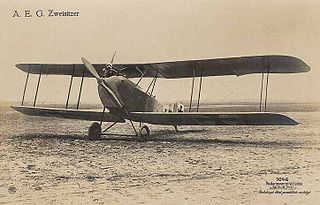
The AEG C.IV was a two-seat biplane reconnaissance aircraft designed and produced by the German aircraft manufacturer Allgemeine Elektrizitäts-Gesellschaft.
The AEG G.IV was a biplane bomber aircraft designed and produced by the German aircraft manufacturer Allgemeine Elektrizitäts-Gesellschaft. It saw action during the First World War with the Luftstreitkräfte.
The Albatros C.III was a twin-seat general-purpose biplane designed and produced by the German aircraft manufacturer Albatros Flugzeugwerke. It was produced in greater numbers than any other C-type aircraft by Albatros as well as being the company's most-produced twin-seat aircraft.
The Albatros C.I,, was a twin-seat general-purpose biplanes designed and produced by the German aircraft manufacturer Albatros Flugzeugwerke. It was the first of the successful C-series aircraft operated by the Luftstreitkräfte.
The Albatros B.II, was an unarmed two-seat reconnaissance biplane designed and produced by the German aircraft manufacturer Albatros Flugzeugwerke. It was the aircraft that brought Albatros Flugzeugwerke to the world's attention.
The Aviatik (Berg) D.I, was a single-engine, single-seater biplane fighter that was developed and manufactured by the Austro-Hungarian branch of German aircraft company Aviatik. It was also known as Berg D.I or the Berg Fighter, because it was designed by Dipl. Ing. Julius von Berg, and to distinguish it from the D.I fighter built by the parent Aviatik firm in Germany.
The AGO C.IV was a German biplane reconnaissance aircraft designed and produced by the German aircraft manufacturer AGO Flugzeugwerke. It was active with the Luftstreitkräfte during the latter half of the First World War.
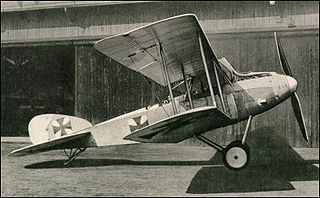
The Albatros C.V was a military reconnaissance aircraft designed and produced by the German aircraft manufacturer Albatros Flugzeugwerke.
The Albatros C.X was a military reconnaissance aircraft designed and produced by the German aircraft manufacturer Albatros Flugzeugwerke.
The Albatros C.XII was a military reconnaissance aircraft designed and produced by the German aircraft manufacturer Albatros Flugzeugwerke.
The Halberstadt D.II was a biplane fighter aircraft developed and manufactured by German aircraft company Halberstädter Flugzeugwerke.
The Caproni Ca.97 was a utility monoplane aircraft designed and produced by the Italian aircraft manufacturer Caproni. It had a range of powerplant arrangements, the aircraft could be flown with many as three radial engines, however, many were built with only the nose engine present or with only the two nacelle-mounted engines.
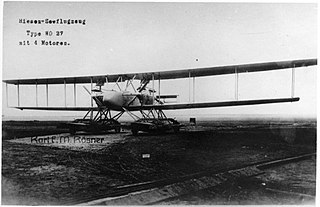
The Gotha WD.27 was a long-range maritime patrol floatplane developed during World War I by Gothaer Waggonfabrik (Gotha) for the Imperial German Navy's Naval Air Service. It was a large, four-engine aircraft with the same general layout as the WD.22; a conventional floatplane with engines grouped in tractor-pusher pairs on the lower wings. Three aircraft were ordered in early 1918, but the first prototype was not completed until after the end of the war in November. It may not have flown before it was ordered to be destroyed by the victorious Allies.
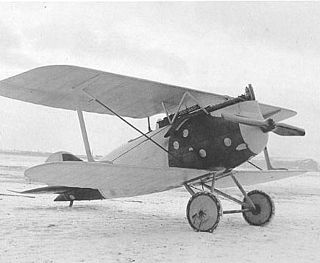
The Rumpler D.I was a fighter-reconnaissance aircraft produced in Germany at the end of World War I. It was a conventional single-bay biplane with wings of unequal span braced by I-struts. It featured an open cockpit and a fixed, tailskid undercarriage. The upper wing was fitted with aerodynamically balanced ailerons and fuselage had an oval cross-section.
The Siemens-Schuckert R.I was a bomber aircraft built in Germany during World War I. It was originally ordered as the Siemens-Schuckert G.I prior to the German Inspectorate of Flying Troops adopting the "R" classification for multi-engine aircraft in late 1915. Some sources refer to the aircraft as the Siemens-Schuckert Steffen R.I, including the name of the brothers that designed it.
The Siemens-Schuckert Forssman was a prototype bomber aircraft designed and built in Germany in 1914 and 1915. When its performance proved inadequate for its intended role, even after numerous modifications, the German Inspectorate of Flying Troops eventually accepted it into service as a trainer. Shortly after its acceptance into military service, the aircraft's fuselage fractured while on the ground, ending its career.
The Zeppelin-Staaken Riesenflugzeuge were a series of very large bomber aircraft - Riesenflugzeuge, usually powered by four or more engines, designed and built in Germany from 1915 to 1919.
The Otto C.I, also known as the Otto KD.15, was a German two-seat biplane reconnaissance and bomber aircraft of the First World War designed and produced by Otto Flugmaschinenfabrik. The C.I was a rare example of an aircraft flown by the Central Powers which had a pusher configuration.
The Hansa-Brandenburg C.II, company designation K,, was a two-seat reconnaissance aircraft built in Germany by Hansa-Brandenburg in World War I, powered by Mercedes D.III or Hiero 6 water-cooled in-line piston engines.
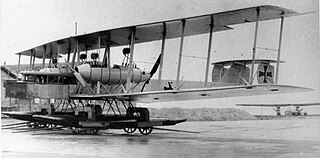
The Zeppelin-Staaken L was an experimental long-range maritime patrol floatplane developed during World War I by Zeppelin-Staaken for the Imperial German Navy's Naval Air Service. Derived from the Zeppelin-Staaken R.VI heavy bomber, it was a large, four-engine aircraft with a crew of seven men. Its engines were grouped in tractor-pusher pairs between the wings. A single aircraft was ordered for evaluation purposes in 1917. It was destroyed in a crash in June 1918 with the death of everyone aboard.