Related Research Articles
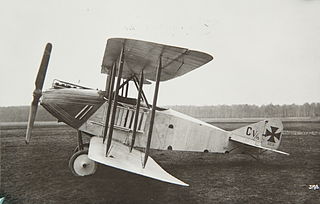
The AEG C.V was a prototype two-seat biplane reconnaissance aircraft of World War I. Designed to use a more powerful engine than previous AEG C-class reconnaissance aircraft, results were disappointing enough that further development was cancelled.

The Albatros C.XV was a German military reconnaissance aircraft developed during World War I. It was essentially a refinement of the C.XII, which had been put into production in 1918. The war ended before any examples became operational. However, some found their way into civilian hands and flew as transport aircraft in peacetime under the factory designation L 47. Others saw service with the air forces of Russia, Turkey, and Latvia.

The Gotha G.III was a twin-engine pusher biplane heavy bomber used by the Luftstreitkräfte during World War I. It succeeded the G.II in production and differed primarily in powerplant and in armament details. The G.II's unreliable Mercedes D.IV was replaced by the new inline six-cylinder 190 kW (250 hp) Mercedes D.IVa engine. The G.III also had an extra 7.92 mm (0.312 in) machine gun firing through a ventral gun opening to protect the underside of the tail.

The LFG Roland C.II, usually known as the Walfisch (Whale), was an advanced German reconnaissance aircraft of World War I. It was manufactured by Luft-Fahrzeug-Gesellschaft G.m.b.H.
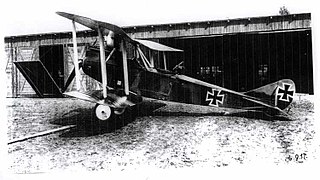
The Rumpler C.IV was a German single-engine, two-seat reconnaissance biplane. It was a development of C.III with different tail surfaces and using a Mercedes D.IVa engine in place of the C.III's Benz Bz.IV. The Rumpler 6B 2 was a single-seat floatplane fighter variant with a 120 kW (160 hp) Mercedes D.III engine built for the Kaiserliche Marine.

The Roland D.VI was a German fighter aircraft built at the end of World War I. It lost a fly-off to the Fokker D.VII, but production went ahead anyway as insurance against problems with the Fokker.

The Gotha WD.14, WD.20, and WD.22 were a family of biplane torpedo bomber floatplanes developed in Germany during World War I.

The LFG Roland D.II was a German single-seat fighter of World War I. The type was manufactured by Luftfahrzeug Gesellschaft, and also by Pfalz Flugzeugwerke under license.

The LVG C.II was a 1910s German two-seat reconnaissance biplane designed at the Luft-Verkehrs-Gesellschaft for the Luftstreitkräfte.

The LFG Roland D.I was a fighter aircraft produced in Germany during World War I. It was a single-seat aircraft based originally on the Roland C.II two-seat reconnaissance type. It shared its predecessor's unusual design feature of having a deep fuselage that completely filled the interplane gap, but in comparison, the fuselage was much sleeker. While the C.II's appearance had earned the Walfisch ("Whale"), the D.I became known as the Haifisch ("Shark"). The I-struts that had been used to brace the C.II's wing were replaced by more conventional struts. Other changes to the wing included the removal of stagger from the design and the introduction of slight sweepback.

The LFG Roland D.III was a fighter aircraft produced in Germany during World War I.
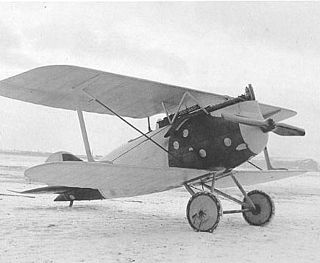
The Rumpler D.I was a fighter-reconnaissance aircraft produced in Germany at the end of World War I. It was a conventional single-bay biplane with wings of unequal span braced by I-struts. It featured an open cockpit and a fixed, tailskid undercarriage. The upper wing was fitted with aerodynamically balanced ailerons and fuselage had an oval cross-section.

The Rumpler G.I was a bomber aircraft produced in Germany during World War I, together with refined versions known as the G.II and G.III.

The Luft-Fahrzeug-Gesellschaft (LFG) Roland D.VII was a German single seat, single engine biplane fighter aircraft built during World War I. Problems with its underdeveloped V-8 engine prevented its production.

The LFG Roland D.IX was a World War I German single seat fighter aircraft, a biplane powered by one of a new generation of powerful rotary engines. Three slightly different prototypes were built but there was no series production.

The LFG Roland G.I was a large prototype single-engine biplane bomber built in Germany in 1915, during World War I. It had a single engine buried in the fuselage driving pusher configuration propellers mounted on outriggers.

The Halberstadt G.I was a German prototype heavy bomber built by Halberstädter Flugzeugwerke during World War I.
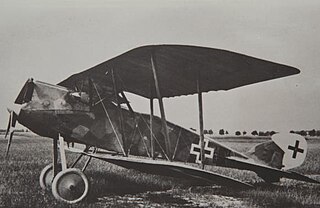
The Aviatik C.IX was a prototype German observation aircraft built by Aviatik in the final months of World War I.

The LVG C.VIII was a prototype reconnaissance aircraft built in Germany during World War I.
Hansa-Brandenburg W.34 was a prototype German two-seat, single-engined floatplane, which had been designed by Hansa und Brandenburgische Flugzeugwerke during World War I.
References
- ↑ "LFG Roland C.VIII". www.airwar.ru (in Russian). Moscow. Retrieved 1 February 2019.