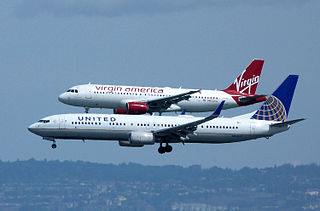
An airliner is a type of airplane for transporting passengers and air cargo. Such aircraft are most often operated by airlines. The modern and most common variant of the airliner is a long, tube shaped, and jet powered aircraft. The largest of them are wide-body jets which are also called twin-aisle because they generally have two separate aisles running from the front to the back of the passenger cabin. These are usually used for long-haul flights between airline hubs and major cities. A smaller, more common class of airliners is the narrow-body or single-aisle. These are generally used for short to medium-distance flights with fewer passengers than their wide-body counterparts.

The Douglas DC-3 is a propeller-driven airliner manufactured by the Douglas Aircraft Company, which had a lasting effect on the airline industry in the 1930s to 1940s and World War II. It was developed as a larger, improved 14-bed sleeper version of the Douglas DC-2. It is a low-wing metal monoplane with conventional landing gear, powered by two radial piston engines of 1,000–1,200 hp (750–890 kW). Although the DC-3s originally built for civil service had the Wright R-1820 Cyclone, later civilian DC-3s used the Pratt & Whitney R-1830 Twin Wasp engine. The DC-3 has a cruising speed of 207 mph (333 km/h), a capacity of 21 to 32 passengers or 6,000 lbs (2,700 kg) of cargo, and a range of 1,500 mi (2,400 km), and can operate from short runways.

The Douglas DC-4 is an American four-engined (piston), propeller-driven airliner developed by the Douglas Aircraft Company. Military versions of the plane, the C-54 and R5D, served during World War II, in the Berlin Airlift and into the 1960s. From 1945, many civil airlines operated the DC-4 worldwide.
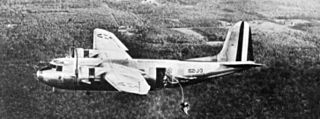
The Douglas DC-5 was a 16-to-22-seat, twin-engine propeller aircraft intended for shorter routes than the Douglas DC-3 or Douglas DC-4. By the time it entered commercial service in 1940, many airlines were canceling orders for aircraft. Consequently, only five civilian DC-5s were built. With the Douglas Aircraft Company already converting to World War II military production, the DC-5 was soon overtaken by world events, although a limited number of military variants were produced.

The Fokker 50 is a turboprop-powered airliner manufactured and supported by Dutch aircraft manufacturer Fokker. It was designed as an improved version of the successful Fokker F27 Friendship. The Fokker 60 is a stretched freighter version of the Fokker 50.
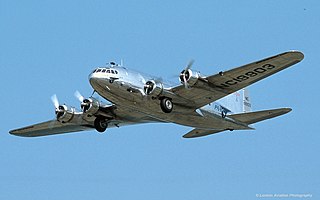
The Boeing Model 307 Stratoliner is an American stressed-skin four-engine low-wing tailwheel monoplane airliner derived from the B-17 Flying Fortress bomber, which entered commercial service in July 1940. It was the first airliner in revenue service with a pressurized cabin, which with supercharged engines, allowed it to cruise above the weather. As such it represented a major advance over contemporaries, with a cruising speed of 220 mph (350 km/h) at 20,000 ft (6,100 m) compared to the Douglas DC-3's 160 mph (260 km/h), at 8,000 ft (2,400 m) then in service. When it entered commercial service it had a crew of five to six, including two pilots, a flight engineer, two flight attendants and an optional navigator, and had a capacity for 33 passengers, which later modifications increased, first to 38, and eventually to 60.

The Fokker F.VII, also known as the Fokker Trimotor, was an airliner produced in the 1920s by the Dutch aircraft manufacturer Fokker, Fokker's American subsidiary Atlantic Aircraft Corporation, and several other companies under license. It was an airliner that could carry 6-12 people, depending on the version, and it used a variety of engines; early versions had one engine but three was more common.

The Fokker F26 was an early jet airliner design created by the Dutch aircraft manufacturer, Fokker.

The Fokker F.VIII was a large twin-engined airliner designed and produced by the Dutch aircraft manufacturer Fokker in the 1920s.

The Fokker F.IX was an airliner developed in the Netherlands in the late 1920s, intended to provide KLM with an aircraft suitable for regular services to the Dutch East Indies. When the onset of the Great Depression forced the postponement of those plans, the market for this aircraft disappeared as well, although it did see military service in Czechoslovakia as a bomber.

The Fokker F.XX was a 1930s Dutch three-engined airliner designed and built by Fokker. It was the first Fokker design to use an elliptical-section fuselage instead of the traditional square fuselage and the first Fokker aircraft with retractable landing gear.

The Fokker F.XXXVI was a 1930s Dutch four-engined 32-passenger airliner designed and built by Fokker. It was the largest transport designed and built by Fokker. Only one was built, and it was used for some commercial routes starting in 1935, and later aviation training by the British Royal Air Force until 1940.

The Fokker F-14 was an American seven/nine passenger transport aircraft designed by Fokker and built by their Atlantic Aircraft factory in New Jersey.
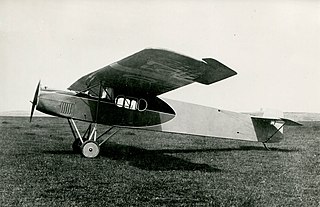
The Fokker F.II was the first of a long series of commercial aircraft from the Fokker Aircraft Company, flying in 1919. In a biplane age, it presented a distinct clean, high-wing monoplane style that sold successfully across Europe and North America during the development of commercial passenger-carrying aviation.

The Fokker F.XIV was a cargo plane built in the Netherlands in the late 1920s by Fokker. It was a high-wing cantilever monoplane of conventional trimotor layout. The sole example was tested by KLM but never put into service.

The SNCAC NC.211 Cormoran was a large four-engined military transport aircraft for passengers and cargo designed and built by SNCAC from 1945.

The Northrop Delta was an American single-engined passenger transport aircraft of the 1930s. Closely related to Northrop's Gamma mail plane, 13 were produced by the Northrop Corporation, followed by 19 aircraft built under license by Canadian Vickers Limited.
The Lockheed Model 44 Excalibur was a proposed American airliner designed by Lockheed. The Model 44 was the first four-engined design from the company, a low-wing monoplane with a retractable tricycle landing gear. Originally fitted with twin fins, the design ended up with three fins. It was to be powered by four 1,200 hp (890 kW) Pratt & Whitney Twin Wasp radial engines. Pan American Airways was close to ordering the Excalibur when Lockheed abandoned the project to devote its resources to developing the Model 49 Constellation that had been ordered by Trans World Airlines.

The Douglas DC-2 is a 14-passenger, twin-engined airliner that was produced by the American company Douglas Aircraft Company starting in 1934. It competed with the Boeing 247. In 1935, Douglas produced a larger version called the DC-3, which became one of the most successful aircraft in history.
The SABCA S.11 or SABCA S.XI was a prototype Belgian airliner designed and produced by the Belgian aircraft manufacturer Sociétés Anonyme Belge de Constructions Aéronautiques (SABCA). It was a three-engined high-winged monoplane intended for service in the Belgian Congo, but only a single example was built.

